- 274 pages
- English
- ePUB (mobile friendly)
- Available on iOS & Android
eBook - ePub
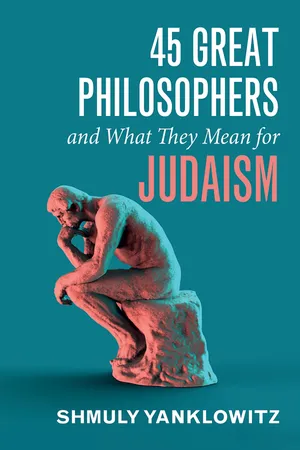
45 Great Philosophers and What They Mean for Judaism
About this book
In this new forty-five-chapter series, Rabbi Shmuly explores forty-five of the most influential philosophers throughout history and how Jewish ideas might engage with each of the philosophers and their philosophical projects. At times, Judaism may need to reject harmful, foreign ideas. Other times, Judaism may need to adapt, integrate, and expand. There are many other approaches we'll see of how Jewish thought can engage with other philosophies as well. In this exciting new exploration, we learn about Jewish intellectual history and what it means for us today.
Information
Topic
Theology & ReligionSubtopic
Philosophy History & TheoryTable of contents
- Title Page
- Acknowledgments
- Introduction
- Chapter 1: Confucius (551–479 B.C.E.)
- Chapter 2: Buddha (About 480 B.C.E.)
- Chapter 3: Socrates (469–399 B.C.E.)
- Chapter 4: Plato (427–348 B.C.E.)
- Chapter 5: Aristotle (384–322 B.C.E.)
- Chapter 6: Avicenna (980–1037 C.E.)
- Chapter 7: Averroes (1126–1198)
- Chapter 8: Moses Maimonides (ca. 1135–1204)
- Chapter 9: Thomas Hobbes (1588–1679)
- Chapter 10: René Descartes (1596–1650)
- Chapter 11: John Locke (1632–1704)
- Chapter 12: Baruch Spinoza (1632–1677)
- Chapter 13: Gottfried Wilhelm Leibniz (1646–1716)
- Chapter 14: Voltaire (1694–1798)
- Chapter 15: David Hume (1711–1776)
- Chapter 16: Jean-Jacques Rousseau (1712–1778)
- Chapter 17: Immanuel Kant (1724–1804)
- Chapter 18: Jeremy Bentham (1748–1832)
- Chapter 19: Mary Wollstonecraft (1759–1797)
- Chapter 20: Georg Wilhelm Friedrich Hegel (1770–1831)
- Chapter 21: John Stuart Mill (1806–1873)
- Chapter 22: Søren Kierkegaard (1813–1855)
- Chapter 23: Henry David Thoreau (1817–1862)
- Chapter 24: Karl Marx (1818–1883)
- Chapter 25: William James (1842–1910)
- Chapter 26: Friedrich Nietzsche (1844–1900)
- Chapter 27: Sigmund Freud (1856–1939)
- Chapter 28: Edmund Husserl (1859–1938)
- Chapter 29: John Dewey (1859–1952)
- Chapter 30: Martin Buber (1878–1965)
- Chapter 31: Ludwig Wittgenstein (1889–1951)
- Chapter 32: Jean-Paul Sartre (1905–1980)
- Chapter 33: Emmanuel Levinas (1906–1995)
- Chapter 34: Hannah Arendt (1906–1975)
- Chapter 35: Simone de Beauvoir (1908–1986)
- Chapter 36: Isaiah Berlin (1909–1997)
- Chapter 37: Albert Camus (1913–1960)
- Chapter 38: John Rawls (1921–2002)
- Chapter 39: Michel Foucault (1926-1984)
- Chapter 40: Noam Chomsky (1928–Present)
- Chapter 41: Jacques Derrida (1930–2004)
- Chapter 42: Daniel Dennett (1942–current)
- Chapter 43: Peter Singer (1946–Present)
- Chapter 44: Martha Nussbaum (1947–Present)
- Chapter 45: Kwame Appiah (1954–Present)
- Conclusion
- Bibliography
Trusted by 375,005 students
Access to over 1.5 million titles for a fair monthly price.
Study more efficiently using our study tools.
Frequently asked questions
Yes, you can cancel anytime from the Subscription tab in your account settings on the Perlego website. Your subscription will stay active until the end of your current billing period. Learn how to cancel your subscription
No, books cannot be downloaded as external files, such as PDFs, for use outside of Perlego. However, you can download books within the Perlego app for offline reading on mobile or tablet. Learn how to download books offline
Perlego offers two plans: Essential and Complete
- Essential is ideal for learners and professionals who enjoy exploring a wide range of subjects. Access the Essential Library with 800,000+ trusted titles and best-sellers across business, personal growth, and the humanities. Includes unlimited reading time and Standard Read Aloud voice.
- Complete: Perfect for advanced learners and researchers needing full, unrestricted access. Unlock 1.5M+ books across hundreds of subjects, including academic and specialized titles. The Complete Plan also includes advanced features like Premium Read Aloud and Research Assistant.
We are an online textbook subscription service, where you can get access to an entire online library for less than the price of a single book per month. With over 1.5 million books across 990+ topics, we’ve got you covered! Learn about our mission
Look out for the read-aloud symbol on your next book to see if you can listen to it. The read-aloud tool reads text aloud for you, highlighting the text as it is being read. You can pause it, speed it up and slow it down. Learn more about Read Aloud
Yes! You can use the Perlego app on both iOS and Android devices to read anytime, anywhere — even offline. Perfect for commutes or when you’re on the go.
Please note we cannot support devices running on iOS 13 and Android 7 or earlier. Learn more about using the app
Please note we cannot support devices running on iOS 13 and Android 7 or earlier. Learn more about using the app
Yes, you can access 45 Great Philosophers and What They Mean for Judaism by Shmuly Yanklowitz in PDF and/or ePUB format, as well as other popular books in Theology & Religion & Philosophy History & Theory. We have over 1.5 million books available in our catalogue for you to explore.