What properties of light can be manipulated for aesthetic effect? What role does the perception of the audience play in how stage information is received and processed? How do changes in technology affect methods or approaches to design and practice?
This book is designed to introduce key ideas about light and to generate questions and perspectives that will encourage readers to explore light in the theatre more fully in their own critical and creative practices.
Examining the theories behind stage lighting practice to help students learn to analyse the aesthetic and critical impacts of light in performance, this book traces the development of lighting practice by focusing on important shifts in technology and aesthetics from the classical period to the modern era.
Central to this study are ideas developed by 'New Stagecraft' theorists and designers Adolphe Appia, Edward Gordon Craig and Robert Edmond Jones. Case studies include semiotic approaches to Loïe Fuller's combination of light, movement and costume, Robert Wilson's Einstein on the Beach and Tadashi Suzuki's The Trojan Women. Further case studies including the installation work of James Turrell and Refik Anadol, the Winston Salem Light Project and David Byrne's American Utopia, examine the use of light in theatrical and non-theatrical spaces by focusing on phenomenology, community engagement and the evolution of lighting technology.
A companion website features links to images, chapter summaries, questions and further resources for study.
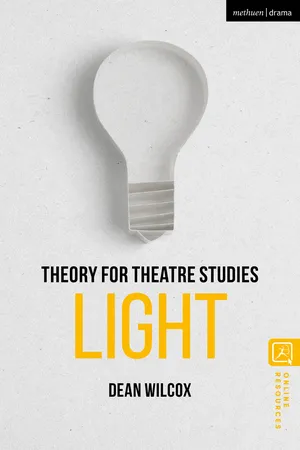
eBook - ePub
Theory for Theatre Studies: Light
- 167 pages
- English
- ePUB (mobile friendly)
- Available on iOS & Android
eBook - ePub
Theory for Theatre Studies: Light
About this book
Information
Table of contents
- Cover
- Half Title
- Title Page
- Dedication
- Contents
- Series Preface
- Acknowledgments
- Introduction: Light, Colour and Perception
- Section One From Natural to Artificial Light
- Section Two From Modernism to the Postmodern Era
- Section Three From the Gallery to the Community to the Stage
- Notes
- Further Reading
- References
- Index
- Copyright Page
Trusted by 375,005 students
Access to over 1.5 million titles for a fair monthly price.
Study more efficiently using our study tools.
Frequently asked questions
Yes, you can cancel anytime from the Subscription tab in your account settings on the Perlego website. Your subscription will stay active until the end of your current billing period. Learn how to cancel your subscription
No, books cannot be downloaded as external files, such as PDFs, for use outside of Perlego. However, you can download books within the Perlego app for offline reading on mobile or tablet. Learn how to download books offline
Perlego offers two plans: Essential and Complete
- Essential is ideal for learners and professionals who enjoy exploring a wide range of subjects. Access the Essential Library with 800,000+ trusted titles and best-sellers across business, personal growth, and the humanities. Includes unlimited reading time and Standard Read Aloud voice.
- Complete: Perfect for advanced learners and researchers needing full, unrestricted access. Unlock 1.5M+ books across hundreds of subjects, including academic and specialized titles. The Complete Plan also includes advanced features like Premium Read Aloud and Research Assistant.
We are an online textbook subscription service, where you can get access to an entire online library for less than the price of a single book per month. With over 1.5 million books across 990+ topics, we’ve got you covered! Learn about our mission
Look out for the read-aloud symbol on your next book to see if you can listen to it. The read-aloud tool reads text aloud for you, highlighting the text as it is being read. You can pause it, speed it up and slow it down. Learn more about Read Aloud
Yes! You can use the Perlego app on both iOS and Android devices to read anytime, anywhere — even offline. Perfect for commutes or when you’re on the go.
Please note we cannot support devices running on iOS 13 and Android 7 or earlier. Learn more about using the app
Please note we cannot support devices running on iOS 13 and Android 7 or earlier. Learn more about using the app
Yes, you can access Theory for Theatre Studies: Light by Dean Wilcox, Kim Solga, Susan Bennett, Kim Solga,Susan Bennett in PDF and/or ePUB format, as well as other popular books in Media & Performing Arts & Theatre History & Criticism. We have over 1.5 million books available in our catalogue for you to explore.