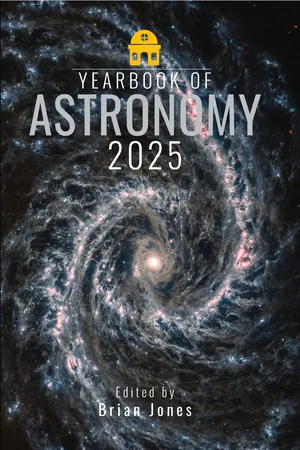
"Overall, this is a wonderful work written to be accessible to people with more than a passing interest in astronomy." — Booklist on the 2023 edition of Yearbook of Astronomy Maintaining its appealing style and presentation, the Yearbook of Astronomy 2025 contains comprehensive jargon-free monthly sky notes and an authoritative set of sky charts to enable backyard astronomers and sky gazers everywhere to plan their viewing of the year's eclipses, comets, meteor showers and minor planets as well as detailing the phases of the Moon and visibility and locations of the planets throughout the year. To supplement all this is a variety of entertaining and informative articles, a feature for which the Yearbook of Astronomy is known. Presenting the reader with information on a wide range of topics, the articles for the 2025 edition include, among others, Recent Advances in Astronomy; Recent Advances in Solar System Exploration; Skies over Ancient America: Mystical Mounds and Landmarks of the Prehistoric Americas; Astrophysicist Cecilia Helena Payne and Professor H. N. Russell; The Astronomers' Stars: The Terrible Twos; Eta Carinae: A Chance Encounter and Journey of Discovery; Saturn at its Equinox: A History of Ring-Plane Crossings from 1612 to 2025; A History of Observatory Designs: Before the Telescope; Signals from the Magnetosphere; How to Read a Scientific Paper; and Small Stars. This iconic publication made its first appearance way back in 1962, shortly after the dawning of the Space Age. Now well into its seventh decade of production, the Yearbook continues to be essential reading for anyone lured and fascinated by the magic of astronomy and who has a desire to extend their knowledge of the Universe and the wonders to which it plays host. The Yearbook of Astronomy is indeed an inspiration to amateur and professional astronomers alike, and warrants a place on the bookshelf of all stargazers and watchers of the skies.
- 368 pages
- English
- ePUB (mobile friendly)
- Available on iOS & Android
eBook - ePub
Yearbook of Astronomy 2025
About this book
Information
Topic
Physical SciencesSubtopic
Astronomy & AstrophysicsTable of contents
- Cover
- Title
- Copyright
- Contents
- Editor’s Foreword
- Preface
- About Time
- Using the Yearbook of Astronomy as an Observing Guide
- The Monthly Star Charts
- Northern Hemisphere Star Charts David Harper
- Southern Hemisphere Star Charts David Harper
- The Planets in 2025 Lynne Marie Stockman
- Mars finder chart – October 2024 to May 2025
- Mars finder chart – January 2025 to September 2025
- Jupiter finder chart – January 2025 to December 2025
- Saturn finder chart – January 2025 to December 2025
- Uranus finder chart – January 2025 to December 2025
- Neptune finder chart – January 2025 to December 2025
- Lunar Phenomena and Eclipses in 2025
- Phases of the Moon
- Apsides
- Nodes
- Lunistices or Lunar StandstillsLunistices or Lunar Standstills
- Lunar Occultations
- Eclipses in 2025
- Monthly Sky Notes and Articles 2025
- Evening Apparition of Venus – June 2024 to March 2025
- Monthly Sky Notes January
- The Speed of Light Neil Haggath
- Monthly Sky Notes February
- An Astrobiological Analogy David M. Harland
- Monthly Sky Notes March
- The Smell of Space Jonathan PowellThe Smell of Space Jonathan Powell
- Monthly Sky Notes April
- Morning Apparition of Venus – March 2025 to January 2026
- An Introduction to Unusual Observatory Domes: The (Peculiar) Porter Turret Telescope Katrin Raynor
- Monthly Sky Notes May
- Saturn at its Equinox: The Ring Plane Crossing of 2025 David Harper
- Monthly Sky Notes June
- Nightfall: When Darkness Falls John McCue
- Monthly Sky Notes July
- Mariner 4 Reveals Mars David M. Harland
- Monthly Sky Notes August
- Gone But Not Forgotten: Anser Lynne Marie Stockman
- Monthly Sky Notes September
- An Introduction to Unusual Observatory Domes: Leo Scanlon’s Aluminium Dome Katrin Raynor
- Monthly Sky Notes October
- The First ‘Hot Jupiter’ David M. Harland
- Monthly Sky Notes November
- The Moon: The Naming of Full Moons in Native American Culture Jonathan Powell
- Monthly Sky Notes December
- Rumblings at the Royal Observatory: The Greenwich Power Station Furore David Harper
- Comets in 2025 Neil Norman
- Minor Planets in 2025 Neil Norman
- Meteor Showers in 2025 Neil Norman
- Article Section
- Recent Advances in Astronomy Rod Hine
- Recent Advances in Solar System Exploration Peter Rea
- Anniversaries in 2025 Neil Haggath
- Skies over Ancient America: Mystical Mounds and Landmarks of the Prehistoric Americas P. Clay Sherrod
- Astrophysicist Cecilia Helena Payne and Professor H. N. Russell David M. Harland
- The Astronomers’ Stars: The Terrible Twos Lynne Marie Stockman
- Mission to Mars: Countdown to Building a Brave New World: It’s Life, But Not as We Know It Martin Braddock
- Eta Carinae: A Chance Encounter and Journey of Discovery Peter Rea
- Saturn at its Equinox: A History of Ring Plane Crossings from 1612 to 2025 David Harper
- A History of Observatory Designs: Before the Telescope Katrin Raynor
- Signals from the Magnetosphere John Vetterlein
- How to Read a Scientific Paper David Harper
- Small Stars John McCue
- Miscellaneous
- Some Interesting Variable Stars Tracie Heywood
- Some Interesting Double Stars Brian Jones
- Some Interesting Nebulae, Star Clusters and Galaxies Brian Jones
- Astronomical Organizations
- Our Contributors
- Society for the History of Astronomy (Advertisement)
- Friends of the Royal Astronomical Society (Advertisement)
- The Federation of Astronomical Societies / CAPCOM (Advertisements)
- Space Oddities (Advertisement)
- The Commission for Dark Skies (Advertisement)
- British Astronomical Association (Advertisement)
- The Planetary Society (Advertisement)
Trusted by 375,005 students
Access to over 1.5 million titles for a fair monthly price.
Study more efficiently using our study tools.
Frequently asked questions
Yes, you can cancel anytime from the Subscription tab in your account settings on the Perlego website. Your subscription will stay active until the end of your current billing period. Learn how to cancel your subscription
No, books cannot be downloaded as external files, such as PDFs, for use outside of Perlego. However, you can download books within the Perlego app for offline reading on mobile or tablet. Learn how to download books offline
Perlego offers two plans: Essential and Complete
- Essential is ideal for learners and professionals who enjoy exploring a wide range of subjects. Access the Essential Library with 800,000+ trusted titles and best-sellers across business, personal growth, and the humanities. Includes unlimited reading time and Standard Read Aloud voice.
- Complete: Perfect for advanced learners and researchers needing full, unrestricted access. Unlock 1.5M+ books across hundreds of subjects, including academic and specialized titles. The Complete Plan also includes advanced features like Premium Read Aloud and Research Assistant.
We are an online textbook subscription service, where you can get access to an entire online library for less than the price of a single book per month. With over 1.5 million books across 990+ topics, we’ve got you covered! Learn about our mission
Look out for the read-aloud symbol on your next book to see if you can listen to it. The read-aloud tool reads text aloud for you, highlighting the text as it is being read. You can pause it, speed it up and slow it down. Learn more about Read Aloud
Yes! You can use the Perlego app on both iOS and Android devices to read anytime, anywhere — even offline. Perfect for commutes or when you’re on the go.
Please note we cannot support devices running on iOS 13 and Android 7 or earlier. Learn more about using the app
Please note we cannot support devices running on iOS 13 and Android 7 or earlier. Learn more about using the app
Yes, you can access Yearbook of Astronomy 2025 by Brian Jones in PDF and/or ePUB format, as well as other popular books in Physical Sciences & Astronomy & Astrophysics. We have over 1.5 million books available in our catalogue for you to explore.