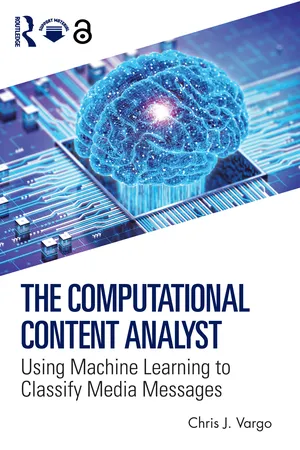
The Computational Content Analyst
eBook - ePub

The Computational Content Analyst

Using Machine Learning to Classify Media Messages

  1. 140 pages
  2. English
  3. ePUB (mobile friendly)
  4. Available on iOS & Android
eBook - ePub

The Computational Content Analyst

Using Machine Learning to Classify Media Messages

About this book

Most digital content, whether it be thousands of news articles, or millions of social media posts, are too large for the naked eye alone. Often, the advent of immense data sets requires a more productive approach to labelling media beyond a team of researchers. This book offers practical guidance and Python code to traverse the vast expanses of data—significantly enhancing productivity without compromising scholarly integrity. We'll survey a wide away of computer-based classification approaches, focusing on easy-to-understand methodological explanations and best practices to ensure that your data is being labelled accurately and precisely. By reading this book, you should leave with an understanding of how to select the best computational content analysis methodology to your needs for the data and problem you have.

This guide gives researchers the tools they need to amplify their analytical reach through the integration of content analysis with computational classification approaches, including machine learning and the latest advancements in generative AI and Large Language Models (LLMs). It is particularly useful for academic researchers looking to classify media data, and advanced scholars in mass communications research, media studies, digital communication, political communication, and journalism.

Complementing the book are online resources: datasets for practice, Python code scripts, extended exercise solutions, and practice quizzes for students, as well as test banks and essay prompts for instructors. Please visit www.routledge.com/9781032846354.

Frequently asked questions

Yes, you can cancel anytime from the Subscription tab in your account settings on the Perlego website. Your subscription will stay active until the end of your current billing period. Learn how to cancel your subscription.
No, books cannot be downloaded as external files, such as PDFs, for use outside of Perlego. However, you can download books within the Perlego app for offline reading on mobile or tablet. Learn more here.
Perlego offers two plans: Essential and Complete
  • Essential is ideal for learners and professionals who enjoy exploring a wide range of subjects. Access the Essential Library with 800,000+ trusted titles and best-sellers across business, personal growth, and the humanities. Includes unlimited reading time and Standard Read Aloud voice.
  • Complete: Perfect for advanced learners and researchers needing full, unrestricted access. Unlock 1.4M+ books across hundreds of subjects, including academic and specialized titles. The Complete Plan also includes advanced features like Premium Read Aloud and Research Assistant.
Both plans are available with monthly, semester, or annual billing cycles.
We are an online textbook subscription service, where you can get access to an entire online library for less than the price of a single book per month. With over 1 million books across 1000+ topics, we’ve got you covered! Learn more here.
Look out for the read-aloud symbol on your next book to see if you can listen to it. The read-aloud tool reads text aloud for you, highlighting the text as it is being read. You can pause it, speed it up and slow it down. Learn more here.
Yes! You can use the Perlego app on both iOS or Android devices to read anytime, anywhere — even offline. Perfect for commutes or when you’re on the go.
Please note we cannot support devices running on iOS 13 and Android 7 or earlier. Learn more about using the app.
Yes, you can access The Computational Content Analyst by Chris J. Vargo in PDF and/or ePUB format, as well as other popular books in Languages & Linguistics & Media Studies. We have over one million books available in our catalogue for you to explore.

Table of contents

  1. Cover
  2. Half Title
  3. Endorsements
  4. Title
  5. Copyright
  6. Dedication
  7. Contents
  8. Preface
  9. 1 Unveiling Content Analysis in the Contemporary Media Ecosystem
  10. 2 Designing a Computational Content Analysis: An Illustration from “Civic Engagement, Social Capital, and Ideological Extremity”
  11. 3 Basic Information Retrieval for Content Analysis
  12. 4 Supervised Machine Learning with BERT for Content Analysis
  13. 5 Text Classification of News Media Content Categories Using Deep Learning
  14. 6 Leveraging Generative AI for Content Analysis
  15. 7 Topic Modeling as a Lens for Discovery
  16. 8 Extending Deep Learning to Image Content Analysis
  17. Appendix A: Codebook and Conceptual Definitions
  18. Appendix B: Deletion Themes
  19. Index