eBook - ePub
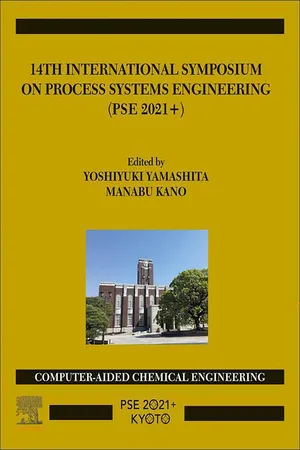
14th International Symposium on Process Systems Engineering
- 2,298 pages
- English
- ePUB (mobile friendly)
- Available on iOS & Android
eBook - ePub
14th International Symposium on Process Systems Engineering
About this book
14th International Symposium on Process Systems Engineering, Volume 49 brings together the international community of researchers and engineers interested in computing-based methods in process engineering. The conference highlights the contributions of the PSE community towards the sustainability of modern society and is based on the 2021 event held in Tokyo, Japan, July 1-23, 2021. It contains contributions from academia and industry, establishing the core products of PSE, defining the new and changing scope of our results, and covering future challenges.
Plenary and keynote lectures discuss real-world challenges (globalization, energy, environment and health) and contribute to discussions on the widening scope of PSE versus the consolidation of the core topics of PSE.
- Highlights how the Process Systems Engineering community contributes to the sustainability of modern society
- Establishes the core products of Process Systems Engineering
- Defines the future challenges of Process Systems Engineering
Information
Table of contents
- Title of Book
- Cover image
- Title page
- Table of Contents
- Copyright
- Preface
- International Program Committee
- Invited Papers and Extended Abstracts
- Actions toward carbon-neutral society with fuel cell technology
- Challenges and Opportunities for Process Systems Engineering in a Changed World
- PSE Tools and Challenges in the Development of Advanced Pharmaceutical Manufacturing
- Experience and Perspectives on our Journey towards Deep Decarbonization
- Surrogate Modeling and Surrogate-Based Optimization with Stochastic Simulations
- Application of PSE into social changes: biomass-based production, recycling systems, and regional systems design and assessment
- Q-MPC: Integration of Reinforcement Learning and Model Predictive Control for Safe Learning
- Presentation abstract: Optimization formulations for machine learning surrogates
- Pharma PSE: a multiscale approach for reimagining pharmaceutical manufacturing
- Artificial Intelligence and Process Systems Engineering
- Contributed Papers: Process and Product Design/Synthesis
- Reinventing the Chemicals/Materials Company: Transitioning to a Sustainable Circular Enterprise
- Value Chain Optimization of a Xylitol Biorefinery with Delaunay Triangulation Regression Models
- Evaluating the Impact of Model Uncertainties in Superstructure Optimization to Reduce the Experimental Effort
- Retrosynthesis Pathway Design Using Hybrid Reaction Templates and Group Contribution-Based Thermodynamic Models
- Optimization-based Design of Product Families with Common Components
- Economic evaluation and analysis of electricity and nano-porous silica productions from rice husk
- Future biofuels: A Superstructure-Based Optimization Framework Integrating Catalysis, Process Synthesis, and Fuel Properties
- Superstructure Optimization of Biodiesel Production from Continuous Stirred Tank and Membrane Reactors
- Process Design and Techno-Economic Analysis of Biomass Pyrolysis By-Product Utilization in the Ontario and Aichi Steel Industries
- Optimal design of solar-aided hydrogen production process using molten salt with CO2 utilization for ethylene glycol production
- Design of a novel hybrid process for membrane assisted clean hydrogen production with CO2 capture through liquefaction
- Analysis and design of integrated renewable energy and CO2 capture, utilization, and storage systems for low-cost emissions reduction
- Techno-economic-environmental assessment for optimal utilisation of CO2 in the Fischer-Tropsch gas-to-liquid process
- Machine Learning-based Hybrid Process Design for the Recovery of Ionic Liquids
- A Short-Cut Method for Synthesis of Solvent-based Separation Processes
- Modeling and Optimization of Ionic-Liquid-Based Carbon Capture: Impact of Thermal Degradation Kinetics
- Process Design of Formic Acid and Methanol Production from CO2 Promoted by Ionic Liquid: Techno-Economic Analysis
- Synthesis of Distillation Sequence with Thermally Coupled Configurations Using Reinforcement Learning
- Optimal Design of Heat Integrated Reduced Vapor Transfer Dividing Wall Columns
- A Model-Data Driven Chemical Analysis System for Products and Associated Processes
- Construction of Database and Data-driven Statistical Models for the Solubility of Nanomaterials in Organic Solvents
- Fast, efficient and reliable problem solution through a new class of systematic and integrated computer-aided tools
- Design of Bio-Oil Solvents using Multi-Stage Computer-Aided Molecular Design Tools
- Synthesis of azeotropic distillation processes without using a decanter
- Reduce Environmental Impact and Carbon Footprint for Cost Competitive Process Plant Design: Integrating AVEVATM Process Simulation with modeFRONTIER®
- Reliability incorporated optimal process pathway selection for sustainable microalgae-based biorefinery system: P-graph approach
- Framework for Designing Solid Drug Product Manufacturing Processes Based on Economic and Quality Assessment
- Marine flue gas desulfurization processes: recent developments, challenges, and perspectives
- A Novel Process Synthesis of a Dehydrating Unit of Domestic Natural Gas Using TEG Contactor and TEG Regenerator
- A new trust-region approach for optimization of multi-period heat exchanger networks with detailed shell-and-tube heat exchanger designs
- A mathematical technique for utility exchanger network synthesis and total site heat integration
- Synthesis and Assessment of NOx to Ammonia Conversion Process in Combined Cycle Power Generation Systems
- Knowledge integrated, deep neural network-based prediction of stress-strain curves of polymer matrix composites for AI-assisted materials design
- Evaluation of Economic Performance of Co2 Separation Process Using Mixed Matrix Membrane
- Nature vs engineering: Production of methanol from CO2 capture
- Superstructure Optimization for the Design of an Algae Biorefinery Producing Added Value Products
- Process simulation of continuous biodiesel production catalysed by a high stability solid in a reactive distillation
- Generative Approaches for the Synthesis of Process Structures
- Metal-Organic Framework Targeting for Optimal Pressure Swing Adsorption Processes
- Energy integration through retrofitting of heat exchanger network at Equinor Kalundborg Oil Refinery
- Modeling and Optimization of Ionic Liquid Enabled Extractive Distillation of Ternary Azeotrope Mixtures
- Optimal Design of Hybrid Distillation/ Pervaporation Processes
- Design and analysis of a single mixed refrigerant natural gas liquefaction process integrated with ethane recovery and carbon removal using cryogenic distillation
- A new decomposition approach for synthesis of heat exchanger network with detailed heat exchanger sizing
- A mathematical approach for the synthesis of a wastewater treatment plant using the concept of circular economy
- Contributed Papers: Process Dynamics and Control
- Convex Q-learning: Reinforcement learning through convex programming
- Differential Dynamic Programming Approach for Parameter Dependent System Control
- Optimization of an air-cooler operation in an industrial distillation column
- Dynamic Operability Analysis for the Calculation of Transient Output Constraints of Linear Time-Invariant Systems
- Effective Re-identification of a Multivariate Process under Model Predictive Control Using Information from Plant-Model Mismatch Detection
- Model Predictive Control of Grade Transition with Attention Base Sequence-to-Sequence Model
- Real Time Optimization of series of fixed bed catalytic reactors
- Self-triggered MPC for Perturbed Continuous-time Non-linear Systems
- A comparative study between MPC and selector-based PID control for an industrial heat exchanger
- MILP Formulation for Dynamic Demand Response of Electrolyzers
- Real-Time Optimal Operation of a Chlor-Alkali Electrolysis Process under Demand Response
- Explicit Multi-Objective and Hierarchical Model Predictive Control
- A Robust Optimization Strategy for Explicit Model Predictive Control
- Data-driven Design of a Feed-forward Controller for Rejecting Measurable Disturbance
- Optimal Operation of Heat Exchanger Networks with Changing Active Constraint Regions
- Iterative Feedback Tuning for Regulatory Control Systems Using Estimate of Sensitivity Function
- D-RTO as Enabler for Green Chemical Processes – Systematic Application and Challenges in Reactive Liquid Multiphase Systems
- Design of PID controllers using semi-infinite programming
- Safe Chance Constrained Reinforcement Learning for Batch Process Optimization and Control
- Contributed Papers: Scheduling and Planning
- Combining Machine Learning with Mixed Integer Linear Programming in Solving Complex Scheduling Problems
- Knowledge-guided Hybrid Approach for Scheduling Multipurpose Batch Plants
- Scheduling of Electrical Power Systems under Uncertainty using Deep Reinforcement Learning
- A Reinforcement Learning Approach to Online Scheduling of Single-Stage Batch Chemical Production Processes
- An adaptive multi-cut decomposition based algorithm for integrated closed loop scheduling and control
- Uncertainty Evaluation of Biorefinery Supply Chain’s Economic and Environmental Performance Using Stochastic Programming
- An Improved Optimization Model for Scheduling of an Industrial Formulation Plant based on Integer Linear Programming
- Optimal Sourcing, Supply and Development of Carbon Dioxide Networks for Enhanced Oil Recovery in CCUS Systems
- Production scheduling in multiproduct multistage semicontinuous processes. A constraint programming approach
- Maintenance scheduling optimization for decaying performance nonlinear dynamic processes
- Cleaning schedule for heat exchanger networks subjected to maintenance constraints
- Estimating Energy Market Schedules using Historical Price Data
- Scheduling of Material and Information Flows in the Manufacturing of Chemicals for the Order-to-Cash Process of a Digital Supply Chain
- Optimization of Maximum Completion Time of Polymerization Section Based on Improved Estimation of Distribution Algorithm
- Evolutionary Algorithm-based Optimal Batch Production Scheduling
- Cream Cheese Fermentation Scheduling
- Contributed Papers: Supply Chain Management and Logistics
- Multi-Objective Optimization of Production Cost and Carbon Loss in the U.S. Petrochemicals Industry
- Mapping Anthropogenic Carbon Mobilization through Chemical Process and Manufacturing Industries
- Optimal Designing and Planning of Ethiopia’s Biomass-to-Biofuel Supply Chain Considering Economic and Environmental Dimensions under Strategic and Tactical Levels
- A Novel Integrated Optimal Scheduling Framework for Holistic Refinery Supply Chain Management
- Roadmap to digital supply chain resilience
- Development of Flexible Framework for Biomass Supply Chain Optimisation
- Lagrangean Decomposition for Integrated Refinery-Petrochemical Short-term Planning
- Green Ammonia Supply Chain Design for Maritime Transportation
- Optimal agriculture residues revalorization as a biofuel alternative in electric power grids
- Global Supply Chain Optimization for COVID-19 Vaccine under COVAX initiative
- Optimal Liquefied Natural Gas (LNG) Annual Delivery Program Reflecting both Supplier and Customer Perspectives
- The Waste-to-Resource Game: Informed Decision-Making for Plastic Waste Transformers
- Implications of Optimal BECCS Supply Chains on Absolute Sustainability
- A Multi-disciplinary Assessment of Innovations to Improve Grocery Bag Circularity
- Process Sustainable Supply Chain: integrating monetization strategies in the design and planning
- Contributed Papers: Process Intensification
- Systematically Identifying Energy-Efficient and Attractive Multicomponent Distillation Configurations
- Synthesis of Advanced Reactive Distillation Technologies: Early-Stage Assessment Based on Thermodynamic Properties and Kinetics
- Process Synthesis and Intensification for Upgrading Natural Gas Liquids in Shale Gas
- Energy-Efficient Direct Cyclohexene to Cyclohexanol Process by Heat Pump Assisted Reactive Distillation
- Sustainable Process Intensification of Refrigerant Mixture Separation and Management: A Multiscale Material Screening and Process Design Approach
- A systematic methodology for the optimisation, control and consideration of uncertainty of reactive distillation
- Equation Oriented Optimization of Multi Stream Heat Exchanger Design and Operation in Natural Gas Liquefaction Process
- Optimal Design of Extractive Dividing-Wall Column Using an Improved Sequential Least Squares Programming Algorithm
- Biphasic Dehydration of Sugars to 5-Hydroxymethylfurfural and Furfural—Multiscale Modeling for Easier Optimization and More Accurate Solvent Selection
- Study of Mass Transfer Coefficient of CO2 Capture in different Solvents using Microchannel: A Comparative Study
- Techno-Economic Study of Intensified Ethylene Oxide Production Using High Thermal Conductivity Microfibrous Entrapped Catalyst
- Contributed Papers: Integration of Process Operation and Design/Synthesis
- Power Systems Infrastructure Planning with High Renewables Penetration
- An Optimization Model for the Design and Operation of Reliable Power Generation Systems
- Rule-based Method for Retrofitting Conventional Processes with Integrated Units
- Integration of Design and Operation for the CO2-based Methanol Synthesis
- Blue Syngas Synthesis via the Integration of Gasification and Reforming Processes
- Network optimization of the electrosynthesis of chemicals from CO2
- A robust design of heat exchanger network for high temperature electrolysis systems
- Techno-economic Assessment of Upstream and Downstream Process Alternatives for the Production of Monoclonal Antibodies
- Biomethane liquefaction followed by CO2 solidification based biogas upgrading process
- Importance of interannual renewable energy variation in the design of green ammonia plants
- Integrating Carbon Negative Technologies in Industrial Clusters
- Flexibility analysis of chemical processes considering overlaying uncertainty sources
- Flexible and Sustainable Methanol Production Including Option with Green Hydrogen
- Optimization and Heat Exchanger Network Design of Diethyl Carbonate Two-step Synthesis Process from CO2 and Propylene Oxide
- Characterization of Industrial Flaring under Uncertainty for the Design of Optimum Flare Recovery and Utilization Systems
- Development of Micro Scale PRC Using Low Grade Geothermal Thermal Energy
- Scenario Outcomes for Electric Power Generation Expansion Planning considering the State of Indiana as a Case Study
- Requirements for the quality assessment of virtual commissioning models for modular process plants
- Copyright
- Contributed Papers: Modeling, Analysis, and Simulation
- A combinatorial tool for monitoring flocculation processes: Using non-invasive measurements and hybrid deep learning assisted modelling
- Optimal Design of Experiments Based on Artificial Neural Network Classifiers for Fast Kinetic Model Recognition
- Modelling of the Rice Bran Protein Extraction using Response Surface Methodology
- Weibull Reliability Regression Model for Prediction of Bearing Remaining Useful Life
- Supporting Hyperparameter Optimization in Adaptive Sampling Methods
- Optimal Catalyst-Reactor Design for Load-Flexible CO2 Methanation by Multi-Period Design Optimization
- Data-Driven Modeling of Long-Term Performance Degradation in Solid Oxide Electrolyzer Cell System
- Modeling and Optimal Design of Pressure Swing Adsorber for Carbon Dioxide and Hydrogen Separation from Industrial Waste Gas
- Membrane Characterization with Model-Based Design of Experiments
- Systematic Modelling of Distillation Columns based on Topologies and Ontologies
- Sensitivity Analysis of an Electrospray Dehumidification System
- Rigorous modelling for comparing batch and flow syntheses of a drug substance using heterogeneous hydrogenation
- Assessment on the heat integration potential for different pressure thermally coupled distillation structures
- Python platform for Tennessee Eastman Process
- Computational Modeling of Lube-Oil Flows in Pipelines to Study the Efficacy of Flushing Operations
- Comparison of ammonia synthesis plants of different scale with a dynamic model
- Simulation Analysis of Gas Feed Method for Development of Ru-Based Catalyst for Ammonia Production
- Estimation of the effect of liquid viscosity on gas-liquid mass transfer in a bioreactor using CFD-PBM coupled model
- Knowledge-matching based computational framework for genome-scale metabolic model refinement
- Multi-Regional Surrogate Model Selection (MRSMS) approach for the analysis and optimal fitting of univariate responses
- A Digital Reality Pilot Plant for Research and Learning
- Soft sensors development for industrial reactive distillation processes under small training datasets
- Comprehensive Quantification of Model Prediction Uncertainty for Simulated Moving Bed Chromatography
- A predictive model for multi-criteria selection of optimal thermochemical processing pathways in biorefineries
- Numerical Investigation of the Shear Rate Variation in Cooling Crystallization
- Application of machine learning model to optimization of the hydrogen liquefaction process
- Density Functional Theory on the CO2 Absorption Process with Ionic Liquids
- Transport of CO2/CH4 through PEBA membranes: experiments and mass transfer modelling
- Mathematical modelling, simulation and optimisation of an indirect water bath heater at the Takoradi distribution station (TDS)
- Marine SOx Scrubber: Mass transfer Analysis, Design, Simulation and Experiment
- Connecting the Simulation Model to the Digital Twin to help drive Sustainability
- Development of predictive model for the size of gas and liquid slugs formed in millimeter scaled T- junctions
- Enviro-economic assessment of DME synthesis using carbon capture and hydrogen from methane pyrolysis
- Operational Envelopes of Cost-effective Sour Gas Desulfurization Processes
- Process Alternatives for the Co-Production of Hydrogen and Methanol using Fuel Switch and Energy Mix Systems
- Documenting Models Comprehensively Using a Minimal Graphical Language
- Simulation and CO2 emission analysis for co-processing of bio-oil and vacuum gas oil
- Dynamic Simulation and Optimization of a Subcritical Coal-Fired Power Plant During Load- Ramping Operations
- Solvent Screening Methodology considering Techno-Economic and Environmental Sustainability criteria for Algae Lipid Extraction
- Modelling and simulation of the production of n- butyl lactate in a reactive distillation column at pilot plant scale
- Optimal Design of Offshore Wind Power Farm Considering Wind Uncertainty
- Economic and environmental impact of fouling in produced water re-injection
- Mathematical Modelling of Reactive Inks for Additive Manufacturing of Charged Membranes
- Economic Analysis of a Hydrogen Liquefaction Process Based on Techno-Economic and Energy Optimization
- How Digital Twins are Propelling Metals Industry to Next Generation Decision-Making: A Practitioner’s View
- The study on feasibility of HFO refrigerants in BOG re-liquefaction process
- Crude Oil Blending Process Optimization with Precise Consideration of Fraction Properties
- Novel Design of Optimum Heat Exchanger Networks for Textile Dyeing Process to Maximize Wastewater Heat Recovery Efficiency
- Study on the Kinetic Parameters of Crystallization Process Modelled by Partial Differential Equations
- Graphical user interface for development of dynamics model of fermentation process applying long short-term memory networks
- The biorefinery concept for the industrial valorization of pineapple leaves co-producing ethanol, citric acid, and xanthan gum: a techno- economic analysis
- First Principles Based Development of Hybrid Models of Distillation Towers
- Model-Based Development of Fuel Cell Stack and System Controllers
- Contributed Papers: Optimization Methods and Computational Tools
- A Nested Schur Decomposition Approach for Multiperiod Process Optimization
- Design and Optimisation of Boil-off Gas Recycling Strategy in Liquefied Natural Gas Production
- An Implicit Function Formulation for Nonlinear Programming with Index-1 Differential Algebraic Equation Systems
- Multi-objective optimization of NH3 and CO2 separation with ionic liquid process
- Primal-dual Feedback-optimizing Control with Direct Constraint Control
- Data-driven coordination of expensive black-boxes
- Data-Driven Adaptive Robust Unit Commitment Assisted by Machine Learning Techniques
- Heat integration for superstructure models: A MILP formulation for easy implementation and fast computing
- A Software Framework for Optimal Multiperiod Carbon-Constrained Energy Planning
- Superstructure optimisation in various carbon capture and utilisation supply chains
- Efficient Scenario Generation for Stochastic Programs with Extreme Events
- A Sustainable Framework for Optimal and Flexible Design Under Uncertainty in Separation Processes: Exergy, Energy, Economic, and Environmental Aspects
- Application of nonlinear surrogate models on optimization of carbon capture and utilization network
- Systematic process energy optimization via multi-level heat integration: A case study on low-temperature reforming for methanol synthesis
- Bayesian Optimization for Automobile Catalyst Development
- Capacity Planning for Sustainable Process Systems with Uncertain Endogenous Technology Learning
- Development of a Bi-Objective Optimisation Framework for Mixed-Integer Nonlinear Programming Problems and Application to Molecular Design
- Data-Driven Scenario Generation for Two-Stage Stochastic Programming
- Joint Chance Constrained Process Optimization through Neural Network Approximation
- Gaussian Processes for Simulation-Based Optimization and Robust Design
- Machine Learning-Enabled Optimization of Force Fields for Hydrofluorocarbons
- Design of an Event-Driven Rescheduling Algorithm via Surrogate-based Optimization
- A two-stage network optimization for sustainable treated wastewater planning
- Surrogate Modeling for Superstructure Optimization with Generalized Disjunctive Programming
- Educational Computer-Aided Tools Towards Industry 4.0: Recommendations and BioVL
- Process Superstructure Optimization through Discrete Steepest Descent Optimization: a GDP Analysis and Applications in Process Intensification
- Advances in Generalized Disjunctive and Mixed- Integer Nonlinear Programming Algorithms and Software for Superstructure Optimization
- Designing Novel Structured Packings by Topology Optimization and Additive Manufacturing
- Multi-Objective Bayesian Optimization for Design and Operating of Fluidized Bed Reactor
- Analysis of Optimization Algorithms for Real-Time Optimization Applied on the Model of a Fluid Catalytic Cracking Unit
- Scalable Stochastic Programming with Bayesian Hybrid Models
- A Combined Particle Swarm Optimization and Outer Approximation Optimization Strategy for the Optimal Design of Distillation Systems
- A semantic based decision support framework to enable model and data integration
- Contributed Papers: Process Monitoring and Safety
- Design of Non-Redundant Sensor Networks for Reliable Estimation in Nonlinear Systems
- A Novel Global-Local Feature Preserving Projection Method Based on Adaptive Linear Local Tangent Space Alignment for Process Monitoring
- Prognostics on Noisy and Uncertain Dynamic Systems using Cumulative Sum Chart of Inferential Sensors
- Quantifying Subsea Gas Leakages using Machine Learning: a CFD-based study
- Dynamic Risk Analysis for Process Safety
- Monitoring of smart chemical processes: A Sixth Sense approach
- Fault detection in a benchmark simulation model for wastewater treatment plants
- Formulation of integrated key performance indicator dashboard for chemical plants
- Evaluation of risk in the biodiesel production process with supercritical ethanol
- Process Monitoring Based on Deep Neural Networks with Continuous Wavelet Transform
- Methyl sec-butyl ether content estimation in MTBE products via clustering-based adaptive nonlinear soft sensors
- Early Identification of Abnormal Deviations in Nonstationary Processes by Removing Non- Stationarity
- AI System for Substance Identification Based on Chemical Substance-Symptom Knowledge Graph
- Model-based monitoring of an intensified unit for continuous pharmaceutical filtration-drying
- Plant Fault Diagnosis System using Negative Selection Algorithm
- Digital Twin of a pilot-scale bio-production setup
- Plant O&M Support System Based on Supervised Data-Clustering Technology
- A Novel Cycle Partitioning Approach to Reliability Based Optimal Sensor Placement for Linear Flow Processes
- The impact of sampling frequency on chemical process monitoring
- Autoregressive Distributed Lag Model Based Cointegration Analysis for Batch Process Monitoring
- A Data-Driven Fault Detection and Diagnosis by NSGAII-t-SNE and Clustering Methods in the Chemical Process Industry
- Contributed Papers: Cyber-Physical Systems and Security
- Cyberattack Detectability-Based Controller Screening: Application to a Nonlinear Process
- OPC UA information transfer via unidirectional data diode for ICS cyber security
- Study on Device Authentication System for Dynamic Zoning of Industrial Control Systems
- Designing Framework for Tabletop Exercise to Promote Resilience Against Cyber Attacks
- Self-Organizing Map Based Approach for Assessment of Control Room Operator Training
- Digital Twin of Alkaline Water Electrolysis Systems for Green Hydrogen Production
- Cyber Security Risks of aspects of operations of OPC Unified Architecture
- Managing Experimental-Computational Workflows in Robotic Platforms using Directed Acyclic Graphs
- Development of cyber incident exercise to be widely adopted in supply chains
- Requirements to a digital twin-centered concept for smart manufacturing in modular plants considering distributed knowledge
- Copyright
- Contributed Papers: Machine Learning and Big Data
- Equivalence Judgment of Equation Groups Representing Process Dynamics
- Data-driven operation support for equipment deterioration detection in drug product manufacturing
- Pilot Plant 4.0: A Review of Digitalization Efforts of the Chemical and Biochemical Engineering Department at the Technical University of Denmark (DTU)
- Identification Method of Multiple Sequential Alarms that Occurred Simultaneously in Plant-operation Data
- Understand how CNN diagnoses faults with Grad-CAM
- A Comprehensive Framework for the Modular Development of Condition Monitoring Systems for a Continuous Dry Granulation Line
- Framework for Suppressing Transient Fault Alarms Online
- Using Reinforcement Learning in a Game-like Setup for Automated Process Synthesis without Prior Process Knowledge
- Generation and Benefit of Surrogate Models for Blackbox Chemical Flowsheet Optimization
- Flowsheet Recognition using Deep Convolutional Neural Networks
- Active learning for multi-objective optimization of processes and energy systems
- Data-driven Stochastic Optimization of Numerically Infeasible Differential Algebraic Equations: An Application to the Steam Cracking Process
- Tensor-Based Autoencoder Models for Hyperspectral Produce Data
- Molecular Representations in Deep-Learning Models for Chemical Property Prediction
- Deep Reinforcement Learning for Continuous Process Scheduling with Storage, Day-Ahead Pricing and Demand Uncertainty
- Convolutional Neural Network based Detection and Measurement for Microfluidic Droplets
- Deep Reinforcement Learning Based Controller for Modified Claus Process
- Process performance prediction based on spatial and temporal feature extraction through bidirectional LSTM
- Exploring the Potential of Fully Convolutional Neural Networks for FDD of a Chemical Process
- Data-driven online scenario selection for multistage NMPC
- Data-driven Robust Model Predictive Control with Disjunctive Uncertainty for Building Control
- Low-Dimensional Input and High-Dimensional Output Modelling Using Gaussian Process
- Piecewise Smooth Hybrid System Identification for Model Predictive Control
- Distillation Column Temperature Prediction Based on Machine-Learning Model Using Wavelet Transform
- Moisture Estimation in Woodchips Using IIoT Wi-Fi and Machine Learning Techniques
- Transfer Learning for Quality Prediction in a Chemical Toner Manufacturing Process
- Towards An Automated Physical Model Builder: CSTR Case Study
- Forward physics-informed neural networks for catalytic CO2 methanation via isothermal fixed-bed reactor
- Hashing-based just-in-time learning for big data quality prediction
- Physics-Constrained Autoencoder Neural Network for the Prediction of Key Granule Properties in a Twin-Screw Granulation Process
- CSTR control with deep reinforcement learning
- Application of machine learning and big data for smart energy management in manufacturing
- Adaptive least-squares surrogate modeling for reaction systems
- Machine Learning and Inverse Optimization Approach for Model Identification of Scheduling Problems in Chemical Batch Plants
- Decision-Focused Surrogate Modeling with Feasibility Guarantee
- Grade transition optimization by using gated recurrent unit neural network for styrene-acrylonitrile copolymer process
- Development of Estimating Algorithm for Biodegradation of Chemicals Using Clustering and Learning Algorithm
- Surrogate Classification based on Accuracy and Complexity
- Training Stiff Dynamic Process Models via Neural Differential Equations
- Wiz 4.0: A Novel Data Visualisation and Analytics Dashboard for a Graphical Approach to Industry 4.0
- About data reduction techniques and the role of outliers for complex energy systems
- DeepGSA: Plant Data-Driven Global Sensitivity Analysis using Deep Learning
- Analysing Different Dynamically Modelled Data Structures and Machine Learning Algorithms to Predict PM2.5 Concentration in China
- A multi-output machine learning approach for generation of surrogate models in process engineering
- Practical Human Interface System for Transition Guidance in Chemical Plants using Reinforcement Learning
- Surrogate modeling for nonlinear gasoline blending operations
- Continuous Manufacturing Process Sequential Prediction using Temporal Convolutional Network
- Surrogate modeling for mixed refrigerant streams in the refrigeration cycle of an LNG plant
- Prediction for heat deflection temperature of polypropylene composite with Catboost
- A New Machine Learning Framework for Efficient MOF Discovery: Application to Hydrogen Storage
- Data-driven Modeling for Magma Density in the Continuous Crystallization Process
- Gaussian Process Regression Machine Learning Models for Photonic Sintering
- Development of Dye Exhaustion Behavior Prediction Model using Deep Neural Network
- Guaranteed Error-bounded Surrogate Modeling and Application to Thermodynamics
- Development of an ANN-based soft-sensor to estimate pH variations in Intelligent Packaging Systems with visual indicators
- Process Systems Engineering Guided Machine Learning for Speech Disorder Screening in Children
- Contributed Papers: Energy, Food and Environmental Systems
- Emission and mitigation of CO2 and CH4 produced by cattle: a case study in the Brazilian Pantanal
- Promoting phosphorus recovery at livestock facilities in the Great Lakes region: Analysis of incentive policies
- Production of ethanol, xylitol and antioxidants in a biorefinery from olive tree wastes: process economics, carbon footprint and water consumption
- Application of CAPE Tools into Prospective Life Cycle Assessment: A Case Study in Acetylated Cellulose Nanofiber-Reinforced Plastics
- Climate Control in Controlled Environment Agriculture Using Nonlinear MPC
- Thermodynamic Analysis of an Integrated Renewable Energy Driven EWF Nexus: Trade-off Analysis of Combined Systems
- Low-Carbon Hydrogen Production in Industrial Clusters
- Thermoacoustic Flow-Through Cooler for Cryogenic Hydrogen
- Life Cycle Assessment of Green Hydrogen Transportation and Distribution Pathways
- Sector Coupling of Green Ammonia Production to Australia’s Electricity Grid
- Development of Multi-Purpose Dynamic Physical Model of Fuel Cell System
- Embracing the era of renewable energy: model-based analysis of the role of operational flexibility in chemical production
- Hollow Fiber-based Rapid Temperature Swing Adsorption (RTSA) Process for Carbon Capture from Coal-fired Power Plants
- Determining Accurate Biofuel System Outcomes: Spatially Explicit Methods for Combined Landscape-Feedstock and Supply Chain Design
- Assessing the Environmental Potential of Hydrogen from Waste Polyethylene
- A Systematic Comparison of Renewable Liquid Fuels for Power Generation: Towards a 100% Renewable Energy System
- Guiding innovations and Value-chain improvements using Life-cycle design for Sustainable Circular Economy
- Simultaneous Optimal Operation and Design of a Thermal Energy Storage Tank for District Heating Systems with Varying Energy Source
- A flexible energy storage dispatch strategy for day-ahead market trading
- Monetizing Flexibility in Day-Ahead and Continuous Intraday Electricity Markets
- Planetary boundaries analysis of Fischer-Tropsch Diesel for decarbonizing heavy-duty transport
- Renewable Power Systems Transition Planning using a Bottom-Up Multi-Scale Optimization Framework
- Design and Operation of Urban Energy Network: Integration of Civic, Industrial, and Transportation Sectors
- Sustainable Design of Hybrid Energy Systems for Net Zero Carbon Emission
- Prediction of Charge / Discharge Behavior of Tri-Electrode Zinc-air Flow Battery Using Linear Parameter Varying Model
- An optimized resource supply network for sustainable agricultural greenhouses: A circular economy approach
- Exergoeconomic optimization of a double effect evaporation process of coffee extract
- Ecohydrological modeling and dynamic optimization for water management in an integrated aquatic and agricultural livestock system
- Parametric Analysis of Ortho-to-Para Conversion in Hydrogen Liquefaction
- Model agnostic framework for analyzing rainwater harvesting system behaviors
- Global assessment and optimization of renewable energy and negative emission technologies
- The Trade-Off between Spatial Resolution and Uncertainty in Energy System Modelling
- Designing a Resilient Biorefinery System under Uncertain Agricultural Land Allocation
- LCA modelling as a decision-tool for experimental design: the case of extraction of astaxanthin from crab waste
- Decomposition of Organic Compounds in Water from Oil Refineries
- Energy Harvesting Wireless Sensors Using Magnetic Phase Transition
- Competitive Adsorption of Copper, Nickel, and Chromium Ions onto Amine Functionalized SBA-15
- Use of Environmental Assessment and Techno Economic Analysis (TEA) to Evaluate the Impact and Feasibility of Coatings for Manufacturing Processes
- Forecasting Operational Conditions: A case-study from dewatering of biomass at an industrial wastewater treatment plant
- Plant wide modelling of a full-scale industrial water treatment system
- A Systematic Framework for the Integration of Carbon Capture, Renewables and Energy Storage Systems for Sustainable Energy
- Integration of experimental study and computer-aided design: A case study in thermal energy storage
- Design support toolbox for renewable-based regional energy systems; The concept, data integration, and simulator development
- Circular Economy Integration into Carbon Accounting Framework for Comprehensive Sustainability Assessment
- Design and analysis of fuel-assisted solid oxide electrolysis cell combined with biomass gasifier for hydrogen production
- Plasma-Based Pyrolysis of Municipal Solid Plastic Waste for a Robust WTE Process
- Contributed Papers: Pharma and Healthcare Systems
- Hybrid Modelling Strategies for Continuous Pharmaceutical Manufacturing within Digital Twin Framework
- Determination of probabilistic design spaces in the hybrid manufacture of an active pharmaceutical ingredient using PharmaPy
- Hybrid Modelling of CHO-MK Cell Cultivation in Monoclonal Antibody Production
- Multimodal modelling of uneven batch data
- Application of MHE-based NMPC on a Rotary Tablet Press under Plant-Model Mismatch
- Gray-box modelling of pharmaceutical roller compaction process
- Multi-objective optimisation for early-stage pharmaceutical process development
- Quality by design and techno-economic modelling of RNA vaccine production for pandemic-response
- Design of Value Function Trajectory for State of Control in Continuous Manufacturing System
- A Thermodynamic Approach for Simultaneous Solvent, Coformer, and Process Optimization of Continuous Cocrystallization Processes
- Optimizing the selection of drug-polymer-water formulations for spray-dried solid dispersions in pharmaceutical manufacturing
- Integrated design of injectable manufacturing processes considering characteristics of process-and discrete-manufacturing systems
- A bi-level decomposition approach for CAR-T cell therapies supply chain optimisation
- An agent-based model for cost-effectiveness analysis in the manufacture of allogeneic human induced pluripotent cells in Japan
- Design and operation of healthcare facilities using batch-lines: the COVID-19 case in Qatar
- Application of PSE Methods on Monoclonal Antibody Productivity Improvement and Quality Control
- Image classification of experimental yields for cardiomyocyte cells differentiated from human induced pluripotent stem cells
- Prediction of API concentration using NIRS measured offline and in-line instruments
- Author Index
Trusted by 375,005 students
Access to over 1.5 million titles for a fair monthly price.
Study more efficiently using our study tools.
Frequently asked questions
Yes, you can cancel anytime from the Subscription tab in your account settings on the Perlego website. Your subscription will stay active until the end of your current billing period. Learn how to cancel your subscription
No, books cannot be downloaded as external files, such as PDFs, for use outside of Perlego. However, you can download books within the Perlego app for offline reading on mobile or tablet. Learn how to download books offline
Perlego offers two plans: Essential and Complete
- Essential is ideal for learners and professionals who enjoy exploring a wide range of subjects. Access the Essential Library with 800,000+ trusted titles and best-sellers across business, personal growth, and the humanities. Includes unlimited reading time and Standard Read Aloud voice.
- Complete: Perfect for advanced learners and researchers needing full, unrestricted access. Unlock 1.5M+ books across hundreds of subjects, including academic and specialized titles. The Complete Plan also includes advanced features like Premium Read Aloud and Research Assistant.
We are an online textbook subscription service, where you can get access to an entire online library for less than the price of a single book per month. With over 1.5 million books across 990+ topics, we’ve got you covered! Learn about our mission
Look out for the read-aloud symbol on your next book to see if you can listen to it. The read-aloud tool reads text aloud for you, highlighting the text as it is being read. You can pause it, speed it up and slow it down. Learn more about Read Aloud
Yes! You can use the Perlego app on both iOS and Android devices to read anytime, anywhere — even offline. Perfect for commutes or when you’re on the go.
Please note we cannot support devices running on iOS 13 and Android 7 or earlier. Learn more about using the app
Please note we cannot support devices running on iOS 13 and Android 7 or earlier. Learn more about using the app
Yes, you can access 14th International Symposium on Process Systems Engineering by Yoshiyuki Yamashita,Manabu Kano in PDF and/or ePUB format, as well as other popular books in Technology & Engineering & Business Intelligence. We have over 1.5 million books available in our catalogue for you to explore.