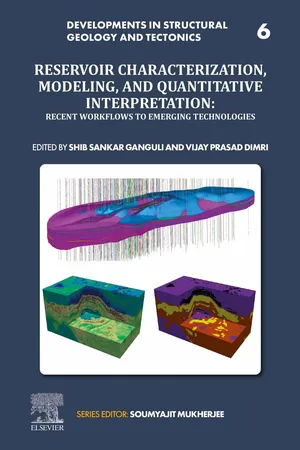
eBook - ePub
Reservoir Characterization, Modeling and Quantitative Interpretation
Recent Workflows to Emerging Technologies
- 488 pages
- English
- ePUB (mobile friendly)
- Available on iOS & Android
eBook - ePub
Reservoir Characterization, Modeling and Quantitative Interpretation
Recent Workflows to Emerging Technologies
About this book
Reservoir Characterization, Modeling and Quantitative Interpretation: Recent Workflows to Emerging Technologies offers a wide spectrum of reservoir characterization techniques and technologies, focusing on the latest breakthroughs and most efficient methodologies in hydrocarbon exploration and development. Topics covered include 4D seismic technologies, AVAz inversion, fracture characterization, multiscale imaging technologies, static and dynamic reservoir characterization, among others. The content is delivered through an inductive approach, which will help readers gain comprehensive insights on advanced practices and be able to relate them to other subareas of reservoir characterization, including CO2 storage and data-driven modeling.
This will be especially useful for field scientists in collecting and analyzing field data, prospect evaluation, developing reservoir models, and adopting new technologies to mitigate exploration risk. They will be able to solve the practical and challenging problems faced in the field of reservoir characterization, as it will offer systematic industrial workflows covering every aspect of this branch of Earth Science, including subsurface geoscientific perspectives of carbon geosequestration. This resource is a 21st Century guide for exploration geologists, geoscience students at postgraduate level and above, and petrophysicists working in the oil and gas industry.
- Covers the latest and most effective technologies in reservoir characterization, including Avo analysis, AVAz inversion, wave field separation and Machine Learning techniques
- Provides a balanced blend of both theoretical and practical approaches for solving challenges in reservoir characterization
- Includes detailed industry-standard practical workflows, along with code structures for algorithms and practice exercises
Information
Topic
Physical SciencesSubtopic
Geology & Earth SciencesTable of contents
- Cover image
- Title page
- Table of Contents
- Copyright
- Contributors
- Foreword
- Preface
- Chapter One: Reservoir characterization: State-of-the-art, key challenges and ways forward
- Chapter Two: 3D seismic attribute visualization and analysis for fault characterization
- Chapter Three: Modeling natural fracture networks and data assimilation using multipoint geostatistics and machine learning-based geomechanical inferences
- Chapter Four: Enhanced artificial intelligence workflow for predicting production within the Bakken formation
- Chapter Five: Relative seismic inversion: A quick way to understand the quantitative potential of the data
- Chapter Six: Striking a balance: Seismic inversion with model- and data-driven priors
- Chapter Seven: AVAz inversion of 4D seismic data for fracture characterization: A case study in the Barnett shale
- Chapter Eight: Modeled AVAZ responses of multiple fractured medium
- Chapter Nine: Seismic AVO analysis for reservoir characterization
- Chapter Ten: 4D seismic for reservoir management
- Chapter Eleven: Rock physics theory: Bridging the gap between seismic data and reservoir properties
- Chapter Twelve: Effective elastic medium properties using digital rocks: Existing practice and emerging trends
- Chapter Thirteen: Role of critical data for geomechanical modeling and characterization of future CO2 storage sites
- Chapter Fourteen: Geoscientific approach for carbon sequestration evaluation: A pragmatic perspective
- Chapter Fifteen: Source rock characterization: Role of plant resins as a stimulus for hydrocarbon potential
- Chapter Sixteen: Multiscale imaging technologies for shale reservoir characterization
- Index
Trusted by 375,005 students
Access to over 1.5 million titles for a fair monthly price.
Study more efficiently using our study tools.
Frequently asked questions
Yes, you can cancel anytime from the Subscription tab in your account settings on the Perlego website. Your subscription will stay active until the end of your current billing period. Learn how to cancel your subscription
No, books cannot be downloaded as external files, such as PDFs, for use outside of Perlego. However, you can download books within the Perlego app for offline reading on mobile or tablet. Learn how to download books offline
Perlego offers two plans: Essential and Complete
- Essential is ideal for learners and professionals who enjoy exploring a wide range of subjects. Access the Essential Library with 800,000+ trusted titles and best-sellers across business, personal growth, and the humanities. Includes unlimited reading time and Standard Read Aloud voice.
- Complete: Perfect for advanced learners and researchers needing full, unrestricted access. Unlock 1.5M+ books across hundreds of subjects, including academic and specialized titles. The Complete Plan also includes advanced features like Premium Read Aloud and Research Assistant.
We are an online textbook subscription service, where you can get access to an entire online library for less than the price of a single book per month. With over 1.5 million books across 990+ topics, we’ve got you covered! Learn about our mission
Look out for the read-aloud symbol on your next book to see if you can listen to it. The read-aloud tool reads text aloud for you, highlighting the text as it is being read. You can pause it, speed it up and slow it down. Learn more about Read Aloud
Yes! You can use the Perlego app on both iOS and Android devices to read anytime, anywhere — even offline. Perfect for commutes or when you’re on the go.
Please note we cannot support devices running on iOS 13 and Android 7 or earlier. Learn more about using the app
Please note we cannot support devices running on iOS 13 and Android 7 or earlier. Learn more about using the app
Yes, you can access Reservoir Characterization, Modeling and Quantitative Interpretation by Shib Sankar Ganguli,V.P. Dimri in PDF and/or ePUB format, as well as other popular books in Physical Sciences & Geology & Earth Sciences. We have over 1.5 million books available in our catalogue for you to explore.