eBook - ePub
Rehabilitation Robots for Neurorehabilitation in High-, Low-, and Middle-Income Countries
Current Practice, Barriers, and Future Directions
- 532 pages
- English
- ePUB (mobile friendly)
- Available on iOS & Android
eBook - ePub
Rehabilitation Robots for Neurorehabilitation in High-, Low-, and Middle-Income Countries
Current Practice, Barriers, and Future Directions
About this book
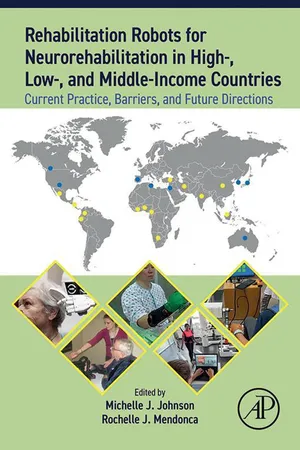
Rehabilitation Robots for Neurorehabilitation in High, Low, and Middle Income Countries: Current Practice, Barriers, and Future Directions describes the state-of-art research of stroke rehabilitation using robot systems in selected High Income Countries (HICs) and Low and Middle Income Countries (LMICs), along with potential solutions that enable these technologies to be available to clinicians worldwide, regardless of country and economic status. The book brings together engineers and clinicians, offers insights into healthcare disparities, and highlights potential solutions to facilitate the availability and accessibility of more robot systems to stroke survivors and their clinicians worldwide, regardless of country and economic status.In addition, the book provides examples on how robotic technology is used to bridge rehabilitation gaps in LMICs and describes potential strategies for increasing the expansion of robot-assisted stroke rehabilitation across more LMICs.
- Provides a global picture of robot-assisted neurorehabilitation
- Describes stroke healthcare in selected LMICs and selected HICs, along with disparity issues
- Discusses potential barriers to the penetration of rehabilitation robots into LMICs
- Presents concrete examples on how clinicians and engineers have begun to address healthcare gaps with rehabilitation robotics and how to deal with accessibility barriers
Information
Table of contents
- Rehabilitation Robots for Neurorehabilitation in High-, Low-, and Middle-Income Countries
- Chapter 1 Stroke
- Chapter 2 Rehabilitation guidelines for stroke care: a worldwide perspective
- Chapter 3 Fundamentals of neurorehabilitation
- Chapter 4 Fundamentals of neurorehabilitation robotics (engineering perspective)
- Chapter 5 Evidence for rehabilitation and socially assistive robotics
- Chapter 6 North America and Caribbean region: USA
- Chapter 7 North America and Caribbean region: Canada
- Chapter 8 Europe region: Italy
- Chapter 9 Europe region: Spain
- Chapter 10 Asia-Pacific region: Japan
- Chapter 11 Asia-Pacific region: Australia
- Chapter 12 Asia-Pacific region: Republic of Korea
- Chapter 13 Middle East region: Israel
- Chapter 14 North America and Caribbean region: México
- Chapter 15 North America and Caribbean region: Costa Rica
- Chapter 16 North America and Caribbean region: Colombia
- Chapter 17 North America and Caribbean region: Ecuador
- Chapter 18 Europe region: Serbia
- Chapter 19 Asia Pacific region: India
- Chapter 20 Asia Pacific region: Malaysia
- Chapter 21 Asia Pacific region: China
- Chapter 22 Middle East region: Iran
- Chapter 23 Middle East region: Turkey
- Chapter 24 Africa region: Nigeria
- Chapter 25 Africa region: Botswana
- Chapter 26 Africa region: Ghana
- Chapter 27 Africa region: Cameroon
- Chapter 28 Africa region: Morocco
- Chapter 29 Psychosocial dimensions of robotic rehabilitation for stroke survivors
- Chapter 30 Human-centered design for acceptability and usability
- Chapter 31 Toward inclusive rehabilitation robots
- Chapter 32 Toward global use of rehabilitation robots and future considerations
- Index
Trusted by 375,005 students
Access to over 1.5 million titles for a fair monthly price.
Study more efficiently using our study tools.
Frequently asked questions
Yes, you can cancel anytime from the Subscription tab in your account settings on the Perlego website. Your subscription will stay active until the end of your current billing period. Learn how to cancel your subscription
No, books cannot be downloaded as external files, such as PDFs, for use outside of Perlego. However, you can download books within the Perlego app for offline reading on mobile or tablet. Learn how to download books offline
Perlego offers two plans: Essential and Complete
- Essential is ideal for learners and professionals who enjoy exploring a wide range of subjects. Access the Essential Library with 800,000+ trusted titles and best-sellers across business, personal growth, and the humanities. Includes unlimited reading time and Standard Read Aloud voice.
- Complete: Perfect for advanced learners and researchers needing full, unrestricted access. Unlock 1.5M+ books across hundreds of subjects, including academic and specialized titles. The Complete Plan also includes advanced features like Premium Read Aloud and Research Assistant.
We are an online textbook subscription service, where you can get access to an entire online library for less than the price of a single book per month. With over 1.5 million books across 990+ topics, we’ve got you covered! Learn about our mission
Look out for the read-aloud symbol on your next book to see if you can listen to it. The read-aloud tool reads text aloud for you, highlighting the text as it is being read. You can pause it, speed it up and slow it down. Learn more about Read Aloud
Yes! You can use the Perlego app on both iOS and Android devices to read anytime, anywhere — even offline. Perfect for commutes or when you’re on the go.
Please note we cannot support devices running on iOS 13 and Android 7 or earlier. Learn more about using the app
Please note we cannot support devices running on iOS 13 and Android 7 or earlier. Learn more about using the app
Yes, you can access Rehabilitation Robots for Neurorehabilitation in High-, Low-, and Middle-Income Countries by Michelle Jillian Johnson,Rochelle J. Mendonca in PDF and/or ePUB format, as well as other popular books in Technology & Engineering & Artificial Intelligence (AI) & Semantics. We have over 1.5 million books available in our catalogue for you to explore.