eBook - ePub
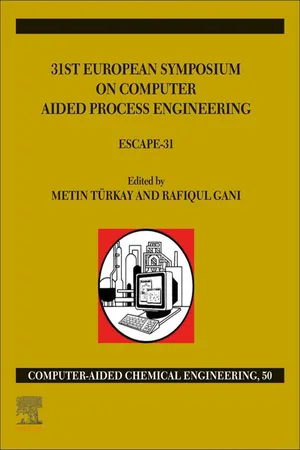
31st European Symposium on Computer Aided Process Engineering
ESCAPE-31
- 2,140 pages
- English
- ePUB (mobile friendly)
- Available on iOS & Android
eBook - ePub
About this book
The 31st European Symposium on Computer Aided Process Engineering: ESCAPE-31, Volume 50 contains the papers presented at the 31st European Symposium of Computer Aided Process Engineering (ESCAPE) event held in Istanbul, Turkey. It is a valuable resource for chemical engineers, chemical process engineers, researchers in industry and academia, students and consultants in the chemical industries.
- Presents findings and discussions from the 31st European Symposium of Computer Aided Process Engineering (ESCAPE) event
Information
Table of contents
- Cover image
- Title page
- Table of Contents
- Copyright
- Preface
- National Organizing Committee
- Theme Coordinators
- International Scientific Committee
- Conference Secretariat
- PROCESS-PRODUCT DESIGN AND INTEGRATION
- Explanatory and Predictive Analysis of Naphtha Splitter Products
- Multi-objective optimization of the supply chain for the production of biofuels and high value-added products in Mexico: importance of the water footprint
- Synthesis of Combined Heat and Mass Exchange Networks Via a Trust Region Filter Optimisation Algorithm Including Detailed Unit Designs
- Computer-Aided Refrigerant Design: New Developments
- Comparative assessment of black liquor upgraded gasification in integrated kraft pulp, methanol and dimethyl ether production plants
- Sustainable Process Design and Synthesis for HDPE Recycling
- A Novel Process Design for Waste Respirator Processing
- Design and optimization of a shell-and-tube heat exchanger using the univariate marginal distribution algorithm
- Synthesis of Microgels with Minimal Final Concentration of Initiator
- Novel Dual Reactive Distillation Process for Eco-efficient Lactic Acid Recovery and Purification from Fermentation Broth
- Exergy Analysis of Vacuum Distillation Unit
- Computer-Aided Solvent Design Integrated with a Machine Learning-based Atom Contribution Method
- A versatile modelling system for integrated chemical product design problems
- An integrated system of multi effect distillation and wind power system - Evaluation of total energy saving
- Modelling and Performance evaluation of the air heated and water heated Humidification-Dehumidification desalination process using solar thermal energy
- Enhancement of energy saving of reverse osmosis system of Arab Potash Company via a wind energy system
- Multi-objective optimization for the incorporation of safety and reliability considerations in process design
- Integrating Reliability and Uncertainty in Process Synthesis
- Optimization of Graded Bed Reactors for Syngas to Olefin (STO) Processes
- Gas Lift Optimization for Optimum Oil Production from a Well Platform
- Techno-economic evaluation of sorption enhanced steam gasification of PKS system for syngas using CaO for CO2 capture
- A Robust Optimization Approach for Hydrogen Allocation Network with Parametric Uncertainties
- Process Design and Techno-economic analysis of Hydrogen Production using Green Ammonia Imported from Australia- A Korea Case Study
- Life Cycle Assessment of Hydrogen Production from Imported Green Ammonia: A Korea Case Study
- Optimal Design of Distillation Columns Using a Combined Optimisation Approach
- Process and product design for the simultaneous synthesis of xylitol and sorbitol from biomass
- An approach for simultaneous computer-aided solvent design and process design for CO2 chemical absorption processes
- Simulation-based Derivative-free Optimization for Hybrid Separation Design
- Material Screening for Thermochemical Energy Storage in Solar Power Systems
- Network design optimization of waste management systems: the case of plastics
- Rational Design of Ionic Liquid Phase-Change Material for Efficient Thermal Energy Storage
- Tailor-made solvents by integrated design of molecules and CO2 absorption processes
- Small-scale GTL Applications with Heat Integration in Reforming and Fischer-Tropsch Stages
- Automated Process Synthesis Using Reinforcement Learning
- Operational Analysis of a Proton-Conducting Solid Oxide Electrolysis Cell for Synthetic Fuel Production
- Octane Optimization with a Combined Machine Learning and Optimization Approach
- A Platform of Machine Learning-Based Next-Generation Property Estimation Methods for CAMD
- Machine Learning Analysis of the Feed Water Parameters Affecting Reverse Osmosis Membrane Operation
- Novel technologies lor low-quality natural gas purification
- The Influence of Cuttings Polydispersity on Wellbore Cleaning Operations using the Kinetic Theory of Granular Flow and the Dense Discrete Phase Model
- A Digital Twin for Process Optimisation in Pharmaceutical Manufacturing
- Development of Hybrid RTO approaches in the absence of a rigorous dynamic model by the use of Hammerstein model structures
- Study of alternative configurations for methanol purification
- Power-to-OME1 via Direct Oxidation of Methanol: Process Design and Global Flowsheet Optimization
- A Machine Learning Approach for Device Design from Materials and Operation Data
- A Computer-Aided Platform for Simultaneous Process Synthesis and Intensification
- Studying the effect of solvent properties in treatment design within CO2 Integration Networks
- A Multi-generation system in Sabkha-Tah operating with nanofluids and a novel RO unit.
- A POD-ROM Methodology for Optimal Structuring of a Non-isothermal Fixed-bed Reactor for Process Integration
- Effect of Pseudo-Homogeneous Concentration Based Kinetics on Hybrid Reactive Distillation Columns for Selectivity Engineering
- An MILP model of post-combustion carbon capture based on detailed process simulation
- Numerical Study of fertilizer granules dynamics within rotary drum granulator
- Application of PharmaPy in the digital design of the manufacturing process of an active pharmaceutical ingredient
- Computer-Aided Screening of Deep Eutectic Solvent Systems for the Associative Extraction of α-Tocopherol from Deodorizer Distillate
- Investigating critical design criteria for photo-electrochemical reactors
- Advanced exergoeconomic analysis of a double effect evaporation process in an instant coffee plant
- Energy-efficient membrane cascades for industrial separations
- Techno-economic evaluation of Carbfix technology for carbon storage in the US
- Computational Exploration of Adsorption Enhanced Haber-Bosch using MOFs and Ionic Liquid/MOFs
- Optimization of a Continuous Fluidized Bed Process for the Separation of Enantiomers by Preferential Crystallization
- Methanol and power production from waste tyres: a process synthesis approach
- Analysing the robustness of multi-stage bioseparations to measurement errors
- Improvements in Methyl Ethyl Ketone Production Through Intensified Processes
- DATA ANALYTICS, MODELING, OPTIMİZATION AND SIMULATION
- Flexibility Assessment of Spirits Distillation Processes: Focus on the Armagnac Distillation
- OUTDOOR – An open-source superstructure construction and optimization tool
- Probabilistic Modeling for Optimization of Bioreactors using Reinforcement Learning with Active Inference
- SPH Simulation of the Rising of a Kerosene Bubble in a Water Column: Effect of the Injection Condition
- Novel method for properties prediction of pure organic compounds using machine learning
- Self-learning surrogate models in superstructure optimization
- Data-driven Modeling of an Industrial Ethylene Oxide Plant: Superstructure-based Optimal Design for Artificial Neural Networks
- Novel Tool for Selecting Surrogate Modeling Techniques for Surface Approximation
- ProREFD: Tool for Automated Computer-Aided Refrigerant Design, Analysis, and Verification
- Event driven analysis to enhance model calibration of experiments with high offline sampling rates
- Process System Engineering Tool Integration in the Context of Industry 4.0
- Benchmarking of Surrogate Models for the Conceptual Process Design of Biorefineries
- Predicting the Estrogen Receptor Activity of Environmental Chemicals by Single-Cell Image Analysis and Data-driven Modeling
- Data-driven prognostics for Lithium-ion battery health monitoring
- The Adaptive Radial Basis Method (ARBM): An application to the hydrodynamics of liquid-liquid dispersions
- Process modeling and multi-criteria optimization of an industrial phosphoric acid wet-process
- Towards Automated HAZOPs
- Multi-objective optimization of co-processing of algae hydrothermal liquefaction oil and vacuum gas oil: a survey of algal oil co-processing ratio and gasoline selling price
- Modeling of a software for sizing a wastewater treatment plant
- Joint Chance Constraint Approach based on Data-Driven Models for Optimization Under Uncertainty applied to the Williams-Otto Process
- CFD Simulations of High Efficiency Gas Cyclones: An Influence of Dustbin Geometry
- InvQMOM: A Simple Inversion Method that Works
- A Dual-Layer Attention-Based LSTM Network for Fed-batch Fermentation Process Modelling
- Resilience and Survivability-aware Optimal Design and Operation of Interconnected Supply Chains
- A Hybrid Modeling Approach for Liquid Entrainment Fraction Predictions
- Rethinhing Balance Models Applied to PFRS and Extracting New Insights
- Digital Twin Model Development for Chemical Plants Using Multiple Time-Steps Prediction Data-Driven Model and Rolling Training
- Parameter estimation and sensitivity analysis for a diesel hydro-processing model
- Model Development of Amine Regeneration Process with Electrodialysis Reclamation Unit
- CO2 methanation: Reactor modelling and parametric analysis
- An uncertainty-aware hybrid modelling approach using probabilistic machine learning
- Modelling and Dynamic Optimization of beer fermentation towards optimal flavor and operation
- On the fitting of bathtub-shaped failure models to lifetime data for selective maintenance optimization
- Sampling Space Reduction for Data-driven Modelling of Batch Distillation - Introducing Expert Process Knowledge through Operation Recipes
- On the acceleration of global optimization algorithms using a cutting plane decomposition and machine learning
- Towards a Digital Twin: A validated Digital Model of a Pilot Scale Bioreactor producing Green Fluorescent Protein (GFP)
- Automated Box-Jenkins Methodology to Forecast the Prices of Crude Oil and Its Derivatives
- Systematic Modelling of Transport Processes across Interfaces
- An identification approach to a reaction network for an ABE catalytic upgrade
- MOSKopt: A simulation-based data-driven digital twin optimizer with embedded uncertainty quantification
- Global Optimization of Mixed-Integer Polynomial Programs via Quadratic Reformulation
- A data-based approach for the development of asynchronous and distributed optimization algorithms in complex engineering applications
- Title Page
- Copyright
- How tools and technologies help drive sustainability
- A homotopy continuation-based branch and bound algorithm for process synthesis and design using rigorous unit operation models
- ROmodel: A Python Robust Optimization Modeling Toolbox
- Modelling – Mechanistic reductionism extended with holistic empirical components
- Thermodynamic Optimization of a Biomass-based Integrated Gasification Combined Cycle with Post Combustion Carbon Capture using Potassium Carbonate
- The state of play towards modeling of air quality in the city of Rabat
- Machine learning applications and process intelligence for cement industries
- Process Modelling and Simulation of Volatile Organic Compound (VOC) Recovery from Pharmaceutical Gas Emission Streams
- Multi-zonal compartmentalization methodology for surrogate modelling in continuous pharmaceutical manufacturing
- ProMo variable/equation Ontology-based systemmodelling
- Multi-scenario Design Optimization using ADMM of a Thermal Energy Storage System
- Performance comparison of different optimization methods for the wastewater treatment plant model based on the Activated Sludge Model No. 3 and design of the plant control
- Comparison of Group-Contribution and Machine Learning-based Property Prediction Models with Uncertainty Quantification
- Intelligent Management Platform for Material Exchange Optimization and Industrial Symbiosis
- Towards a Software Prototype for Synthesis of Operable Process Intensification Systems
- Data-driven modelling of choke valve erosion using data simulated from a first principles model
- A Metamodelling Approach for Air Pollution Source Estimation
- Uncertainty analysis in life-cycle assessment of early-stage processes and products: a case study in dialkyl-imidazolium ionic liquids
- Interval-Valued Data Learning for Robustness of Energy Recovery Systems
- Rules for Predicting Benefits in Simultaneous versus Sequential Heat Integration
- Processing systems design considering resilience
- Applying quality assurance concepts from software development to simulation model assessment in smart equipment
- Studying the Synergy between Dimension Reduction and Clustering Methods to Facilitate Fault Classification
- Computational Fluid Dynamics Modelling of Phenol Oxidation in a Trickle-Bed Reactor using 3D Eulerian Model
- Enhanced deterministic approach for heat exchanger network synthesis
- Modelling Biogas and H2S in Anaerobic Digestion
- Implementation of first-principles surface interactions in a hybrid machine learning assisted modelling of flocculation
- Optimal physical property data for process simulations by optimal experimental design
- On the practical identifiability of kinetic models of hydroxymethylfurfural hydrogenation in batch reaction systems
- Continuous-Effort Approach to Model-Based Experimental Designs
- Application of Machine Learning and Global Sensitivity Analysis for Identification and Visualization of Design Space
- A Hybrid Model Coupling Advanced Oxidation Processes (AOP) and Conventional Bio-processes for the Removal of Recalcitrant Contaminants in Wastewaters
- Analysis of the dissolution mechanism in the phosphoric acid manufacturing process: modelling and simulation
- Focusing experiments in the early phase process design by process optimization and global sensitivity analysis
- Design Space Approximation with Gaussian Processes
- Employing Adaptive Just-In-Time-Learning in a Transfer Learning Frame for Soft-Sensor Design
- AC-Optimal Power Flow Solutions with Security Constraints from Deep Neural Network Models
- The impact of CO2 pricing in SC Resilience – An optimisation model
- Machine learning-based approach to identify the optimal design and operation condition of organic solvent nanofiltration (OSN)
- Development of System Dynamic Model for Sustainability driven Technology Adoption in Indian Transport Sector
- Multi-Period Design Optimization of Flexible Fixed-Bed Reactors by Stoichiometry-Based Model Reduction
- Optimization based sampling for gray-box modeling using a modified upper confidence bound acquisition function
- How to design cooperative sustainable industrial systems?
- Population Balance Modelling of Pan Granulation Processes
- Estimation of cutpoint temperature under uncertain feed composition and process conditions using artificial intelligence methods
- Application of Constrained EKF based State Estimation to a Coiled Flow Inverter Copolymerization Reactor
- Towards Automated Information Retrieval of Process Data and Knowledge from Academic Databases
- Prediction of Bioconcentration Factors (BCF) using Graph Neural Networks
- Data and environment based approach for process systems engineering
- A Data-based Predictive Model for Distillation Column of Bio-based 2,3-Butanediol
- Data-driven Process Design Exemplified on the Steam Methane Reforming Process
- Input transformation for linearization, decoupling and disturbance rejection with application to steam networks
- SEARCH: A Symptom-based Expert for Advanced Response to Chemical Hazards
- A Cloud Computing Application for the Supercritical Carbon Dioxide Extraction Using Coffee Grounds Silverskin
- Multi-objective optimization of the shape of a fixed-bed reactor
- Artificial Intelligence Based Prediction of Exergetic Efficiency of a Blast Furnace
- AI System for Supporting Generation of Optimal Synthetic Pathways Based on Chemical Reaction Big Data
- Application of data science to study fluorine losses in the phosphate industry
- Data-driven Branch-and-bound Algorithms for Constrained Simulation-based Optimization
- Reactor scale modelling of gas hydrate-based CO2 capture (HBCC) process
- SMITH: differential homotopy and automatic differentiation for computing thermodynamic diagrams of complex mixtures.
- Dynamic modeling of a three-phase gas-solid-liquid fluidized bed absorber for CO2 capture
- Steady and Dynamic State Simulation-based Study of the Coupling of Electrolysis and Methanation Processes within Power to Methane (PtM) Context
- Upgraded Meta-Learning based Surrogate Selection Paradigm (LEAPS2v2)
- Flexibility analysis of chemical processes considering dependencies between uncertain parameters
- Computational Characterization of a Pore Network Model by Using a Fast Nitrogen Porosimetry Simulation
- Acyclic modular flowsheet optimization using multiple trust regions and Gaussian process regression
- Systematic generation and targeting of chemical recycling pathways: A mixed plastic waste upcycling case study
- Calibration of an EPANET model by using monitoring points in the bulk distribution of Sedibeng Water, for predicting disinfectant decay
- Compartmental Modelling of Shell Side Fouling in a Shell and Tube Heat Exchanger
- Optimization-based digital design of a commercial pharmaceutical crystallization process for size and shape control
- PROCESS OPERATIONS AND CONTROL
- Condition Number As A Quantitative Measure Of Flexibility In A Process
- Nonlinear Model Predictive Control of Food Sterilization Processes
- Design and control of triple-column pressure swing distillation process for acetone-methanol-hexane separation
- Design and control of a Biobutanol Purification Process through IBE Fermentation: Basic Design Configuration
- Fault Diagnosis of Electrical Power Systems with Hybrid Quantum-Classical Deep Learning
- Data-Driven Robust MPC for Controlled Environment Agriculture
- Initialization strategy for the dynamic optimization of a batch distillation column with a rate-based model
- Adversarial Autoencoder Based Nonlinear Process Monitoring
- Machine learning for constrained self-optimizing control
- Driving Force Based Design and Control Performance Analysis of Reactive Distillation Columns
- Generating an optimal control policy via apprenticeship and reinforcement learning
- Systematic model-based dynamic optimization of a combined cooling and antisolvent multistage continuous crystallization process
- Predicting Microclimate of a Closed Greenhouse Using Support Vector Machine Regression
- Adjustable Robust Optimal Control for Nonlinear Chemical Process under Uncertainty
- Adaptive Optimal Control of Baker’s Yeast Fermentation Process with Extreme Learning Machine and Recursive Least Square Technique
- Data-based Industrial Soft-sensor Design via Optimal Subset Selection
- Economic MPC with Modifier Adaptation using Transient Measurements
- Attack Detection Using Unsupervised Learning Algorithms in Cyber-Physical Systems
- Application of Self-Optimizing Control in a Real Heat Exchanger Network
- Data-Driven Control Strategies for the Autonomous Operation of the Pharmaceutical Crystallization Process
- Dynamic optimization of a stand-alone alkaline water electrolyzer for future operation using a predicted solar forecast
- A Mixed Integer Dynamic Optimization Approach for a Hybrid-Stand Alone Solar and Wind Powered Alkaline Water Electrolyser for Renewable Hydrogen
- A framework for adaptive online model-based redesign of experiments in dynamic systems
- Investigation of the use of transient process data for steady-state Real-Time Optimization in presence of complex dynamics
- Evaluating Control Room Operator Training Outcomes Through Eye Gaze Augmented Multi-Scale Data
- Multi-layer Multivariate Statistical Analysis for Process Monitoring
- Digitalization, Control and Optimization for Cement Plants
- Process Monitoring with Advanced Analytics for Improved Plant Efficiency in the Pharmaceutical Industry
- A Study of Spectral Envelope Method for Multi-Cause Diagnosis using Industrial Data
- Dynamic Model Based Detection of Cyberattacks in Industrial Facilities
- Evaluation of control strategies in CO2 capture unit
- Modelling and Temperature Uncertainty Analysis of a Fermentation Bioreactor at an Industrial Brewery
- Symbolic transfer entropy for root cause analysis of process disturbances
- Quality-by-Control of continuous drug substance isolation: study on a novel unit for integrated filtration-drying
- Control of Batch and Continuous Crystallization Processes using Reinforcement Learning
- Title Page
- Copyright
- Process Monitoring under Uncertainty: An Opportunity for Bayesian Multilevel Modelling
- Modelling and Health Monitoring of a Pressure Regulating System
- Unsupervised Monitoring of Flocculation Processes based on Recurrence Theory
- ENERGY/WATER/FOOD NEXUS AND SUSTAINABILITY
- Optimal Supply Chain for Renewable Furfural Production Involving Economic, Environmental and Social Criteria
- Levels of Approximation for the Optimal Design of Distributed Energy Systems
- A Coordinated Framework for the Optimization of Municipal Solid Waste Management
- A Probabilistic Scenario Generation Framework for Optimal Decision Making in Turkish Renewable Energy Market
- Dynamic optimization modelling for a national-scale energy sysem in transition
- Carbon Policy Assessment in Process Integration
- Back-End Design and Development of an Energy Systems Analysis Tool
- Compression system power requirements for various CO2 sources and transportation options
- Life Cycle Optimization of Hybrid Energy Systems towards Carbon Neutrality
- Value of aggregator-led community energy storage systems with degradation constraints
- Clean Electricity Generation from Sewage: a novel Ultra-Supercritical Water Oxidation Technology with integrated CCS
- Design of Food-Energy-Water-Waste Nexus Systems in New York State under COVID-19 Pandemic
- Assessment strategies of different molten salts for heat transfer in tri-generation systems
- Techno-economic Assessment of Load Following Operation for Super-critical Power Plants Equipped with Carbon Capture Feature
- Utilisation of CO2 in transnational LNG supply chain for the enhancement of jet fuel production in globally decentralised GTL industries
- River Water Quality Prediction in Malaysia Based on Extra Tree Regression Model Coupled with Linear Discriminant Analysis (LDA)
- Synthesis and Design of Sustainable Integrated Process, Water Treatment, Energy Supply Networks and Carbon Utilization Networks Under Uncertainty
- Optimising the Sustainability Performance of an Industrial Park: an Energy-Water-Food Nexus
- A Study to Target Energy Consumption in Wastewater Treatment Plant using Machine Learning Algorithms
- Development of sustainable integrated biorefinery networks in pulp and paper industries
- Optimization of biogas autothermal reforming integrated with PEM based on renewable energy
- Integration of CO2 capture to power plants: the effect of fuel and gas composition in process configuration
- Optimal Integration of Renewables, Flexible Carbon Capture, and Energy Storage for Reducing CO2 emissions from Fossil Power Plants
- Circular Economy Systems Engineering: A case study on the Coffee Supply Chain
- Towards a Circular Economy Calculator for Measuring the “Circularity” of Companies
- Economic Optimization of Qatar’s Hydrocarbon-based Fuels for Sustainable Maritime Applications
- Unmanned aerial vehicles in precision agriculture towards circular economy: a process system engineering (PSE) assessment
- Utilisation of Carbon Dioxide and Gasified Biomass for the Generation of Value Added Products
- Synthesis of the EU Supply Networks for the Gradual Transition to 100 % Renewable Energy Production
- Simultaneous optimization and heat integration of a macroalgae-based biorefinery
- Integrated optimization of Multi-Energy System operation and thermal comfort management for buildings
- Towards a Rational, Quantum-Chemistry-Based Selection and Screening of Green Solvents for Liquid-Liquid Phase Transfer Catalysis
- A Model-Centric Multivariate Analysis for Reducing H2S Emissions in Wastewater Treatment Plants
- Gas-to-liquid strategy for liquid fuel production from industrial residue gases: Process development and technoeconomic analysis
- Multi-Objective Optimization of Lignocellulosic Ethanol Production Based on Regional Land and Water Availability
- Deep Learning and AutoML for Dynamic Modeling of LNG Regasification Process Using Seawater
- Carbon or Nitrogen-based e-fuels? A comparative techno-economic and full environmental assessment
- Techno-economic assessment of a renewable energy-based electric vehicle fast-charging station in Qatar
- Simultaneous Synthesis and Optimization of Refrigeration Cycles and Heat Exchangers Networks
- Waste- to-DME: Process Synthesis and Sustainability Evaluation
- Long-distance hydrogen delivery using a toluene-based liquid organic hydrogen carrier system
- Assessment of energy efficiency improvement in ceramic industry through waste heat recovery modelling
- Targeting and Optimisation of Industrial and Urban Symbiosis for Circular Economy
- Negative CO2 emissions in biomass gasification process with hybrid amine-deep eutectic solvents
- Development and optimization of an energy efficient and self-sustained integrated process for nitrogen removal for baseload LNG plant
- Integration of Green Power in a Gas to Liquid Process
- Comparative Study of Different Hybrid Life Cycle Assessment Methodologies Applied to Biomass-based Chemical Production
- Optimising the energy, water and food nexus node to support decision making for sustainable food security in Risky Environments
- Synthesis of Sunlight, Seawater and CO2 based Industrial Parks
- OPERATIONS AND SUPPLY CHAINS
- Planning production of solar grade silicon to yield solar panels involving behaviour of population
- Bi-level Mixed-Integer Data-Driven Optimization of Integrated Planning and Scheduling Problems
- A Prospective Approach in the Design of Lignin-Based Products Supply Chains
- Flexibility Analysis in Supply Chain Management: Application to the Traveling Salesman Problem
- Production scheduling of continuous make-and-pack processes with byproducts recycling
- Robust Optimization for Scheduling and Lot-sizing of a Single Machine with Sequence-dependent Changeovers
- Simultaneous minimization of minimum resource and storage requirements in batch process
- A Hybrid Solution Approach for Large-scale Batch Scheduling with Quantum Computing
- A Digital Twin Framework for Business Transactional Processes in Supply Chains
- A Data-Driven Approach to Plan Electricity Production from Diesel Engines with Constrained Parameters
- An Efficient Computational Strategy for Process Scheduling: a Case Study of the Omsk Lubricant Plant
- Centralised vs. decentralised production and storage: optimal design of a decarbonised hydrogen supply chain with multiple end uses
- Optimal Design of the Reverse Logistics Network of Empty Agrochemical Containers
- Designing a Rectification Strategy for Managing Disruptions in LNG Supply Chain
- Statistical Decision-Theoretic Risk Management for Planning Renewable Energy Pathways
- Supply Chain Planning with Vehicle Allocation for Gas Industry
- Optimal Day-Ahead Load Curtailment for Central Chiller Plants
- Interplaying of food supply chain resilience, industry 4.0 and sustainability in the poultry market
- Integrated Spatially Explicit Landscape and Biofuel Supply Chain Network Design
- Techno-economic and environmental assessment of Gasoline produced from GTL and MTG processes
- Simplified targeting models for Sustainable Supply Chains retrofitting in process industries
- Flexibility-expansion planning for enhanced balancing-power market participation of decentralized energy systems
- A fair profit allocation model for the distribution plan optimisation of refined products supply chains
- Markov Decision Process to Optimise Long-term Asset Maintenance and Technologies Investment in Chemical Industry
- Cost, environmental and exergy optimization of hydrogen and methane supply chains: application to Occitania region, France
- Planning of non-conventional gas field development with parametric uncertainties
- BIOLOGICAL SYSTEMS AND PROCESSES
- Effect of the lignin extraction process on the economics of a woody-based biorefinery
- Economic and environmental assessment of bio-hydrogenated diesel production process from waste cooking oil integrated with reforming process
- Modelling and simulation of a multiple feedstock integrated biorefinery for the production of aviation biofuel and other biofuels
- Coordinated Management of Agricultural Waste and High-tech Value Bioproducts
- A design and optimization framework for (bio-) chemical process based on exergo-economic and environmental aspects
- Integrating Process Simulation and Life Cycle Assessment to Evaluate the Economic and Environmental Performance of Algae Biodiesel
- Optimization of biogas production from cattle manure by anaerobic digestion using a gradient-based algorithm
- Photosynthetic Bioplastics Production with Cyanobacteria by Coupled Growth-Production Mutants
- Parametric analysis of mammalian cell (GS-NS0) culture performance for advanced mAb biopharmaceutical manufacturing
- A technoeconomic assessment of an on-site biocrude production from sewage sludge in Qatar’s wastewater treatment plants
- Production costs of advanced biofuels using a multi-component learning curve model
- Simulation of the Biofuel Production Process from Organic Fraction of Municipal Solid Waste (OFMSW)
- Comparison of different processing routes for the valorisation of olive tree pruning wastes
- The Use of GVL for Holistic Utilization of Biomass
- Valorization of sugarcane bagasse to lactic acid: Life cycle assessment and Techno-economic evaluation in Indian scenario
- Hybrid Cybernetic Modeling of the Microbial Production of Polyhydroxyalkanoates Using Two Carbon Sources
- Microbial Production of Polyhydroxyalkanoates – Modeling of Chain Length Distribution
- Identifiability of metabolic flux ratios on carbon labeling experiments
- Metabolic Network Reconstruction from Time-Series of Concentration Data: Evaluation of the Numerical Matrices Methods
- Assessment of intermediate storage and distribution nodes in personalised medicine
- Thermal treatment in dairy processes: Validation of protein deposition models
- Optimal efficiency of biomass conversion from bio-based byproducts to biofuel production in the Ethiopian sugar industry: A case study in Wonji-Shoa sugar factory, Ethiopia
- Data-driven prediction of antiviral peptides based on periodicities of amino acid properties
- Allosteric Regulation of CRYs in Mammalian Circadian Clock
- EDUCATION AND TRAINING
- Reflections on the development of scenario and problem-based chemical engineering projects
- Programming skills across the (bio)engineering curriculum – a students’ perspective
- Engineering Social Responsibility: Rising to the Challenge of Sustainable Development
- Virtualization of Pressure Control Demonstration Unit – A Step Towards Virtual Laboratory
- Complementarities of part-time and full-time postgraduates in process systems engineering (PSE): when industry and academia merges
- Building Knowledge Capacity for Quantum Computing in Engineering Education
- Teaching PSE Mastery During, and After, the COVID-19 Pandemic
- Real-Time Chemical Process Monitoring with UMAP
- Efficient Energy Integration and Design of Distillation Separation Sequences
- Enhancing operability during early stage of process synthesis considering flexibility and inherent safety simultaneously
Trusted by 375,005 students
Access to over 1.5 million titles for a fair monthly price.
Study more efficiently using our study tools.
Frequently asked questions
Yes, you can cancel anytime from the Subscription tab in your account settings on the Perlego website. Your subscription will stay active until the end of your current billing period. Learn how to cancel your subscription
No, books cannot be downloaded as external files, such as PDFs, for use outside of Perlego. However, you can download books within the Perlego app for offline reading on mobile or tablet. Learn how to download books offline
Perlego offers two plans: Essential and Complete
- Essential is ideal for learners and professionals who enjoy exploring a wide range of subjects. Access the Essential Library with 800,000+ trusted titles and best-sellers across business, personal growth, and the humanities. Includes unlimited reading time and Standard Read Aloud voice.
- Complete: Perfect for advanced learners and researchers needing full, unrestricted access. Unlock 1.5M+ books across hundreds of subjects, including academic and specialized titles. The Complete Plan also includes advanced features like Premium Read Aloud and Research Assistant.
We are an online textbook subscription service, where you can get access to an entire online library for less than the price of a single book per month. With over 1.5 million books across 990+ topics, we’ve got you covered! Learn about our mission
Look out for the read-aloud symbol on your next book to see if you can listen to it. The read-aloud tool reads text aloud for you, highlighting the text as it is being read. You can pause it, speed it up and slow it down. Learn more about Read Aloud
Yes! You can use the Perlego app on both iOS and Android devices to read anytime, anywhere — even offline. Perfect for commutes or when you’re on the go.
Please note we cannot support devices running on iOS 13 and Android 7 or earlier. Learn more about using the app
Please note we cannot support devices running on iOS 13 and Android 7 or earlier. Learn more about using the app
Yes, you can access 31st European Symposium on Computer Aided Process Engineering by Metin Türkay,Rafiqul Gani in PDF and/or ePUB format, as well as other popular books in Technology & Engineering & Chemical & Biochemical Engineering. We have over 1.5 million books available in our catalogue for you to explore.