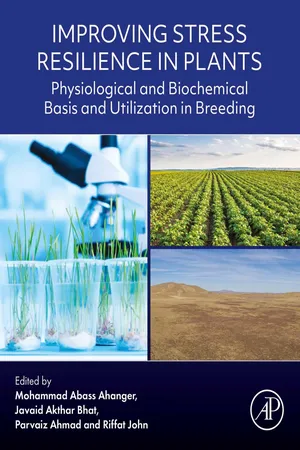
eBook - ePub
Improving Stress Resilience in Plants
Physiological and Biochemical Basis and Utilization in Breeding
- 500 pages
- English
- ePUB (mobile friendly)
- Available on iOS & Android
eBook - ePub
Improving Stress Resilience in Plants
Physiological and Biochemical Basis and Utilization in Breeding
About this book
Improving Stress Resilience in Plants: Physiological and Biochemical Basis and Utilization in Breeding addresses the urgent need for improved understanding of major plant stress tolerance mechanisms, the identification of the genes and gene products that are key to improving those mechanisms and means of optimizing those genes through molecular approaches. With a focus on plant physiological and biochemical attributes at both cellular and whole plant levels, this book includes the latest information on crosstalk between the various signaling molecules and quantitative trait locus (QTL). Further, it explores the extension of these mechanisms to breeding approaches, confirming overall understanding and inspiring further research.
Written by a team of global experts, and presented in three thematic sections, the book provides insights into physical adaptations, metabolism and pathways, and breeding techniques including CRISPR and conventional approaches to reduce the negative effects of stresses and improve crop yield even under stress conditions.
Improving Stress Resilience in Plants: Physiological and Biochemical Basis and Utilization in Breeding is ideal for researchers, academics and advanced students seeking to improve stress tolerance among crop plants and developing key future strategies for sustainable food production.
- Explores key strategies, including signaling molecules and Quantitative Trait Locus (QTLs)
- Highlights stress mitigating agents for improved crop yield
- Provides an integrated and holistic overview, enabling and inspiring further research toward improved food security
Information
Table of contents
- Cover
- Front Matter
- Table of Contents
- Copyright
- Contributors
- List of Illustrations
- List of Tables
- Chapter 1 : Physiological adaptation of plants to abiotic stresses
- Chapter 2 : Role of soil microbes in modulating the physiological attributes of plants under extreme environmental conditions
- Chapter 3 : Regulation of photosynthesis under stress
- Chapter 4 : Mechanistic view of plant adaptation under iron deficiency stress
- Chapter 5 : Improving stress resilience in plants by nanoparticles
- Chapter 6 : Nitrogen forms and their availability-dependent root developmental adaptation in plants
- Chapter 7 : Physiological and biochemical responses of cereals to heavy metal stress
- Chapter 8 : Application of halophyte microbiome for development of salt tolerance in crops
- Chapter 9 : Role of compatible osmolytes in plant stress tolerance under the influence of phytohormones and mineral elements
- Chapter 10 : Recent progress in enzymatic antioxidant defense system in plants against different environmental stresses
- Chapter 11 : Role of sulfur and its crosstalk with phytohormones under abiotic stress in plants
- Chapter 12 : Plant growth coordination during stress conditions: Role of phytohormones
- Chapter 13 : Modulation of HSPs by phytohormone applications
- Chapter 14 : Modulation in phytohormone metabolism in plants under stress conditions
- Chapter 15 : Integrated approaches of “omics” for the improvement of stress tolerance in plants
- Chapter 16 : Understanding the regulatory mechanism of abiotic stress tolerance in plants by using genomic approaches
- Chapter 17 : Genotypic variation for stress tolerance in legume crops
- Chapter 18 : Marker-assisted selection in plant breeding for stress tolerance
- Chapter 19 : Induced mutation technology towards improving stress resilience in plants
- Chapter 20 : CRISPR gene-mediated technology for biotic and abiotic resistance
- Chapter 21 : Rootstock mediates postharvest fruit quality, phytochemicals, and plant stress of fruit crops
- Chapter 22 : Physiological mechanism and adaptation of plants to abiotic stresses
- Chapter 23 : Physiological and molecular pathways of crop plants in response to heat stress
- Index
- A
Trusted by 375,005 students
Access to over 1.5 million titles for a fair monthly price.
Study more efficiently using our study tools.
Frequently asked questions
Yes, you can cancel anytime from the Subscription tab in your account settings on the Perlego website. Your subscription will stay active until the end of your current billing period. Learn how to cancel your subscription
No, books cannot be downloaded as external files, such as PDFs, for use outside of Perlego. However, you can download books within the Perlego app for offline reading on mobile or tablet. Learn how to download books offline
Perlego offers two plans: Essential and Complete
- Essential is ideal for learners and professionals who enjoy exploring a wide range of subjects. Access the Essential Library with 800,000+ trusted titles and best-sellers across business, personal growth, and the humanities. Includes unlimited reading time and Standard Read Aloud voice.
- Complete: Perfect for advanced learners and researchers needing full, unrestricted access. Unlock 1.5M+ books across hundreds of subjects, including academic and specialized titles. The Complete Plan also includes advanced features like Premium Read Aloud and Research Assistant.
We are an online textbook subscription service, where you can get access to an entire online library for less than the price of a single book per month. With over 1.5 million books across 990+ topics, we’ve got you covered! Learn about our mission
Look out for the read-aloud symbol on your next book to see if you can listen to it. The read-aloud tool reads text aloud for you, highlighting the text as it is being read. You can pause it, speed it up and slow it down. Learn more about Read Aloud
Yes! You can use the Perlego app on both iOS and Android devices to read anytime, anywhere — even offline. Perfect for commutes or when you’re on the go.
Please note we cannot support devices running on iOS 13 and Android 7 or earlier. Learn more about using the app
Please note we cannot support devices running on iOS 13 and Android 7 or earlier. Learn more about using the app
Yes, you can access Improving Stress Resilience in Plants by Mohammad Abass Ahanger,Javaid Akthar Bhat,Parvaiz Ahmad,Riffat John in PDF and/or ePUB format, as well as other popular books in Technology & Engineering & Botany. We have over 1.5 million books available in our catalogue for you to explore.