eBook - ePub
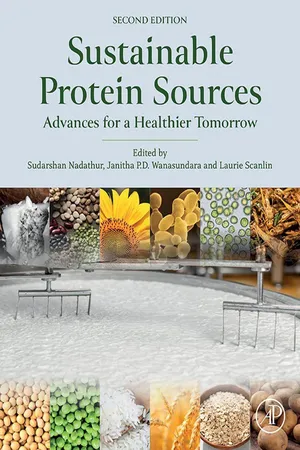
Sustainable Protein Sources
Advances for a Healthier Tomorrow
- 687 pages
- English
- ePUB (mobile friendly)
- Available on iOS & Android
eBook - ePub
Sustainable Protein Sources
Advances for a Healthier Tomorrow
About this book
Sustainable Protein Sources: Advances for a Healthier Tomorrow, Second Edition explores alternative proteins, including plant, fungal, algal and insect proteins that can take the place of meat as sustainable sources to satisfy human protein needs. This revised edition presents the benefits of plant and alternative protein consumption, including those that benefit the environment, population, and consumer trends and contains new chapters on potato protein, faba bean, chickpea, and coconut. Organized by protein, chapters also cover cereals and legumes, oilseeds, pseudocereals, fungi, algae, insects and fermentation-derived dairy and meat proteins paying particular attention to the nutrition, uses, functions, benefits, and challenges of each.
The book also explores ways to improve utilization and addresses everything from consumer acceptability, methods of improving the taste of products containing these proteins and ways in which policies can affect the use of alternate proteins. In addition, the book addresses sustainable protein as a pathway to securing the food supply and considers regenerative versus extractive agriculture alongside new methods in farming and water usage.
- Introduces the need to shift from animal-derived to plant-based protein and fermentation derived proteins
- Discusses nutritive values of each protein source and compares each alternate protein to more complete proteins
- Provides an overview of production, including processing, protein isolation, use cases and functionality
Information
Table of contents
- Title of Book
- Cover image
- Title page
- Table of Contents
- Copyright
- Dedication
- List of contributors
- Preface
- Acknowledgments
- Introduction
- Chapter 1 Proteins in Our Diet: Challenges in Feeding the Global Population
- Chapter 2 Soy Protein: Environmental Impacts, Production, Applications and Nutrition
- Chapter 3 Rice: A Source of Plant Protein with Many Valuable Processing Co-products
- Chapter 4 Proteins from Wheat: Sustainable Production and New Developments in Nutrition-Based and Functional Applications
- Chapter 5 Proteins from Sorghum and Millets
- Chapter 6 Protein From Oat: Structure, Processes, Functionality, and Nutrition
- Chapter 7 Pea—A Sustainable Vegetable Protein Crop
- Chapter 8 Faba Bean as a Sustainable Plant Protein Source
- Chapter 9 Chickpea Protein: Sustainable Production, Functionality, Modification, and Applications
- Chapter 10 Lentil: Revival of Poor Man’s Meat
- Chapter 11 Lupin: An Important Protein and Nutrient Source
- Chapter 12 Underutilized Protein Resources from African Legumes
- Chapter 13 Coconut: A Sustainable Source Providing Plant Protein and Several Coproducts
- Chapter 14 Proteins from Canola/Rapeseed—Current Status
- Chapter 15 Peanut as a Source of Sustainable Vegetable Protein-Processes and Applications
- Chapter 16 Hempseed (Cannabis sativa L.) Proteins: Composition, Structure, Enzymatic Modification, and Functional or Bioactive Properties
- Chapter 17 Flaxseed (Linum usitatissimum L.) for Protein Based Products
- Chapter 18 Sunflower as a Developing Plant Protein Source for Food
- Chapter 19 Quinoa as a Sustainable Protein Source: Production, Nutrition, and Processing
- Chapter 20 Sustainability, Processing, Applications, and International Trade of Amaranth Grain
- Chapter 21 Amaranth Part 2—Sustainable Crop for the 21st Century: Food Properties and Nutraceuticals for Improving Human Health
- Chapter 22 Chia—The New Golden Seed for the 21st Century: Nutraceutical Properties and Technological Uses
- Chapter 23 Potato: A Sustainable Source of Functional and Nutritional Proteins
- Chapter 24 Moringa Proteins: Nutrition, Functionality, and Applications
- Chapter 25 Edible Insects: a Neglected and Promising Food Source
- Chapter 26 Mycoprotein: A Healthy New Protein with a Low Environmental Impact
- Chapter 27 Fermotein®: A Novel Versatile Protein- and Fiber-Rich Food Ingredient Based on Fungal Fermentation
- Chapter 28 Microalgae: A Potential Opportunity for Proteins and Bioactive Compounds Destined for Food and Health Industry
- Chapter 29 Fermentation Farming: An Overview of the Technologies Driving the New Food Revolution
- Chapter 30 The Future of Sustainable Dairy
- Chapter 31 Flavors, Taste Preferences, and the Consumer: Taste Modulation and Influencing Change in Dietary Patterns for a Sustainable Earth
- Chapter 32 Feeding the Globe Nutritious Food in 2050: Obligations and Ethical Choices
- Index
Trusted by 375,005 students
Access to over 1.5 million titles for a fair monthly price.
Study more efficiently using our study tools.
Frequently asked questions
Yes, you can cancel anytime from the Subscription tab in your account settings on the Perlego website. Your subscription will stay active until the end of your current billing period. Learn how to cancel your subscription
No, books cannot be downloaded as external files, such as PDFs, for use outside of Perlego. However, you can download books within the Perlego app for offline reading on mobile or tablet. Learn how to download books offline
Perlego offers two plans: Essential and Complete
- Essential is ideal for learners and professionals who enjoy exploring a wide range of subjects. Access the Essential Library with 800,000+ trusted titles and best-sellers across business, personal growth, and the humanities. Includes unlimited reading time and Standard Read Aloud voice.
- Complete: Perfect for advanced learners and researchers needing full, unrestricted access. Unlock 1.5M+ books across hundreds of subjects, including academic and specialized titles. The Complete Plan also includes advanced features like Premium Read Aloud and Research Assistant.
We are an online textbook subscription service, where you can get access to an entire online library for less than the price of a single book per month. With over 1.5 million books across 990+ topics, we’ve got you covered! Learn about our mission
Look out for the read-aloud symbol on your next book to see if you can listen to it. The read-aloud tool reads text aloud for you, highlighting the text as it is being read. You can pause it, speed it up and slow it down. Learn more about Read Aloud
Yes! You can use the Perlego app on both iOS and Android devices to read anytime, anywhere — even offline. Perfect for commutes or when you’re on the go.
Please note we cannot support devices running on iOS 13 and Android 7 or earlier. Learn more about using the app
Please note we cannot support devices running on iOS 13 and Android 7 or earlier. Learn more about using the app
Yes, you can access Sustainable Protein Sources by Sudarshan Nadathur,Janitha P.D. Wanasundara,Laurie Scanlin in PDF and/or ePUB format, as well as other popular books in Technology & Engineering & Nutrition, Dietics & Bariatrics. We have over 1.5 million books available in our catalogue for you to explore.