eBook - ePub
Conceptual Breakthroughs in The Evolutionary Biology of Aging
- 288 pages
- English
- ePUB (mobile friendly)
- Available on iOS & Android
eBook - ePub
Conceptual Breakthroughs in The Evolutionary Biology of Aging
About this book
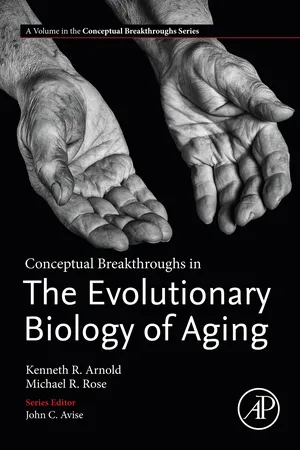
Conceptual Breakthroughs in the Evolutionary Biology of Aging continues the innovative Conceptual Breakthroughs series by providing a comprehensive outline of the major breakthroughs that built the evolutionary biology of aging as a leading scientific field. Following the evolutionary study of aging from its humble origins to the present, the book's chapters treat the field's breakthroughs one at a time. Users will find a concise and accessible analysis of the science of aging viewed through an evolutionary lens. Building upon widely-cited studies conducted by author Michael Rose, this book covers 30 subsequent years of growth and development within the field.The book highlights key publications for those who are not experts in the field, providing an important resource for researchers. Given the prevailing interest in changing the aging process dramatically, it is a powerful tool for readers who have a vested interest in understanding its causes and future control measures.
- Reviews cell-molecular theories of aging in the light of evolutionary biology
- Offers an evolutionary analysis of prospects for mitigating aging not commonly discussed within private and public sectors
- Provides readers with a radically different perspective on contemporary biological gerontology, specifically through the lens of evolutionary biology
Information
Table of contents
- Title of Book
- Cover image
- Title page
- Table of Contents
- Copyright
- Dedication
- Foreword from the Series Editor, John C. Avise
- Chapter One Introduction
- Chapter Two 384–322 B.C: The first biologist on aging
- Chapter Three 1645: A tale of two Bacons
- Chapter Four 1881: Natural selection is the ultimate determinant of aging
- Chapter Five 1922: Early laboratory experiments on demography
- Chapter Six 1928: Basic mathematics of selection with age-structure
- Chapter Seven 1930: First explanation of aging by age-specific patterns of selection
- Chapter Eight 1941: First proposal of the general idea of declining force of natural selection
- Chapter Nine 1946–57: Verbal hypotheses for the evolutionary genetics of aging
- Chapter Ten 1953: Absence of a Lansing effect in inbred Drosophila
- Chapter Eleven 1961: Presence of aging in a fish with continued adult growth
- Chapter Twelve 1966: Mathematical derivation of the forces of natural selection
- Chapter Thirteen 1960s: Falsification of the somatic mutation theory
- Chapter Fourteen 1960s: Falsification of the translation error catastrophe theory
- Chapter Fifteen 1968: Proposal of experimental designs to test evolutionary theories of aging
- Chapter Sixteen 1968: Accidental evolutionary postponement of aging
- Chapter Seventeen 1970: Experimental evolution of accelerated aging in Tribolium
- Chapter Eighteen 1970–74: Development of evolutionary genetics of age-structured populations
- Chapter Nineteen 1975: Application of Charlesworth's theory to the evolution of aging
- Chapter Twenty 1980: Full development of evolutionary genetic theory for aging
- Chapter Twenty One 1980–81: Quantitative genetic tests of hypotheses for the evolution of aging
- Chapter Twenty Two 1980–84: Mitigation of aging by postponing the decline in forces of natural selection
- Chapter Twenty Three 1977–1988: Characterization of Caenorhabditis elegans mutants with extended lifespan
- Chapter Twenty four 1982–85: Further mathematical characterization of evolution with antagonistic pleiotropy
- Chapter Twenty Five 1984: Genetic covariation is shifted to positive values by inbreeding
- Chapter Twenty Six 1984: Direct demonstration of nonaging in fissile species
- Chapter Twenty seven 1989: Additional experiments support antagonistic pleiotropy
- Chapter Twenty eight 1985: Genotype-by-environment interaction shown for aging
- Chapter Twenty nine 1985–onward: Evolutionary physiology of aging
- Chapter Thirty 1987: Accelerated senescence explained in terms of mutation accumulation with inbreeding depression
- Chapter Thirty one 1988: Reverse evolution of aging
- Chapter Thirty two 1985–88: Genetic analysis of aging in males
- Chapter Thirty three 1987–1991: Quantitative genetic analysis of how many genes determine aging
- Chapter Thirty four 1988: Evidence for senescence in the wild
- Chapter Thirty five 1989–onward: Molecular genetic variation at selected loci in the evolution of aging
- Chapter Thirty six 1988–89: The evolutionary logic of extending lifespan by dietary restriction
- Chapter Thirty seven 1992: Selection for stress resistance increases lifespan
- Chapter Thirty eight 1992: In late adult life, mortality rates stop increasing
- Chapter Thirty nine 1993–1995: Evolution of increased longevity among mammals, in the wild and the lab
- Chapter Forty 1993: Evolutionary physiology of dietary restriction
- Chapter Forty one 1993: Genetic association between dauer metabolic arrest and increased lifespan
- Chapter Forty two 1992–95: Experimental evolution of aging is connected to development
- Chapter Forty three 1994–96: Evidence for mutation accumulation affecting virility and aging
- Chapter Forty four 1996–98: Physiological research on evolution of aging supports organismal mechanisms
- Chapter Forty five 1996: Late-life mortality plateaus explained using evolutionary theory
- Chapter Forty six 1998–2003: Falsification of lifelong heterogeneity models for the cessation of aging
- Chapter Forty seven 1998–2000: Discovery of Drosophila mutants that sometimes increase longevity
- Chapter Forty eight 1999–2004: Nematode longevity mutants show antagonistic pleiotropy
- Chapter Forty nine 2002–06: Evolution of life-history fits evolutionary analysis of late life
- Chapter Fifty 2003–2005: Breakdown in correlations between stress resistance and aging
- Chapter Fifty one 2007–11: Development of demographic models that separate aging from dying
- Chapter Fifty two 2010: Studying the evolutionary origins of aging in bacteria
- Chapter Fifty three 2010: Genome-wide sequencing of evolved aging reveals many sites
- Chapter Fifty four 2011–19: Evolutionary transcriptomics also reveal complex physiology of aging
- Chapter Fifty five 2012: Late life is physiologically different from aging
- Chapter Fifty six 2014: Genomic studies of centenarians have low scientific power
- Chapter Fifty seven 2015: Evolutionary genetic effects produce two evolutionary biologies of aging
- Chapter Fifty eight 2016: Experimental evolution can produce nonaging young adults
- Chapter Fifty nine 2017: The heart is implicated in the evolution of aging
- Chapter Sixty 2020: Evolutionary adaptation to diet and its impact on healthspan
- Conclusion
- Glossary
- Author Index
- Index
Trusted by 375,005 students
Access to over 1.5 million titles for a fair monthly price.
Study more efficiently using our study tools.
Frequently asked questions
Yes, you can cancel anytime from the Subscription tab in your account settings on the Perlego website. Your subscription will stay active until the end of your current billing period. Learn how to cancel your subscription
No, books cannot be downloaded as external files, such as PDFs, for use outside of Perlego. However, you can download books within the Perlego app for offline reading on mobile or tablet. Learn how to download books offline
Perlego offers two plans: Essential and Complete
- Essential is ideal for learners and professionals who enjoy exploring a wide range of subjects. Access the Essential Library with 800,000+ trusted titles and best-sellers across business, personal growth, and the humanities. Includes unlimited reading time and Standard Read Aloud voice.
- Complete: Perfect for advanced learners and researchers needing full, unrestricted access. Unlock 1.5M+ books across hundreds of subjects, including academic and specialized titles. The Complete Plan also includes advanced features like Premium Read Aloud and Research Assistant.
We are an online textbook subscription service, where you can get access to an entire online library for less than the price of a single book per month. With over 1.5 million books across 990+ topics, we’ve got you covered! Learn about our mission
Look out for the read-aloud symbol on your next book to see if you can listen to it. The read-aloud tool reads text aloud for you, highlighting the text as it is being read. You can pause it, speed it up and slow it down. Learn more about Read Aloud
Yes! You can use the Perlego app on both iOS and Android devices to read anytime, anywhere — even offline. Perfect for commutes or when you’re on the go.
Please note we cannot support devices running on iOS 13 and Android 7 or earlier. Learn more about using the app
Please note we cannot support devices running on iOS 13 and Android 7 or earlier. Learn more about using the app
Yes, you can access Conceptual Breakthroughs in The Evolutionary Biology of Aging by Kenneth R. Arnold,Michael R. Rose, John C. Avise in PDF and/or ePUB format, as well as other popular books in Biological Sciences & Biology. We have over 1.5 million books available in our catalogue for you to explore.