- 500 pages
- English
- ePUB (mobile friendly)
- Available on iOS & Android
eBook - ePub
Resilience and Riverine Landscapes
About this book
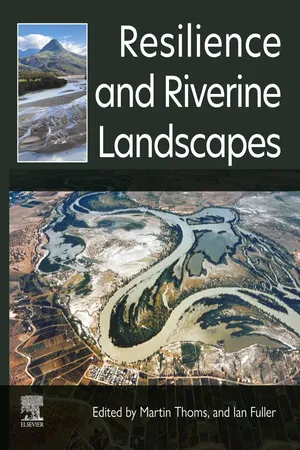
Resilience and Riverine Landscapes presents contributed chapters from global experts in Riverine Landscapes, making it the most comprehensive reference available on the topic. The book explores why rivers are ideal landscapes to study resilience and why studying rivers from a resilience perspective is important for our biophysical understanding of these landscapes and for society. The book focuses on the biophysical character of resilience in riverine landscapes, providing an interdisciplinary perspective of the structure, function, and interactions of riverine landscapes and the ecosystems they contain. The editors conclude by proposing a research agenda for the future, emphasizing the need for transdisciplinary research across a range of spatial and temporal scales and research domains.
- Presents the resilience of rivers with both a theoretical and applied focus
- Includes case studies from a wide geographical base, allowing for a full range of viewpoints
- Showcases how resilience is being incorporated into the study and management of riverine landscapes
- Includes a transdisciplinary focus on riverine landscapes, from theory to applied, and from biophysical to social-ecological systems
Information
Table of contents
- Resilience and Riverine Landscapes
- Cover
- Title Page
- Copyright Page
- Table of Contents
- Contributors
- Chapter 1 Riverine landscapes and resilience
- Chapter 2 The resilience of riverine ecological communities
- Chapter 3 Resilient floodplains in the Anthropocene
- Chapter 4 Understanding changing riverine landscapes: instability, thresholds, and tipping points
- Chapter 5 Resilience and adaptive cycles in water-dependent ecosystems: Can panarchy explain trajectories of change among floodplain trees?
- Chapter 6 Geomorphic meanings of a resilient river
- Chapter 7 Drought, disturbance and river resilience in the southern Murray–Darling Basin, Australia
- Chapter 8 Multiscale ecological resilience in braided rivers
- Chapter 9 Rivers and resilience: A longer term view from the drylands
- Chapter 10 The Anthropocene: Rivers and resilience
- Chapter 11 Invasion wave patterns testify to the resilience of river systems
- Chapter 12 Resilience of ecosystem services of a large river-floodplain complex: The Lower Mississippi River system
- Chapter 13 Resilience and the biophysical science of rivers
- Chapter 14 Sustainability and resilience for riverine landscapes
- Chapter 15 Neoliberalism, normativity and agency: constructive tensions in the application of resilience
- Chapter 16 Resilience, rivers and governance: Learning from experience
- Chapter 17 Fostering interactional resilience in social–ecological riverine landscapes: A case study from the Santa Fe River Watershed in New Mexico, US
- Chapter 18 Indigenous engagement to support resilience: A case study from Kamilaroi Country (NSW, Australia)
- Chapter 19 Emerging roles for finance in river restoration and resilience
- Chapter 20 Multi-scale and multi-level dynamics shape the resilience and sustainability of the Columbia River Basin, USA
- Chapter 21 Building resilience in South and Southeast Asian mega-deltas
- Chapter 22 Conceptualising resilience for river management
- Chapter 23 Flow management through a resilience lens: Allocation of an environmental water budget using the Functional Flows Adaptive Implementation Model
- Chapter 24 Resilience-based challenges and opportunities for fisheries management in Anthropocene rivers
- Chapter 25 A framework for river recovery in Anthropocene rivers undergoing regime shift: Application to the Upper Colorado River Endangered Fish Recovery Program
- Chapter 26 Slowing the flow for climate resilience in human-dominated riverine landscapes
- Chapter 27 Circumstances supporting the emergence, flourishing and decline of resilience planning in the Australian State of New South Wales
- Chapter 28 Applying resilience thinking to rehabilitating a novel social–ecological system: A case study from the lower Ok Tedi, Papua New Guinea
- Glossary of terms
- Index
Trusted by 375,005 students
Access to over 1.5 million titles for a fair monthly price.
Study more efficiently using our study tools.
Frequently asked questions
Yes, you can cancel anytime from the Subscription tab in your account settings on the Perlego website. Your subscription will stay active until the end of your current billing period. Learn how to cancel your subscription
No, books cannot be downloaded as external files, such as PDFs, for use outside of Perlego. However, you can download books within the Perlego app for offline reading on mobile or tablet. Learn how to download books offline
Perlego offers two plans: Essential and Complete
- Essential is ideal for learners and professionals who enjoy exploring a wide range of subjects. Access the Essential Library with 800,000+ trusted titles and best-sellers across business, personal growth, and the humanities. Includes unlimited reading time and Standard Read Aloud voice.
- Complete: Perfect for advanced learners and researchers needing full, unrestricted access. Unlock 1.5M+ books across hundreds of subjects, including academic and specialized titles. The Complete Plan also includes advanced features like Premium Read Aloud and Research Assistant.
We are an online textbook subscription service, where you can get access to an entire online library for less than the price of a single book per month. With over 1.5 million books across 990+ topics, we’ve got you covered! Learn about our mission
Look out for the read-aloud symbol on your next book to see if you can listen to it. The read-aloud tool reads text aloud for you, highlighting the text as it is being read. You can pause it, speed it up and slow it down. Learn more about Read Aloud
Yes! You can use the Perlego app on both iOS and Android devices to read anytime, anywhere — even offline. Perfect for commutes or when you’re on the go.
Please note we cannot support devices running on iOS 13 and Android 7 or earlier. Learn more about using the app
Please note we cannot support devices running on iOS 13 and Android 7 or earlier. Learn more about using the app
Yes, you can access Resilience and Riverine Landscapes by Martin Thoms,Ian Fuller in PDF and/or ePUB format, as well as other popular books in Technology & Engineering & Agriculture. We have over 1.5 million books available in our catalogue for you to explore.