- 276 pages
- English
- ePUB (mobile friendly)
- Available on iOS & Android
eBook - ePub
Multiscale Biomechanical Modeling of the Brain
About this book
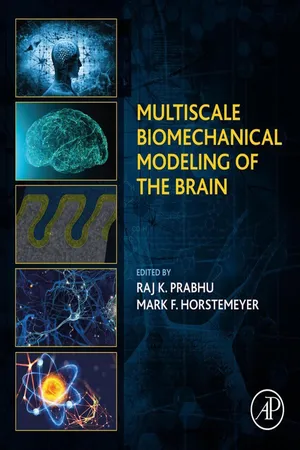
Multiscale Biomechanical Modeling of the Brain discusses the constitutive modeling of the brain at various length scales (nanoscale, microscale, mesoscale, macroscale and structural scale). In each scale, the book describes the state-of-the- experimental and computational tools used to quantify critical deformational information at each length scale. Then, at the structural scale, several user-based constitutive material models are presented, along with real-world boundary value problems. Lastly, design and optimization concepts are presented for use in occupant-centric design frameworks. This book is useful for both academia and industry applications that cover basic science aspects or applied research in head and brain protection.The multiscale approach to this topic is unique, and not found in other books. It includes meticulously selected materials that aim to connect the mechanistic analysis of the brain tissue at size scales ranging from subcellular to organ levels.
- Presents concepts in a theoretical and thermodynamic framework for each length scale
- Teaches readers not only how to use an existing multiscale model for each brain but also how to develop a new multiscale model
- Takes an integrated experimental-computational approach and gives structured multiscale coverage of the problems
Information
Table of contents
- Title of Book
- Cover image
- Title page
- Table of Contents
- Copyright
- Table of Contents
- Contributors
- Preface
- Chapter 1 The multiscale nature of the brain and traumatic brain injury
- Chapter 2 Introduction to multiscale modeling of the human brain
- Chapter 3 Density functional theory and bridging to classical interatomic force fields
- Chapter 4 Modeling nanoscale cellular structures using molecular dynamics
- Chapter 5 Microscale mechanical modeling of brain neuron(s) and axon(s)
- Chapter 6 Mesoscale finite element modeling of brain structural heterogeneities and geometrical complexities
- Chapter 7 Modeling mesoscale anatomical structures in macroscale brain finite element models
- Chapter 8 A macroscale mechano-physiological internal state variable (MPISV) model for neuronal membrane damage with subscale microstructural effects
- Chapter 9 MRE-based modeling of head trauma
- Chapter 10 Robust concept exploration of driver’s side vehicular impacts for human-centric crashworthiness
- Chapter 11 Development of a coupled physical–computational methodology for the investigation of infant head injury
- Chapter 12 Experimental data for validating the structural response of computational brain models
- Chapter 13 A review of fluid flow in and around the brain, modeling, and abnormalities
- Chapter 14 Resonant frequencies of a human brain, skull, and head
- Chapter 15 State-of-the-art of multiscale modeling of mechanical impacts to the human brain
- Index
Trusted by 375,005 students
Access to over 1.5 million titles for a fair monthly price.
Study more efficiently using our study tools.
Frequently asked questions
Yes, you can cancel anytime from the Subscription tab in your account settings on the Perlego website. Your subscription will stay active until the end of your current billing period. Learn how to cancel your subscription
No, books cannot be downloaded as external files, such as PDFs, for use outside of Perlego. However, you can download books within the Perlego app for offline reading on mobile or tablet. Learn how to download books offline
Perlego offers two plans: Essential and Complete
- Essential is ideal for learners and professionals who enjoy exploring a wide range of subjects. Access the Essential Library with 800,000+ trusted titles and best-sellers across business, personal growth, and the humanities. Includes unlimited reading time and Standard Read Aloud voice.
- Complete: Perfect for advanced learners and researchers needing full, unrestricted access. Unlock 1.5M+ books across hundreds of subjects, including academic and specialized titles. The Complete Plan also includes advanced features like Premium Read Aloud and Research Assistant.
We are an online textbook subscription service, where you can get access to an entire online library for less than the price of a single book per month. With over 1.5 million books across 990+ topics, we’ve got you covered! Learn about our mission
Look out for the read-aloud symbol on your next book to see if you can listen to it. The read-aloud tool reads text aloud for you, highlighting the text as it is being read. You can pause it, speed it up and slow it down. Learn more about Read Aloud
Yes! You can use the Perlego app on both iOS and Android devices to read anytime, anywhere — even offline. Perfect for commutes or when you’re on the go.
Please note we cannot support devices running on iOS 13 and Android 7 or earlier. Learn more about using the app
Please note we cannot support devices running on iOS 13 and Android 7 or earlier. Learn more about using the app
Yes, you can access Multiscale Biomechanical Modeling of the Brain by Mark F. Horstemeyer,Raj K. Prabhu in PDF and/or ePUB format, as well as other popular books in Technology & Engineering & Engineering General. We have over 1.5 million books available in our catalogue for you to explore.