- 266 pages
- English
- ePUB (mobile friendly)
- Available on iOS & Android
About this book
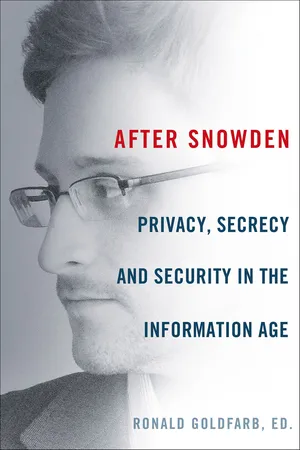
Seven previously unpublished essays exploring the ramifications of NSA whistleblower Edward Snowden's actions on our lives today.
"These essays point to the need to put in place now, while we are still somewhat rational on the subject, real standards, tests, and consequences that will sufficiently reward the right kinds of disclosures about our national intelligence system, while deterring the wrong kinds." ?Anne Richardson, Los Angeles Review of Books
Was Edward Snowden a patriot or a traitor? Just how far do American privacy rights extend? And how far is too far when it comes to government secrecy in the name of security? These are just a few of the questions that have dominated American consciousness since Edward Snowden exposed the breath of the NSA's domestic surveillance program.
In these seven previously unpublished essays, a group of prominent legal and political experts delve in to life After Snowden, examining the ramifications of the infamous leak from multiple angles:
• Washington lawyer and literary agent RONALD GOLDFARB acts as the book's editor and provides an introduction outlining the many debates sparked by the Snowden leaks.
• Pulitzer Prize–winning journalist BARRY SIEGEL analyses the role of the state secrets provision in the judicial system.
• Former Assistant Secretary of State HODDING CARTER explores whether the press is justified in unearthing and publishing classified information.
• Ethics expert and dean of the UC Berkley School of Journalism EDWARD WASSERMAN discusses the uneven relationship between journalists and whistleblowers.
• Georgetown Law Professor DAVID COLE addresses the motives and complicated legacy of Snowden and other leakers.
• Director of the National Security Archive THOMAS BLANTON looks at the impact of the Snowden leaks on the classification of government documents.
• Dean of the University of Florida Law School JON MILLS addresses the constitutional right to privacy and the difficulties of applying it in the digital age.
"Readers interested in the legal, political, and journalistic ramifications of national security leaks, including students in these areas, will find these essays accessible and discover much to consider in them." ?Amanda Mastrull, Library Journal
Frequently asked questions
- Essential is ideal for learners and professionals who enjoy exploring a wide range of subjects. Access the Essential Library with 800,000+ trusted titles and best-sellers across business, personal growth, and the humanities. Includes unlimited reading time and Standard Read Aloud voice.
- Complete: Perfect for advanced learners and researchers needing full, unrestricted access. Unlock 1.4M+ books across hundreds of subjects, including academic and specialized titles. The Complete Plan also includes advanced features like Premium Read Aloud and Research Assistant.
Please note we cannot support devices running on iOS 13 and Android 7 or earlier. Learn more about using the app.
Information
Table of contents
- Cover
- Title Page
- Copyright Notice
- 1. Introduction by Ronald Goldfarb
- 2. The Press by Hodding Carter III
- 3. Protecting News in the Era of Disruptive Sources by Edward Wasserman
- 4. What Should We Do About the Leakers? by David Cole
- 5. Judging State Secrets: Who Decides—And How? by Barry Siegel
- 6. The Future of Privacy in the Surveillance Age by Jon L. Mills
- 7. Secrecy, Surveillance, and the Snowden Effect by Thomas Blanton
- 8. Epilogue by Ronald Goldfarb
- Notes
- Acknowledgments
- About the Editor
- Newsletter Sign-up
- Contents
- Copyright