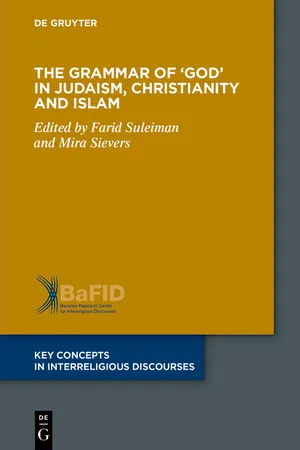
Engendering an intimate and deep relationship with God is at the heart of Judaism, Christianity and Islam. This relationship manifests, among other things, in worshipping Him with sincerity, talking to (and about) Him, and being conscious of Him in every moment of life. For believers, God himself plays also an active role in pursuing this relationship by, for example, answering prayers and making the believer know and feel His uninterrupted presence. Many would consider this as common knowledge about the religions mentioned above. However, only few are aware that the meaning of the above differs significantly based on how one thinks that religious language works. Rather, it is taken for granted that the word 'God' refers to a metaphysical being with personal traits and plays a similar role in structure as words in empirical language. This has several implications such as the following: God can be talked about in an abstract and theoretical manner; His existence can be subject to inquiry like that of any other being such as planets or unicorns; and calling God good, while creation is obviously full of evil, is a proposition that needs rational justification. The famous 20th century thinker Ludwig Wittgenstein has famously stated that his goal in philosophy essentially amounts to "showing that things which look the same are really different". By his insistence to pay close attention to the grammar of a word – that is its use in language – he has opened up new perspectives on (not only religious) language that challenges the prevalent view outlined above. The goal of this volume is to pick up on Wittgenstein's insights about language and religion and to bring them in fruitful relation to the three mentioned religious traditions respectively in an attempt to reassess the grammar of the word 'God'.
eBook - ePub
The Grammar of ‘God’ in Judaism, Christianity and Islam
- 125 pages
- English
- ePUB (mobile friendly)
- Available on iOS & Android
eBook - ePub
The Grammar of ‘God’ in Judaism, Christianity and Islam
About this book
Information
Subtopic
Théologie chrétienneTable of contents
- Title Page
- Copyright
- Contents
- Introduction Jewish-Christian-Islamic Encounters through Wittgenstein’s Lens: Bridging the Gap between Religious Language and Theology
- “An Equation Entirely Unlike Any of the Familiar Curves”: Wittgenstein on the Grammar of “God,” the Trinity, and the Meaning of Religious Language
- Wittgenstein and the Rabbinic Grammar of God’s Name
- The Grammar of “God” – Muslim Perspectives
- Epilogue
- Index of Persons
- Index of Subjects
Trusted by 375,005 students
Access to over 1.5 million titles for a fair monthly price.
Study more efficiently using our study tools.
Frequently asked questions
Yes, you can cancel anytime from the Subscription tab in your account settings on the Perlego website. Your subscription will stay active until the end of your current billing period. Learn how to cancel your subscription
No, books cannot be downloaded as external files, such as PDFs, for use outside of Perlego. However, you can download books within the Perlego app for offline reading on mobile or tablet. Learn how to download books offline
Perlego offers two plans: Essential and Complete
- Essential is ideal for learners and professionals who enjoy exploring a wide range of subjects. Access the Essential Library with 800,000+ trusted titles and best-sellers across business, personal growth, and the humanities. Includes unlimited reading time and Standard Read Aloud voice.
- Complete: Perfect for advanced learners and researchers needing full, unrestricted access. Unlock 1.5M+ books across hundreds of subjects, including academic and specialized titles. The Complete Plan also includes advanced features like Premium Read Aloud and Research Assistant.
We are an online textbook subscription service, where you can get access to an entire online library for less than the price of a single book per month. With over 1.5 million books across 990+ topics, we’ve got you covered! Learn about our mission
Look out for the read-aloud symbol on your next book to see if you can listen to it. The read-aloud tool reads text aloud for you, highlighting the text as it is being read. You can pause it, speed it up and slow it down. Learn more about Read Aloud
Yes! You can use the Perlego app on both iOS and Android devices to read anytime, anywhere — even offline. Perfect for commutes or when you’re on the go.
Please note we cannot support devices running on iOS 13 and Android 7 or earlier. Learn more about using the app
Please note we cannot support devices running on iOS 13 and Android 7 or earlier. Learn more about using the app
Yes, you can access The Grammar of ‘God’ in Judaism, Christianity and Islam by Farid Suleiman, Mira Sievers, Farid Suleiman,Mira Sievers in PDF and/or ePUB format, as well as other popular books in Théologie et religion & Théologie chrétienne. We have over 1.5 million books available in our catalogue for you to explore.