eBook - ePub
Mid-century women's writing
Disrupting the public/private divide
- 242 pages
- English
- ePUB (mobile friendly)
- Available on iOS & Android
eBook - ePub
Mid-century women's writing
Disrupting the public/private divide
About this book
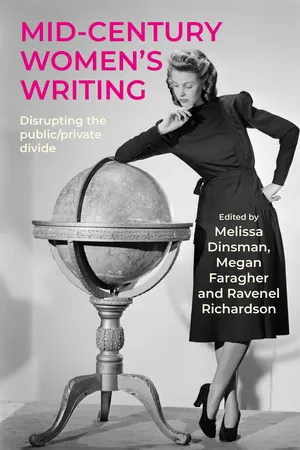
The traditional narrative of the mid-century (1930s-60s) is that of a wave of expansion and constriction, with the swelling of economic and political freedoms for women in the 1930s, the cresting of women in the public sphere during the Second World War, and the resulting break as employment and political opportunities for women dwindled in the 1950s when men returned home from the front. But as the burgeoning field of interwar and mid-century women's writing has demonstrated, this narrative is in desperate need of re-examination. Mid-century women's writing: Disrupting the public/private divide aims to revivify studies of female writers, journalists, broadcasters, and public intellectuals living or working in Britain, or under British rule, during the mid-century while also complicating extant narratives about the divisions between domesticity and politics.
Information
Table of contents
- Cover
- Half-Title
- Title
- Copyright
- Contents
- Introduction: politicizing the domestic and domesticizing politics
- Part I: Professionalizing the domestic
- Introduction to Part I
- 1 Professional identity and personal space in Mary Renault’s Kind Are Her Answers and Return to Night
- 2 Talking shop: Celia Fremlin and invisible work
- 3 ‘Some thoroughly tiresome housekeeping crisis’: Rebecca West’s wartime journalism
- 4 ‘Coldly kind’: calculated care in post-war British women’s writing
- Part II: Nationalizing gender politics
- Introduction to Part II
- 5 New world women and the Labour Party win in Marghanita Laski’s The Village
- 6 Beyond ‘companionate marriage’: Elizabeth Taylor’s gendered critique of post-war consensus in A View of the Harbour and A Wreath of Roses
- 7 Dissident friendship and revolutionary love in the novels of Sabitri Roy and Sulekha Sanyal
- 8 ‘The political theory of heaven’: religious nationalism, mystical anarchism, and the Spanish Civil War in Sylvia Townsend Warner’s After the Death of Don Juan
- Part III: Women beyond the nation
- Introduction to Part III
- 9 ‘A woman is always a woman!’: British women writers and refugees
- 10 Families in a time of catastrophe: Anna Gmeyner’s Manja, 1920–33
- 11 ‘Some other land, some other sea’: Attia Hosain’s fiction and non-fiction in Distant Traveller
- Bibliography
- Index
Trusted by 375,005 students
Access to over 1.5 million titles for a fair monthly price.
Study more efficiently using our study tools.
Frequently asked questions
Yes, you can cancel anytime from the Subscription tab in your account settings on the Perlego website. Your subscription will stay active until the end of your current billing period. Learn how to cancel your subscription
No, books cannot be downloaded as external files, such as PDFs, for use outside of Perlego. However, you can download books within the Perlego app for offline reading on mobile or tablet. Learn how to download books offline
Perlego offers two plans: Essential and Complete
- Essential is ideal for learners and professionals who enjoy exploring a wide range of subjects. Access the Essential Library with 800,000+ trusted titles and best-sellers across business, personal growth, and the humanities. Includes unlimited reading time and Standard Read Aloud voice.
- Complete: Perfect for advanced learners and researchers needing full, unrestricted access. Unlock 1.5M+ books across hundreds of subjects, including academic and specialized titles. The Complete Plan also includes advanced features like Premium Read Aloud and Research Assistant.
We are an online textbook subscription service, where you can get access to an entire online library for less than the price of a single book per month. With over 1.5 million books across 990+ topics, we’ve got you covered! Learn about our mission
Look out for the read-aloud symbol on your next book to see if you can listen to it. The read-aloud tool reads text aloud for you, highlighting the text as it is being read. You can pause it, speed it up and slow it down. Learn more about Read Aloud
Yes! You can use the Perlego app on both iOS and Android devices to read anytime, anywhere — even offline. Perfect for commutes or when you’re on the go.
Please note we cannot support devices running on iOS 13 and Android 7 or earlier. Learn more about using the app
Please note we cannot support devices running on iOS 13 and Android 7 or earlier. Learn more about using the app
Yes, you can access Mid-century women's writing by Melissa Dinsman,Megan Faragher,Ravenel Richardson in PDF and/or ePUB format, as well as other popular books in Literature & English Literary Criticism. We have over 1.5 million books available in our catalogue for you to explore.