eBook - ePub
Environmental, Physiological and Chemical Controls of Adventitious Rooting in Cuttings
- 495 pages
- English
- ePUB (mobile friendly)
- Available on iOS & Android
eBook - ePub
Environmental, Physiological and Chemical Controls of Adventitious Rooting in Cuttings
About this book
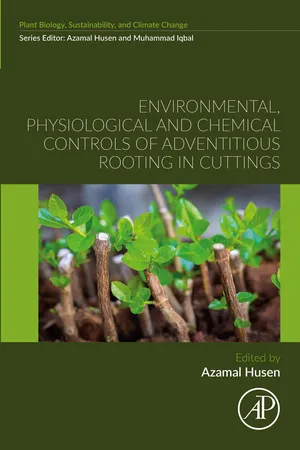
Environmental, Physiological and Chemical Controls of Adventitious Rooting in Cuttings provides a review of the environmental, physiological and chemical controls of adventitious rooting in cuttings obtained from plants. In plants, adventitious roots, which are highly useful for vegetative propagation (or clonal propagation) are produced mainly from leaves, hypocotyls, stems or shoots. Vegetative propagation may occur naturally by using propagules such as roots, underground and aerial stems, leaves, buds and bulbils. It may also be done artificially through regenerative organs (rhizomes, bulbs, and corms) and by utilizing specialized methods, like cutting, grafting and layering. This book covers the latest tactics surrounding these processes.
As a plethora of factors affect the adventitious rooting of cuttings, adding to the complexity of the phenomenon. The main factors which control adventitious root formation are types of cuttings, presence of leaf area on cuttings, types of hormones and their concentration, duration of hormonal treatment (quick dip, long soak, dry dip, spray dip, or total immerse method), maturation (juvenile or mature), genotype, explant position, and more, all of which are discussed here.
- Provides a comprehensive and exclusive book on the environmental, physiological and chemical factors associated with adventitious root formation in cutting, with up-to-date literature and lucid illustrations
- Presents a multidimensional approach and a broad range of explanation on adventitious root formation associated with mature and juvenile cutting
- Discusses a number of molecular, histological and physiological markers associated with adventitious root formation in numerous plant species
- Elaborates on how external and internal factors control the cell/tissue initiation, differentiation and overall adventitious root formation in cutting
Information
Table of contents
- Title of Book
- Cover image
- Title page
- Table of Contents
- Copyright
- Dedication
- Contributors
- About the editor
- Preface
- Chapter 1 Physiological and environmental control of adventitious root formation in cuttings: An overview
- Chapter 2 Molecular control of adventitious root formation
- Natural variation in adventitious root formation
- Chapter 4 Wound response and primary metabolism during adventitious root formation in cuttings
- Chapter 5 Revisiting the anatomical changes during adventitious root formation in cuttings
- Chapter 6 Metabolism during adventitious root primordia initiation and development
- Chapter 7 Role of plant growth-promoting Rhizobacterium in adventitious root formation
- Chapter 8 Adventitious root formation after cuttings and its regulation by transcriptome analysis
- Chapter 9 Role of various auxins in adventitious root formation
- Chapter 10 Role of cytokinins in adventitious root formation
- Chapter 11 Role of phenolic compounds in adventitious root formation
- Chapter 12 Role of polyamines in adventitious root formation
- Chapter 13 Role of hydrogen peroxide in adventitious root formation
- Chapter 14 Role of nitric oxide in adventitious root formation
- Chapter 15 Strigolactones: A new player in regulating adventitious root formation
- Chapter 16 Role of plant stem or shoot cutting positions and hormone treatments in adventitious root formation
- Chapter 17 Adventitious root formation in cuttings as influenced by genotypes, leaf area, and types of cuttings
- Chapter 18 Adventitious root formation in cuttings and effects of maturation
- Chapter 19 Micropropagation in mature trees by manipulation of phase change, stress, and culture environment
- Chapter 20 In vitro micrografting to induce juvenility and improvement of rooting
- Chapter 21 Adventitious root formation in ornamental and horticulture plants
- Chapter 22 Adventitious root formation and clonal propagation of forest-based tree species
- Index
Trusted by 375,005 students
Access to over 1.5 million titles for a fair monthly price.
Study more efficiently using our study tools.
Frequently asked questions
Yes, you can cancel anytime from the Subscription tab in your account settings on the Perlego website. Your subscription will stay active until the end of your current billing period. Learn how to cancel your subscription
No, books cannot be downloaded as external files, such as PDFs, for use outside of Perlego. However, you can download books within the Perlego app for offline reading on mobile or tablet. Learn how to download books offline
Perlego offers two plans: Essential and Complete
- Essential is ideal for learners and professionals who enjoy exploring a wide range of subjects. Access the Essential Library with 800,000+ trusted titles and best-sellers across business, personal growth, and the humanities. Includes unlimited reading time and Standard Read Aloud voice.
- Complete: Perfect for advanced learners and researchers needing full, unrestricted access. Unlock 1.5M+ books across hundreds of subjects, including academic and specialized titles. The Complete Plan also includes advanced features like Premium Read Aloud and Research Assistant.
We are an online textbook subscription service, where you can get access to an entire online library for less than the price of a single book per month. With over 1.5 million books across 990+ topics, we’ve got you covered! Learn about our mission
Look out for the read-aloud symbol on your next book to see if you can listen to it. The read-aloud tool reads text aloud for you, highlighting the text as it is being read. You can pause it, speed it up and slow it down. Learn more about Read Aloud
Yes! You can use the Perlego app on both iOS and Android devices to read anytime, anywhere — even offline. Perfect for commutes or when you’re on the go.
Please note we cannot support devices running on iOS 13 and Android 7 or earlier. Learn more about using the app
Please note we cannot support devices running on iOS 13 and Android 7 or earlier. Learn more about using the app
Yes, you can access Environmental, Physiological and Chemical Controls of Adventitious Rooting in Cuttings by Azamal Husen in PDF and/or ePUB format, as well as other popular books in Biological Sciences & Botany. We have over 1.5 million books available in our catalogue for you to explore.