eBook - ePub
Data Science for COVID-19 Volume 1
Computational Perspectives
- 752 pages
- English
- ePUB (mobile friendly)
- Available on iOS & Android
eBook - ePub
Data Science for COVID-19 Volume 1
Computational Perspectives
About this book
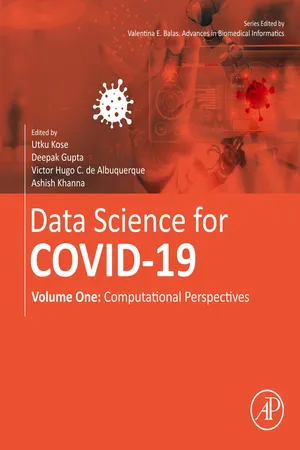
Data Science for COVID-19 presents leading-edge research on data science techniques for the detection, mitigation, treatment and elimination of COVID-19. Sections provide an introduction to data science for COVID-19 research, considering past and future pandemics, as well as related Coronavirus variations. Other chapters cover a wide range of Data Science applications concerning COVID-19 research, including Image Analysis and Data Processing, Geoprocessing and tracking, Predictive Systems, Design Cognition, mobile technology, and telemedicine solutions. The book then covers Artificial Intelligence-based solutions, innovative treatment methods, and public safety. Finally, readers will learn about applications of Big Data and new data models for mitigation.
- Provides a leading-edge survey of Data Science techniques and methods for research, mitigation and treatment of the COVID-19 virus
- Integrates various Data Science techniques to provide a resource for COVID-19 researchers and clinicians around the world, including both positive and negative research findings
- Provides insights into innovative data-oriented modeling and predictive techniques from COVID-19 researchers
- Includes real-world feedback and user experiences from physicians and medical staff from around the world on the effectiveness of applied Data Science solutions
Information
Table of contents
- Data Science for COVID-19
- Chapter 1 Predictive models to the COVID-19
- Chapter 2 An artificial intelligence–based decision support and resource management system for COVID-19 pandemic
- Chapter 3 Normalizing images is good to improve computer-assisted COVID-19 diagnosis
- Chapter 4 Detection and screening of COVID-19 through chest computed tomography radiographs using deep neural networks.
- Chapter 5 Differential evolution to estimate the parameters of a SEIAR model with dynamic social distancing
- Chapter 6 Limitations and challenges on the diagnosis of COVID-19 using radiology images and deep learning
- Chapter 7 Deep convolutional neural network–based image classification for COVID-19 diagnosis
- Chapter 8 Statistical machine learning forecasting simulation for discipline prediction and cost estimation of COVID-19 pandemic
- Chapter 9 Application of machine learning for the diagnosis of COVID-19
- Chapter 10 PwCOV in cluster-based web server
- Chapter 11 COVID-19–affected medical image analysis using DenserNet
- Chapter 12 uTakeCare
- Chapter 13 COVID-19 detection from chest X-rays using transfer learning with deep convolutional neural networks
- Chapter 14 Lexicon-based sentiment analysis using Twitter data
- Chapter 15 Real-time social distance alerting and contact tracing using image processing
- Chapter 16 Machine-learning models for predicting survivability in COVID-19 patients
- Chapter 17 Robust and secured telehealth system for COVID-19 patients
- Chapter 18 A novel approach to predict COVID-19 using support vector machine
- Chapter 19 An ensemble predictive analytics of COVID-19 infodemic tweets using bag of words
- Chapter 20 Forecast and prediction of COVID-19 using machine learning
- Chapter 21 Time series analysis of the COVID-19 pandemic in Australia using genetic programming
- Chapter 22 Image analysis and data processing for COVID-19
- Chapter 23 A demystifying convolutional neural networks using Grad-CAM for prediction of coronavirus disease (COVID-19) on X-ray images
- Chapter 24 Transfer learning-based convolutional neural network for COVID-19 detection with X-ray images
- Chapter 25 Computational modeling of the pharmacological actions of some antiviral agents against SARS-CoV-2
- Chapter 26 Received signal strength indication—based COVID-19 mobile application to comply with social distancing using bluetooth signals from smartphones
- Chapter 27 COVID-19 pandemic in India
- Chapter 28 Mathematical recipe for curbing coronavirus (COVID-19) transmition dynamics
- Chapter 29 Sliding window time series forecasting with multilayer perceptron and multiregression of COVID-19 outbreak in Malaysia
- Chapter 30 A two-level deterministic reasoning pattern to curb the spread of COVID-19 in Africa
- Chapter 31 Data-driven approach to COVID-19 infection forecast for Nigeria using negative binomial regression model
- Chapter 32 A novel machine learning–based detection and diagnosis model for coronavirus disease (COVID-19) using discrete wavelet transform with rough neural network
- Chapter 33 Artificial intelligence–based solutions for early identification and classification of COVID-19 and acute respiratory distress syndrome
- Chapter 34 Internet of Medical Things (IoMT) with machine learning–based COVID-19 diagnosis model using chest X-ray images
- Chapter 35 The growth of COVID-19 in Spain. A view based on time-series forecasting methods
- Chapter 36 On privacy enhancement using u-indistinguishability to COVID-19 contact tracing approach in Korea
- Chapter 37 Scheduling shuttle ambulance vehicles for COVID-19 quarantine cases, a multi-objective multiple 0–1 knapsack model with a novel Discrete Binary Gaining-Sharing knowledge-based optimization algorithm
- Index
Trusted by 375,005 students
Access to over 1.5 million titles for a fair monthly price.
Study more efficiently using our study tools.
Frequently asked questions
Yes, you can cancel anytime from the Subscription tab in your account settings on the Perlego website. Your subscription will stay active until the end of your current billing period. Learn how to cancel your subscription
No, books cannot be downloaded as external files, such as PDFs, for use outside of Perlego. However, you can download books within the Perlego app for offline reading on mobile or tablet. Learn how to download books offline
Perlego offers two plans: Essential and Complete
- Essential is ideal for learners and professionals who enjoy exploring a wide range of subjects. Access the Essential Library with 800,000+ trusted titles and best-sellers across business, personal growth, and the humanities. Includes unlimited reading time and Standard Read Aloud voice.
- Complete: Perfect for advanced learners and researchers needing full, unrestricted access. Unlock 1.5M+ books across hundreds of subjects, including academic and specialized titles. The Complete Plan also includes advanced features like Premium Read Aloud and Research Assistant.
We are an online textbook subscription service, where you can get access to an entire online library for less than the price of a single book per month. With over 1.5 million books across 990+ topics, we’ve got you covered! Learn about our mission
Look out for the read-aloud symbol on your next book to see if you can listen to it. The read-aloud tool reads text aloud for you, highlighting the text as it is being read. You can pause it, speed it up and slow it down. Learn more about Read Aloud
Yes! You can use the Perlego app on both iOS and Android devices to read anytime, anywhere — even offline. Perfect for commutes or when you’re on the go.
Please note we cannot support devices running on iOS 13 and Android 7 or earlier. Learn more about using the app
Please note we cannot support devices running on iOS 13 and Android 7 or earlier. Learn more about using the app
Yes, you can access Data Science for COVID-19 Volume 1 by Utku Kose,Deepak Gupta,Victor Hugo Costa de Albuquerque,Ashish Khanna in PDF and/or ePUB format, as well as other popular books in Biological Sciences & Biotechnology. We have over 1.5 million books available in our catalogue for you to explore.