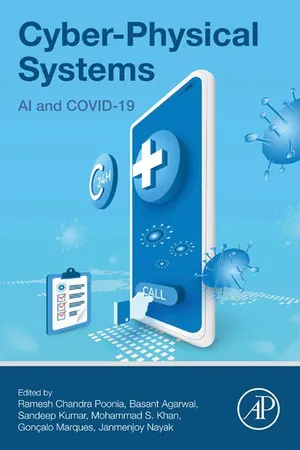
eBook - ePub
Cyber-Physical Systems
AI and COVID-19
- 260 pages
- English
- ePUB (mobile friendly)
- Available on iOS & Android
eBook - ePub
Cyber-Physical Systems
AI and COVID-19
About this book
Cyber-Physical Systems: AI and COVID-19 highlights original research which addresses current data challenges in terms of the development of mathematical models, cyber-physical systems-based tools and techniques, and the design and development of algorithmic solutions, etc. It reviews the technical concepts of gathering, processing and analyzing data from cyber-physical systems (CPS) and reviews tools and techniques that can be used. This book will act as a resource to guide COVID researchers as they move forward with clinical and epidemiological studies on this outbreak, including the technical concepts of gathering, processing and analyzing data from cyber-physical systems (CPS).
The major problem in the identification of COVID-19 is detection and diagnosis due to non-availability of medicine. In this situation, only one method, Reverse Transcription Polymerase Chain Reaction (RT-PCR) has been widely adopted and used for diagnosis. With the evolution of COVID-19, the global research community has implemented many machine learning and deep learning-based approaches with incremental datasets. However, finding more accurate identification and prediction methods are crucial at this juncture.
- Offers perspectives on the design, development and commissioning of intelligent applications
- Provides reviews on the latest intelligent technologies and algorithms related to the state-of-the-art methodologies of monitoring and mitigation of COVID-19
- Puts forth insights on how future illnesses can be supported using intelligent corona virus monitoring techniques
Information
Table of contents
- Title of Book
- Cover image
- Title page
- Table of Contents
- Copyright
- List of contributors
- Chapter 1 AI-based implementation of decisive technology for prevention and fight with COVID-19
- Chapter 2 Internet of Things-based smart helmet to detect possible COVID-19 infections
- Chapter 3 Role of mobile health in the situation of COVID-19 pandemics: pros and cons
- Chapter 4 Combating COVID-19 using object detection techniques for next-generation autonomous systems
- Chapter 5 Non-contact measurement system for COVID-19 vital signs to aid mass screening—An alternate approach
- Chapter 6 Evolving uncertainty in healthcare service interactions during COVID-19: Artificial Intelligence - a threat or support to value cocreation?
- Chapter 7 The COVID-19 outbreak: social media sentiment analysis of public reactions with a multidimensional perspective
- Chapter 8 A new approach to predict COVID-19 using artificial neural networks
- Chapter 9 Rapid medical guideline systems for COVID-19 using database-centric modeling and validation of cyber-physical systems
- Chapter 10 Machine learning and security in Cyber Physical Systems
- Chapter 11 Impact analysis of COVID-19 news headlines on global economy
- Chapter 12 Impact of COVID-19: a particular focus on Indian education system
- Chapter 13 Designing of Latent Dirichlet Allocation Based Prediction Model to Detect Midlife Crisis of Losing Jobs due to Prolonged Lockdown for COVID-19
- Chapter 14 Autonomous robotic system for ultraviolet disinfection
- Chapter 15 Emerging health start-ups for economic feasibility: opportunities during COVID-19
- Index
Trusted by 375,005 students
Access to over 1.5 million titles for a fair monthly price.
Study more efficiently using our study tools.
Frequently asked questions
Yes, you can cancel anytime from the Subscription tab in your account settings on the Perlego website. Your subscription will stay active until the end of your current billing period. Learn how to cancel your subscription
No, books cannot be downloaded as external files, such as PDFs, for use outside of Perlego. However, you can download books within the Perlego app for offline reading on mobile or tablet. Learn how to download books offline
Perlego offers two plans: Essential and Complete
- Essential is ideal for learners and professionals who enjoy exploring a wide range of subjects. Access the Essential Library with 800,000+ trusted titles and best-sellers across business, personal growth, and the humanities. Includes unlimited reading time and Standard Read Aloud voice.
- Complete: Perfect for advanced learners and researchers needing full, unrestricted access. Unlock 1.5M+ books across hundreds of subjects, including academic and specialized titles. The Complete Plan also includes advanced features like Premium Read Aloud and Research Assistant.
We are an online textbook subscription service, where you can get access to an entire online library for less than the price of a single book per month. With over 1.5 million books across 990+ topics, we’ve got you covered! Learn about our mission
Look out for the read-aloud symbol on your next book to see if you can listen to it. The read-aloud tool reads text aloud for you, highlighting the text as it is being read. You can pause it, speed it up and slow it down. Learn more about Read Aloud
Yes! You can use the Perlego app on both iOS and Android devices to read anytime, anywhere — even offline. Perfect for commutes or when you’re on the go.
Please note we cannot support devices running on iOS 13 and Android 7 or earlier. Learn more about using the app
Please note we cannot support devices running on iOS 13 and Android 7 or earlier. Learn more about using the app
Yes, you can access Cyber-Physical Systems by Ramesh Chandra Poonia,Basant Agarwal,Sandeep Kumar,Mohammad S. Khan,Goncalo Marques,Janmenjoy Nayak in PDF and/or ePUB format, as well as other popular books in Technology & Engineering & Artificial Intelligence (AI) & Semantics. We have over 1.5 million books available in our catalogue for you to explore.