eBook - ePub
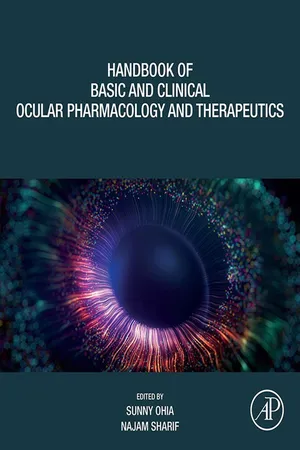
Handbook of Basic and Clinical Ocular Pharmacology and Therapeutics
- 647 pages
- English
- ePUB (mobile friendly)
- Available on iOS & Android
eBook - ePub
Handbook of Basic and Clinical Ocular Pharmacology and Therapeutics
About this book
Handbook of Basic and Clinical Ocular Pharmacology and Therapeutics provides a review of the basic anatomy, physiology, biochemistry and pathology of the eye with a focus drug therapy, drug delivery and use of therapeutic medical miniature devices. An understanding of the pharmacological actions of drugs acting on the eye requires the student and health care practitioner to learn additional principles in basic and clinical sciences that are unique to this organ. As a sensory organ, the eye is relatively inaccessible to the systemic circulation due to the blood-vitreous, blood-aqueous and blood-retinal barriers. Consequently, the administration of drugs for therapeutic effects in the eye necessitates an understanding of physico-chemical properties of the molecules and pharmacokinetic principles involved in the access to its site of action via topical, intracameral and intravitreal administration. This book includes information on the general principles of pharmacokinetics and pharmacodynamics of drugs as it pertains to the eye and in combating ocular disorders and diseases. Using a disease-themed approach, the book discusses basic and clinical pharmacological principles involved in the therapy of these diseases including the ocular side effect of systemically-administered drugs, drugs used in ophthalmic surgery and miscellaneous agents, the therapeutic utility of biologics, drug conjugates, combination products, gene and cellular therapy are also covered. Handbook of Basic and Clinical Ocular Pharmacology and Therapeutics is useful as a primary and secondary source of reference for up-to-date information about the pharmacological mechanisms of action, pharmacokinetics, side effects, drug-drug interactions and therapeutic indications of drugs for pharmacologists, pharmaceutical scientists, students in the health care disciplines (nursing, pharmacy, optometry, medical), and practitioners in optometry and ophthalmology.
- Explains the mechanisms of action, side-effects and therapeutic uses of drugs, biologics, miniature devices, gene and cellular therapies for the eye
- Provides a comprehensive review of the anatomy, physiology, biochemistry, pharmacology, microbiology, genetics and pathology of parts of the eye involved in drug therapy to combat eye disorders and diseases
- Explores the pharmacological and clinical basis of drugs, drug conjugates, combination products used in the treatment of anterior and posterior segment diseases
Information
Table of contents
- Title of Book
- Cover image
- Title page
- Table of Contents
- Copyright
- Dedication
- List of contributors
- Preface
- Acknowledgments
- Chapter 1 The eye as a target for drugs and other treatment modalities
- Subchapter 1.2 Ocular biochemistry
- Subchapter 1.3 Physiology
- Subchapter 1.4 Receptors, ion channels, and signal transduction pathways as targets for drug intervention to mitigate ocular diseases
- Chapter 2 Ocular autonomic physiology and pharmacology
- Chapter 3 Ocular drug discovery and development
- Subchapter 3.2 Screening strategies for drug discovery-focus on ocular hypertension
- Subchapter 3.3 Therapeutic modality aspects in safety and efficacy of ocular drugs
- Subchapter 3.4 Investigational new drug-enabling studies for ocular and other therapeutics
- Subchapter 3.5 Preclinical ocular regulatory science—investigational new drug-enabling studies
- Subchapter 3.6 Ocular clinical regulatory sciences
- Chapter 4 Drug formulation, delivery, and ocular pharmacokinetics
- Subchapter 4.2 Ocular pharmacokinetics
- Chapter 5 Pharmaco-devices therapy for glaucoma
- Subchapter 5.2 Various forms of glaucoma and their treatments
- Subchapter 5.3 Glaucoma pharmacology
- Subchapter 5.4 Minimally invasive glaucoma surgical devices
- Subchapter 5.5 Gene therapy for ocular hypertension and glaucoma treatment
- Subchapter 5.6 Retina–brain axis and neuroprotection
- Chapter 6 Pharmacotherapy of retinal diseases
- Subchapter 6.2 Age-related macular degeneration and its treatment options
- Subchapter 6.3 Pharmacotherapy of diabetic retinopathy
- Subchapter 6.4 Inherited retinal dystrophies
- Chapter 7 Pharmacotherapy of inflammatory eye diseases
- Subchapter 7.2 Noninfectious anterior, posterior, and panuveitis and their treatments
- Chapter 8 Etiology and pharmacotherapy of ocular surface allergic diseases
- Chapter 9 Pharmacotherapy of dry eye disease and ocular pain
- Chapter 10 Pharmacotherapies for myopia and ocular refractive errors
- Subchapter 10.2 Cataracts and presbyopia
- Chapter 11 Pharmacotherapy of ocular infectious diseases
- Chapter 12 Ocular side effects of drugs administered systemically for treatment of nonocular diseases
- Chapter 13 Current and emerging techniques/technologies in ocular research and drug/device development
- Subchapter 13.2 Single-cell genetics approach in ophthalmology
- Subchapter 13.3 Muller glia-derived exosomes and their microRNA cargo–potential for glaucoma therapies
- Subchapter 13.4 Genetics and other techniques to create novel animal models for ocular research
- Subchapter 13.5 Imaging of apoptosing retinal cells for early diagnosis
- Subchapter 13.6 Optogenetic approaches to gene therapy for vision restoration in retinal degenerative diseases
- Subchapter 13.7 Multispecific biologics in opthalmology
- Subchapter 13.8 CRISPR–Cas9: current and future utilities in ocular diseases
- Subchapter 13.9 DNA methylation: its role in retinal health and diseases
- Index
Trusted by 375,005 students
Access to over 1.5 million titles for a fair monthly price.
Study more efficiently using our study tools.
Frequently asked questions
Yes, you can cancel anytime from the Subscription tab in your account settings on the Perlego website. Your subscription will stay active until the end of your current billing period. Learn how to cancel your subscription
No, books cannot be downloaded as external files, such as PDFs, for use outside of Perlego. However, you can download books within the Perlego app for offline reading on mobile or tablet. Learn how to download books offline
Perlego offers two plans: Essential and Complete
- Essential is ideal for learners and professionals who enjoy exploring a wide range of subjects. Access the Essential Library with 800,000+ trusted titles and best-sellers across business, personal growth, and the humanities. Includes unlimited reading time and Standard Read Aloud voice.
- Complete: Perfect for advanced learners and researchers needing full, unrestricted access. Unlock 1.5M+ books across hundreds of subjects, including academic and specialized titles. The Complete Plan also includes advanced features like Premium Read Aloud and Research Assistant.
We are an online textbook subscription service, where you can get access to an entire online library for less than the price of a single book per month. With over 1.5 million books across 990+ topics, we’ve got you covered! Learn about our mission
Look out for the read-aloud symbol on your next book to see if you can listen to it. The read-aloud tool reads text aloud for you, highlighting the text as it is being read. You can pause it, speed it up and slow it down. Learn more about Read Aloud
Yes! You can use the Perlego app on both iOS and Android devices to read anytime, anywhere — even offline. Perfect for commutes or when you’re on the go.
Please note we cannot support devices running on iOS 13 and Android 7 or earlier. Learn more about using the app
Please note we cannot support devices running on iOS 13 and Android 7 or earlier. Learn more about using the app
Yes, you can access Handbook of Basic and Clinical Ocular Pharmacology and Therapeutics by Sunny Ohia,Najam Sharif in PDF and/or ePUB format, as well as other popular books in Medicine & Oncology. We have over 1.5 million books available in our catalogue for you to explore.