eBook - ePub
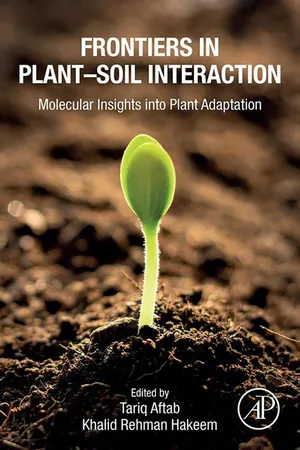
Frontiers in Plant–Soil Interaction
Molecular Insights into Plant Adaptation
- 638 pages
- English
- ePUB (mobile friendly)
- Available on iOS & Android
eBook - ePub
Frontiers in Plant–Soil Interaction
Molecular Insights into Plant Adaptation
About this book
Plants face a wide range of environmental challenges, which are expected to become more intense as a result of global climate change. Plant–soil interactions play an important role in the functioning of ecosystems. Soil properties represent a strong selection pressure for plant diversity and influence the structure of plant communities and biodiversity. The complexity of plant–soil interactions has recently been studied by developing a trait-based approach in which responses and effects of plants on soil environment are quantified and modelled. This fundamental research on plant–soil interaction in ecosystems is essential to transpose knowledge of functional ecology to environmental management.Frontiers in Plant-Soil Interaction: Molecular Insights into Plant Adaptation will address topics that provide advances in understanding plant responses to soil conditions through the integration of genetic, molecular, and plant-level studies of diverse biotic and abiotic stresses under field and laboratory conditions. This book will be beneficial to students and researchers working on stress physiology and stress proteins, genomics, proteomics, genetic engineering and other fields of plant-soil interactions. Frontiers in Plant-Soil Interaction will also help scientists explore new horizons in their area of research.
- Brings together global leaders working in the area of plant–environment interactions and shares their research findings
- Presents current and future scenarios for the management of stressors
- Illustrates the central role for plant-soil interactions in applying basic research to address current and future challenges to humans
Information
Table of contents
- Title of Book
- Cover image
- Title page
- Table of Contents
- Copyright
- List of contributors
- Chapter 1 Plant–soil interactions in a changing world: a climate change perspective
- Chapter 2 Role of carbon cycle in soil productivity and carbon fluxes under changing climate
- Chapter 3 Molecular advances in plant root system architecture response and redesigning for improved performance under unfavorable environments
- Chapter 4 Nanotechnology-based biofortification: a plant–soil interaction modulator/enhancer
- Chapter 5 Transcription factors involved in plant responses to stress adaptation
- Chapter 6 Nitrate assimilation: cross talk between plants and soil
- Chapter 7 Next-generation genetic engineering tools for abiotic stress tolerance in plants
- Chapter 8 Omics approaches for improving abiotic stress tolerance in rice: recent advances and future prospects
- Chapter 9 Interactions of phytohormones with abiotic stress factors under changing climate
- Chapter 10 The role of soil microbes in the plant adaptation to stresses: current scenario and future perspective
- Chapter 11 CRISPR/Cas-mediated genome editing for improved stress tolerance in plants
- Chapter 12 Photosynthetic and cellular responses in plants under saline conditions
- Chapter 13 Physiological and molecular strategies of plant adaptationin phosphorus-deficient soils
- Chapter 14 Biotic stresses on plants: reactive oxygen species generation and antioxidant mechanism
- Chapter 15 Physiological mechanisms and adaptation strategies of plants under heavy metal micronutrient deficiency/toxicity conditions
- Chapter 16 Halophytes as effective tool for phytodesalination and land reclamation
- Chapter 17 Role of nickel in regulation of nitrogen metabolism in legume–rhizobium symbiosis under critical conditions
- Chapter 18 Beneficial aspects of cobalt uptake in plants exposed to abiotic stresses
- Chapter 19 Iron in the soil–plant–human continuum
- Chapter 20 The molecular mechanism of brassinosteroids in mediating the abiotic stress responses of plants
- Chapter 21 Emerging roles of osmoprotectant glycine betaine against salt-induced oxidative stress in plants: a major outlook of maize (Zea mays L.)
- Chapter 22 Ecodesigning for ecological sustainability
- Index
Trusted by 375,005 students
Access to over 1.5 million titles for a fair monthly price.
Study more efficiently using our study tools.
Frequently asked questions
Yes, you can cancel anytime from the Subscription tab in your account settings on the Perlego website. Your subscription will stay active until the end of your current billing period. Learn how to cancel your subscription
No, books cannot be downloaded as external files, such as PDFs, for use outside of Perlego. However, you can download books within the Perlego app for offline reading on mobile or tablet. Learn how to download books offline
Perlego offers two plans: Essential and Complete
- Essential is ideal for learners and professionals who enjoy exploring a wide range of subjects. Access the Essential Library with 800,000+ trusted titles and best-sellers across business, personal growth, and the humanities. Includes unlimited reading time and Standard Read Aloud voice.
- Complete: Perfect for advanced learners and researchers needing full, unrestricted access. Unlock 1.5M+ books across hundreds of subjects, including academic and specialized titles. The Complete Plan also includes advanced features like Premium Read Aloud and Research Assistant.
We are an online textbook subscription service, where you can get access to an entire online library for less than the price of a single book per month. With over 1.5 million books across 990+ topics, we’ve got you covered! Learn about our mission
Look out for the read-aloud symbol on your next book to see if you can listen to it. The read-aloud tool reads text aloud for you, highlighting the text as it is being read. You can pause it, speed it up and slow it down. Learn more about Read Aloud
Yes! You can use the Perlego app on both iOS and Android devices to read anytime, anywhere — even offline. Perfect for commutes or when you’re on the go.
Please note we cannot support devices running on iOS 13 and Android 7 or earlier. Learn more about using the app
Please note we cannot support devices running on iOS 13 and Android 7 or earlier. Learn more about using the app
Yes, you can access Frontiers in Plant–Soil Interaction by Tariq Aftab,Khalid Rehman Hakeem in PDF and/or ePUB format, as well as other popular books in Biological Sciences & Botany. We have over 1.5 million books available in our catalogue for you to explore.