- 316 pages
- English
- ePUB (mobile friendly)
- Available on iOS & Android
eBook - ePub
iPSCs - State of the Science
About this book
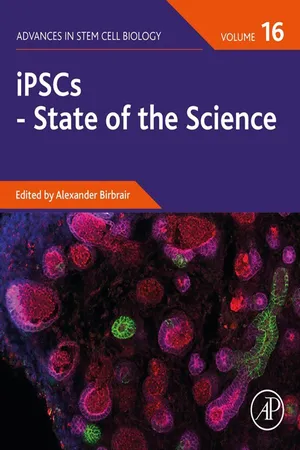
iPSCs - State of the Science, Volume Sixteen, the latest release in the Advances in Stem Cell Biology series, is an expansive collection of information and new discoveries in the field. This volume addresses the importance of induced pluripotent stems cells and how can they be derived from different sources. It addresses advances in research in induced pluripotent stem cells from alternate sources, such as spermatogonial stem cells, ovarian tissue, cancer cells, and many other sources. It is written for researchers and scientists in stem cell therapy, cell biology, regenerative medicine and organ transplantation, and is contributed by world-renowned authors.
- Provides an overview of the fast-moving field of stem cell biology and function, regenerative medicine and therapeutics
- Covers iPSCs derived from amniotic fluid, oral tissue derived iPSCs, muse cells, postmortem tissue, and much more
- Contributed by world-renowned experts in the field
Information
Topic
Scienze biologicheSubtopic
BiologiaTable of contents
- Title of Book
- Cover image
- Title page
- Table of Contents
- Advances in Stem Cell Biology
- Copyright
- Dedication
- List of contributors
- About the editor
- Preface
- Chapter 1 Revealing nervous and cardiac system interactions by iPSC-Based platforms
- Chapter 2 Human iPSC models of cardiac electrophysiology and arrhythmia
- Chapter 3 Human iPSCs for modeling of hepatobiliary development and drug discovery
- Chapter 4 The application of iPSC-derived kidney organoids and genome editing in kidney disease modeling
- Chapter 5 Toward the in vitro understanding of iPSC nucleoskeletal and cytoskeletal biology, and their relevance for organoid development
- Chapter 6 Induced pluripotent stem cell models for mitochondrial disorders
- Chapter 7 Induced pluripotent stem cells for studying genetic autonomic disorders
- Chapter 8 Applications of iPSCs in Gaucher Disease and other rare sphingolipidoses
- Chapter 9 Application of CRISPR/Cas system in iPSC-based disease model of hereditary deafness
- Chapter 10 Progress and possibilities for patient-derived iPSCs and genetically engineered stem cells in cancer modeling and targeted therapies
- Index
Trusted by 375,005 students
Access to over 1.5 million titles for a fair monthly price.
Study more efficiently using our study tools.
Frequently asked questions
Yes, you can cancel anytime from the Subscription tab in your account settings on the Perlego website. Your subscription will stay active until the end of your current billing period. Learn how to cancel your subscription
No, books cannot be downloaded as external files, such as PDFs, for use outside of Perlego. However, you can download books within the Perlego app for offline reading on mobile or tablet. Learn how to download books offline
Perlego offers two plans: Essential and Complete
- Essential is ideal for learners and professionals who enjoy exploring a wide range of subjects. Access the Essential Library with 800,000+ trusted titles and best-sellers across business, personal growth, and the humanities. Includes unlimited reading time and Standard Read Aloud voice.
- Complete: Perfect for advanced learners and researchers needing full, unrestricted access. Unlock 1.5M+ books across hundreds of subjects, including academic and specialized titles. The Complete Plan also includes advanced features like Premium Read Aloud and Research Assistant.
We are an online textbook subscription service, where you can get access to an entire online library for less than the price of a single book per month. With over 1.5 million books across 990+ topics, we’ve got you covered! Learn about our mission
Look out for the read-aloud symbol on your next book to see if you can listen to it. The read-aloud tool reads text aloud for you, highlighting the text as it is being read. You can pause it, speed it up and slow it down. Learn more about Read Aloud
Yes! You can use the Perlego app on both iOS and Android devices to read anytime, anywhere — even offline. Perfect for commutes or when you’re on the go.
Please note we cannot support devices running on iOS 13 and Android 7 or earlier. Learn more about using the app
Please note we cannot support devices running on iOS 13 and Android 7 or earlier. Learn more about using the app
Yes, you can access iPSCs - State of the Science by Alexander Birbrair in PDF and/or ePUB format, as well as other popular books in Scienze biologiche & Biologia. We have over 1.5 million books available in our catalogue for you to explore.