eBook - ePub
Microbes in Land Use Change Management
- 598 pages
- English
- ePUB (mobile friendly)
- Available on iOS & Android
eBook - ePub
Microbes in Land Use Change Management
About this book
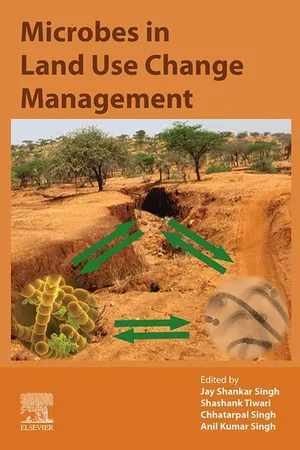
Microbes in Land Use Change Management details the various roles of microbial resources in management of land uses and how the microbes can be used for the source of income due to their cultivation for the purpose of biomass and bioenergy production. Using various techniques, the disturbed and marginal lands may also be restored eco-friendly in present era to fulfil the feeding needs of mankind around the globe.
Microbes in Land Use Change Management provides standard and up to date information towards the land use change management using various microbial technologies to enhance the productivity of agriculture. Needless to say that Microbes in Land Use Change Management also considers the areas including generation of alternative energy sources, restoration of degraded and marginal lands, mitigation of global warming gases and next generation -omics technique etc.
Land use change affects environment conditions and soil microbial community. Microbial population and its species diversity have influence in maintaining ecosystem balance. The study of changes of microbial population provides an idea about the variation occurring in a specific area and possibilities of restoration.
Meant for a multidisciplinary audience Microbes in Land Use Change Management shows the need of next-generation omics technologies to explore microbial diversity.
- Describes the role of microbes in generation of alternative source of energy
- Gives recent information related to various microbial technology and their diversified applications
- Provides thorough insight in the problems related to landscape dynamics, restoration of soil, reclamation of lands mitigation of global warming gases etc. eco-friendly way using versatility of microbes
- Includes microbial tools and technology in reclamation of degraded, disturbed and marginal lands, mitigation of global warming gases
Information
Table of contents
- Cover
- Title page
- Table of Contents
- Copyright
- Contents
- List of contributors
- Foreword
- Preface
- List of Illustrations
- List of Tables
- 1 : Temperature sensitivity of litter and soil organic matter decomposition: perspective of soil microbial community structure and function
- 2 : Adaptation of bacterial communities and plant strategies for amelioration and eco-restoration of an organometallic industrial waste polluted site
- 3 : Effect of soil biofilms on ecological function and impact on soil properties
- 4 : Alteration in microbial population density composition in different land use systems
- 5 : Molecular characterization of bacterial community succession and analysis of physiochemical properties in a compost of solid organic waste from Gandhinagar, Gujarat, India
- 6 : Molecular technologies for the early detection of fungal phytopathogens associated with cereal crops
- 7 : Applicability of fungi in agriculture and environmental sustainability
- 8 : Litterfall decomposition of selected plant species and nutrient cycling in Madhupur Sal (Shorea robusta Roth) forest of Bangladesh
- 9 : Bioactivity of soil microorganisms for agriculture development
- 10 : Next generation OMICS: a tool to understand the diversity of soil microbiota and improvement of agricultural sustainability
- 11 : Microbial associations in ecological reclamation and restoration of marginal lands
- 12 : Assessment of microbial biomass for production of ecofriendly single-cell protein, bioenergy, and other useful products
- 13 : Participation and understanding of plant microbes interaction in plant health and growth by combating mercury stress: a sustainable approach towards agricultural practices
- 14 : The role of plant growth promoting bacteria in mineralization of endosulfan and its metabolites
- 15 : Influence of land use change on native microbial community and their response to the variations in micro environment
- 16 : Soil-plant-microbial interactions for soil fertility management and sustainable agriculture
- 17 : Endophytic microbial interaction with legume crop for developing resistance against nutrient stress
- 18 : Function-driven microbial genomics for ecofriendly agriculture
- 19 : Role of microbial communities in restoration disturbed lands
- 20 : Impact of microbial biofilm on crop productivity and agricultural sustainability
- 21 : Valuing each patch of land: utilizing plant-microbe interactions for the betterment of agriculture
- 22 : Tripartite interactions: plant-Pseudomonas putida-microRNAs in agricultural productivity
- 23 : Next-generation omics technologies to explore microbial diversity
- Index
- A
Trusted by 375,005 students
Access to over 1.5 million titles for a fair monthly price.
Study more efficiently using our study tools.
Frequently asked questions
Yes, you can cancel anytime from the Subscription tab in your account settings on the Perlego website. Your subscription will stay active until the end of your current billing period. Learn how to cancel your subscription
No, books cannot be downloaded as external files, such as PDFs, for use outside of Perlego. However, you can download books within the Perlego app for offline reading on mobile or tablet. Learn how to download books offline
Perlego offers two plans: Essential and Complete
- Essential is ideal for learners and professionals who enjoy exploring a wide range of subjects. Access the Essential Library with 800,000+ trusted titles and best-sellers across business, personal growth, and the humanities. Includes unlimited reading time and Standard Read Aloud voice.
- Complete: Perfect for advanced learners and researchers needing full, unrestricted access. Unlock 1.5M+ books across hundreds of subjects, including academic and specialized titles. The Complete Plan also includes advanced features like Premium Read Aloud and Research Assistant.
We are an online textbook subscription service, where you can get access to an entire online library for less than the price of a single book per month. With over 1.5 million books across 990+ topics, we’ve got you covered! Learn about our mission
Look out for the read-aloud symbol on your next book to see if you can listen to it. The read-aloud tool reads text aloud for you, highlighting the text as it is being read. You can pause it, speed it up and slow it down. Learn more about Read Aloud
Yes! You can use the Perlego app on both iOS and Android devices to read anytime, anywhere — even offline. Perfect for commutes or when you’re on the go.
Please note we cannot support devices running on iOS 13 and Android 7 or earlier. Learn more about using the app
Please note we cannot support devices running on iOS 13 and Android 7 or earlier. Learn more about using the app
Yes, you can access Microbes in Land Use Change Management by Jay Shankar Singh,Shashank Tiwari,Chhatarpal Singh,Anil Kumar Singh in PDF and/or ePUB format, as well as other popular books in Biological Sciences & Microbiology. We have over 1.5 million books available in our catalogue for you to explore.