- 482 pages
- English
- ePUB (mobile friendly)
- Available on iOS & Android
eBook - ePub
Current Research in Neuroadaptive Technology
About this book
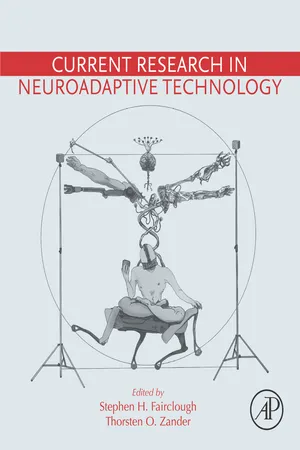
Current Research in Neuroadaptive Technology provides readers with insight into the state-of-the-art field of neuroadaptive technology. The book covers the breadth and depth of current research in this field, covering a range of application domains in sufficient technical detail. The multidisciplinary character of this field means that the publication of key research is often fragmented across specialist journals. Here, the editors have consolidated current research, carefully selecting key topics that are clustered around the concept of neuroadaptive technology. In summary, the book meets the needs of readers by consolidating multidisciplinary research around a nascent technological concept.
The topic of neuroadaptive technology is novel and contemporary and editors Dr. Stephen H. Fairclough and Dr. Thorsten O. Zander have captured issues related to this emerging technology at the point of inception. It is a key reference for biomedical engineers and researchers in neural engineering, biomedical engineering, computer science, and mathematics.
- Includes applications of neuroadaptive technology in a variety of disciplines
- Comprises in-depth technical coverage of Passive Brain-Computer Interfaces, Physiological Computing, Affective Computing, Neurofeedback, and Closed-Loop Human-Computer Interaction
- Covers topics such as monitoring safety-critical behaviour, brain-computer interfaces, neurofeedback, virtual reality, neurostimulation, tangible interfaces, mobile brain-body imaging, system taxonomy and ethical implications of neuroadaptive technology
- Covers applied research using techniques such as: EEG, fNIRS, eye-tracking, psychophysiology, spontaneous radio frequency transmission and tDCS
- Written by engineers to help engineers, computer scientists, researchers and clinicians understand the technology and its applications
Information
Table of contents
- Cover
- Front Matter
- Table of Contents
- Copyright
- Contents
- List of contributors
- Preface
- List of Illustrations
- List of Tables
- Chapter 1 : Designing human-computer interaction with neuroadaptive technology
- Chapter 2 : Defining neuroadaptive technology: the trouble with implicit human-computer interaction
- Chapter 3 : The multi-stage theory of neurofeedback learning: a framework for understanding mechanisms
- Chapter 4 : Towards neuroadaptive modeling: assessing the cognitive states of pilots through passive brain-computer interfacing
- Chapter 5 : Tangible physiological devices for positive computing, a retrospective
- Chapter 6 : The influence of a neuroadaptive game as a distraction from pain: a fNIRS study
- Chapter 7 : Ecological measures of cognitive impairments in aeronautics: theory and application
- Chapter 8 : Transcranial Direct-Current Stimulation (tDCS) attenuates perceived temporal demand during simulated laparoscopic tasks
- Chapter 9 : Adaptive virtual reality
- Chapter 10 : Possibilities and pitfalls for the co-registration of mobile EEG and eye-tracking in the study of economic decision-making in naturalistic settings
- Chapter 11 : The impact of electrode shifts on BCI classifier accuracy
- Chapter 12 : Walking improves the performance of a brain-computer interface for group decision making
- Chapter 13 : Spontaneous radiofrequency emission from electron spins within Drosophila: a novel biological signal
- Abstracts from the First Neuroadaptive Technology Conference, 2017
- Abstracts from the Second Neuroadaptive Technology Conference, 2019
- Index
- A
Trusted by 375,005 students
Access to over 1.5 million titles for a fair monthly price.
Study more efficiently using our study tools.
Frequently asked questions
Yes, you can cancel anytime from the Subscription tab in your account settings on the Perlego website. Your subscription will stay active until the end of your current billing period. Learn how to cancel your subscription
No, books cannot be downloaded as external files, such as PDFs, for use outside of Perlego. However, you can download books within the Perlego app for offline reading on mobile or tablet. Learn how to download books offline
Perlego offers two plans: Essential and Complete
- Essential is ideal for learners and professionals who enjoy exploring a wide range of subjects. Access the Essential Library with 800,000+ trusted titles and best-sellers across business, personal growth, and the humanities. Includes unlimited reading time and Standard Read Aloud voice.
- Complete: Perfect for advanced learners and researchers needing full, unrestricted access. Unlock 1.5M+ books across hundreds of subjects, including academic and specialized titles. The Complete Plan also includes advanced features like Premium Read Aloud and Research Assistant.
We are an online textbook subscription service, where you can get access to an entire online library for less than the price of a single book per month. With over 1.5 million books across 990+ topics, we’ve got you covered! Learn about our mission
Look out for the read-aloud symbol on your next book to see if you can listen to it. The read-aloud tool reads text aloud for you, highlighting the text as it is being read. You can pause it, speed it up and slow it down. Learn more about Read Aloud
Yes! You can use the Perlego app on both iOS and Android devices to read anytime, anywhere — even offline. Perfect for commutes or when you’re on the go.
Please note we cannot support devices running on iOS 13 and Android 7 or earlier. Learn more about using the app
Please note we cannot support devices running on iOS 13 and Android 7 or earlier. Learn more about using the app
Yes, you can access Current Research in Neuroadaptive Technology by Stephen H. Fairclough,Thorsten O. Zander in PDF and/or ePUB format, as well as other popular books in Biological Sciences & Biotechnology. We have over 1.5 million books available in our catalogue for you to explore.