eBook - ePub
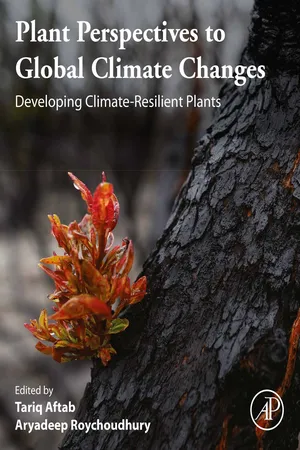
Plant Perspectives to Global Climate Changes
Developing Climate-Resilient Plants
- 556 pages
- English
- ePUB (mobile friendly)
- Available on iOS & Android
eBook - ePub
Plant Perspectives to Global Climate Changes
Developing Climate-Resilient Plants
About this book
Plant Perspectives to Global Climate Changes: Developing Climate-Resilient Plants reviews and integrates currently available information on the impact of the environment on functional and adaptive features of plants from the molecular, biochemical and physiological perspectives to the whole plant level. The book also provides a direction towards implementation of programs and practices that will enable sustainable production of crops resilient to climatic alterations. This book will be beneficial to academics and researchers working on stress physiology, stress proteins, genomics, proteomics, genetic engineering, and other fields of plant physiology.
Advancing ecophysiological understanding and approaches to enhance plant responses to new environmental conditions is critical to developing meaningful high-throughput phenotyping tools and maintaining humankind's supply of goods and services as global climate change intensifies.
- Illustrates the central role for plant ecophysiology in applying basic research to address current and future challenges for humans
- Brings together global leaders working in the area of plant-environment interactions and shares research findings
- Presents current scenarios and future plans of action for the management of stresses through various approaches
Information
Table of contents
- Cover
- Front Matter
- Table of Contents
- Copyright
- Contributors
- List of Illustrations
- List of Tables
- Chapter 1 : Climate change impact on plants: Plant responses and adaptations
- Chapter 2 : Towards understanding abiotic stress physiological studies in plants: Conjunction of genomic and proteomic approaches
- Chapter 3 : Co-overexpression of genes in plants for abiotic stress tolerance
- Chapter 4 : Molecular investigation of plant-environment interaction at functional level
- Chapter 5 : Physiological, biochemical, and molecular adaptation mechanisms of photosynthesis and respiration under challenging environments
- Chapter 6 : Harnessing the potential of modern omics approaches to study plant biotic and abiotic stresses
- Chapter 7 : Soil-plant interactions for agricultural sustainability under challenging climate change
- Chapter 8 : Biological nitrification inhibition for sustainable crop production
- Chapter 9 : Application of nanoparticles in developing resilience against abiotic stress in rice plant (Oryza sativa L.)
- Chapter 10 : Physiological mechanisms and adaptation strategies of plants under nutrient deficiency and toxicity conditions
- Chapter 11 : Genomics-based approaches to improve abiotic stress tolerance in plants: Present status and future prospects
- Chapter 12 : Transcription factors involved in plant responses to heavy metal stress adaptation
- Chapter 13 : The role of soil microorganisms in plant adaptation to abiotic stresses: Current scenario and future perspectives
- Chapter 14 : Ecological aspects of the soil-water-plant-atmosphere system
- Chapter 15 : Role of miRNA technology and miRNAs in abiotic and biotic stress resilience
- Chapter 16 : CRISPR-Cas9-mediated genome editing technology for abiotic stress tolerance in crop plant
- Chapter 17 : Reactive oxygen and nitrogen species: Antioxidant defense studies in plants
- Chapter 18 : Role of plant hormones in combating biotic stress in plants
- Chapter 19 : CRISPR-mediated genome editing for developing climate-resilient monocot and dicot crops
- Chapter 20 : Mechanism of temperature stress acclimation and the role of transporters in plants
- Chapter 21 : Role of β-aminobutyric acid in generating stress-tolerant and climate-resilient plants
- Chapter 22 : Wild relatives of plants as sources for the development of abiotic stress tolerance in plants
- Chapter 23 : Role of magnetopriming in alleviation of abiotic stress in plants
- Index
- A
Trusted by 375,005 students
Access to over 1.5 million titles for a fair monthly price.
Study more efficiently using our study tools.
Frequently asked questions
Yes, you can cancel anytime from the Subscription tab in your account settings on the Perlego website. Your subscription will stay active until the end of your current billing period. Learn how to cancel your subscription
No, books cannot be downloaded as external files, such as PDFs, for use outside of Perlego. However, you can download books within the Perlego app for offline reading on mobile or tablet. Learn how to download books offline
Perlego offers two plans: Essential and Complete
- Essential is ideal for learners and professionals who enjoy exploring a wide range of subjects. Access the Essential Library with 800,000+ trusted titles and best-sellers across business, personal growth, and the humanities. Includes unlimited reading time and Standard Read Aloud voice.
- Complete: Perfect for advanced learners and researchers needing full, unrestricted access. Unlock 1.5M+ books across hundreds of subjects, including academic and specialized titles. The Complete Plan also includes advanced features like Premium Read Aloud and Research Assistant.
We are an online textbook subscription service, where you can get access to an entire online library for less than the price of a single book per month. With over 1.5 million books across 990+ topics, we’ve got you covered! Learn about our mission
Look out for the read-aloud symbol on your next book to see if you can listen to it. The read-aloud tool reads text aloud for you, highlighting the text as it is being read. You can pause it, speed it up and slow it down. Learn more about Read Aloud
Yes! You can use the Perlego app on both iOS and Android devices to read anytime, anywhere — even offline. Perfect for commutes or when you’re on the go.
Please note we cannot support devices running on iOS 13 and Android 7 or earlier. Learn more about using the app
Please note we cannot support devices running on iOS 13 and Android 7 or earlier. Learn more about using the app
Yes, you can access Plant Perspectives to Global Climate Changes by Tariq Aftab,Aryadeep Roychoudhury in PDF and/or ePUB format, as well as other popular books in Biological Sciences & Botany. We have over 1.5 million books available in our catalogue for you to explore.