eBook - ePub
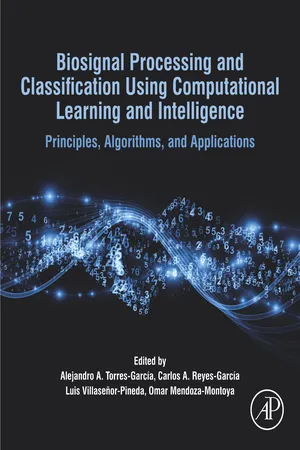
Biosignal Processing and Classification Using Computational Learning and Intelligence
Principles, Algorithms, and Applications
- 536 pages
- English
- ePUB (mobile friendly)
- Available on iOS & Android
eBook - ePub
Biosignal Processing and Classification Using Computational Learning and Intelligence
Principles, Algorithms, and Applications
About this book
Biosignal Processing and Classification Using Computational Learning and Intelligence: Principles, Algorithms and Applications posits an approach for biosignal processing and classification using computational learning and intelligence, highlighting that the term biosignal refers to all kinds of signals that can be continuously measured and monitored in living beings. The book is composed of five relevant parts. Part One is an introduction to biosignals and Part Two describes the relevant techniques for biosignal processing, feature extraction and feature selection/dimensionality reduction. Part Three presents the fundamentals of computational learning (machine learning). Then, the main techniques of computational intelligence are described in Part Four. The authors focus primarily on the explanation of the most used methods in the last part of this book, which is the most extensive portion of the book. This part consists of a recapitulation of the newest applications and reviews in which these techniques have been successfully applied to the biosignals' domain, including EEG-based Brain-Computer Interfaces (BCI) focused on P300 and Imagined Speech, emotion recognition from voice and video, leukemia recognition, infant cry recognition, EEGbased ADHD identification among others.
- Provides coverage of the fundamentals of signal processing, including sensing the heart, sending the brain, sensing human acoustic, and sensing other organs
- Includes coverage biosignal pre-processing techniques such as filtering, artifiact removal, and feature extraction techniques such as Fourier transform, wavelet transform, and MFCC
- Covers the latest techniques in machine learning and computational intelligence, including Supervised Learning, common classifiers, feature selection, dimensionality reduction, fuzzy logic, neural networks, Deep Learning, bio-inspired algorithms, and Hybrid Systems
- Written by engineers to help engineers, computer scientists, researchers, and clinicians understand the technology and applications of computational learning to biosignal processing
Information
Table of contents
- Cover
- Front Matter
- Table of Contents
- Copyright
- Contents
- List of figures
- List of contributors
- About the authors
- List of Illustrations
- List of Tables
- Chapter 1 : Introduction to this book
- Chapter 2 : Biosignals analysis (heart, phonatory system, and muscles)
- Chapter 3 : Neuroimaging techniques
- Chapter 4 : Pre-processing and feature extraction
- Chapter 5 : Dimensionality reduction
- Chapter 6 : A brief introduction to supervised, unsupervised, and reinforcement learning
- Chapter 7 : Assessing classifier's performance
- Chapter 8 : Fuzzy logic and fuzzy systems
- Chapter 9 : Neural networks and deep learning
- Chapter 10 : Spiking neural networks and dendrite morphological neural networks: an introduction
- Chapter 11 : Bio-inspired algorithms
- Chapter 12 : A survey on EEG-based imagined speech classification
- Chapter 13 : P300-based brain–computer interface for communication and control
- Chapter 14 : EEG-based subject identification with multi-class classification
- Chapter 15 : Emotion recognition: from speech and facial expressions
- Chapter 16 : Trends and applications of ECG analysis and classification
- Chapter 17 : Analysis and processing of infant cry for diagnosis purposes
- Chapter 18 : Physics augmented classification of fNIRS signals
- Chapter 19 : Evaluation of mechanical variables by registration and analysis of electromyographic activity
- Chapter 20 : A review on machine learning techniques for acute leukemia classification
- Chapter 21 : Attention deficit and hyperactivity disorder classification with EEG and machine learning
- Chapter 22 : Representation for event-related fMRI
- Index
- A
Trusted by 375,005 students
Access to over 1.5 million titles for a fair monthly price.
Study more efficiently using our study tools.
Frequently asked questions
Yes, you can cancel anytime from the Subscription tab in your account settings on the Perlego website. Your subscription will stay active until the end of your current billing period. Learn how to cancel your subscription
No, books cannot be downloaded as external files, such as PDFs, for use outside of Perlego. However, you can download books within the Perlego app for offline reading on mobile or tablet. Learn how to download books offline
Perlego offers two plans: Essential and Complete
- Essential is ideal for learners and professionals who enjoy exploring a wide range of subjects. Access the Essential Library with 800,000+ trusted titles and best-sellers across business, personal growth, and the humanities. Includes unlimited reading time and Standard Read Aloud voice.
- Complete: Perfect for advanced learners and researchers needing full, unrestricted access. Unlock 1.5M+ books across hundreds of subjects, including academic and specialized titles. The Complete Plan also includes advanced features like Premium Read Aloud and Research Assistant.
We are an online textbook subscription service, where you can get access to an entire online library for less than the price of a single book per month. With over 1.5 million books across 990+ topics, we’ve got you covered! Learn about our mission
Look out for the read-aloud symbol on your next book to see if you can listen to it. The read-aloud tool reads text aloud for you, highlighting the text as it is being read. You can pause it, speed it up and slow it down. Learn more about Read Aloud
Yes! You can use the Perlego app on both iOS and Android devices to read anytime, anywhere — even offline. Perfect for commutes or when you’re on the go.
Please note we cannot support devices running on iOS 13 and Android 7 or earlier. Learn more about using the app
Please note we cannot support devices running on iOS 13 and Android 7 or earlier. Learn more about using the app
Yes, you can access Biosignal Processing and Classification Using Computational Learning and Intelligence by Alejandro A. Torres-García,Carlos Alberto Reyes Garcia,Luis Villasenor-Pineda,Omar Mendoza-Montoya in PDF and/or ePUB format, as well as other popular books in Biological Sciences & Biotechnology. We have over 1.5 million books available in our catalogue for you to explore.