- 241 pages
- English
- PDF
- Available on iOS & Android
eBook - PDF
About this book
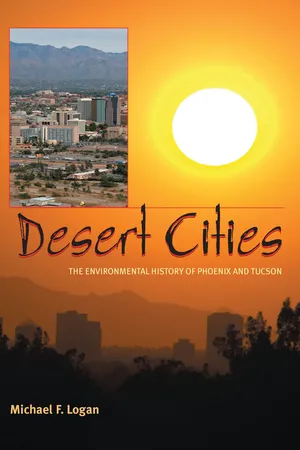
Phoenix is known as the "Valley of the Sun," while Tucson is referred to as "The Old Pueblo." These nicknames epitomize the difference in the public's perception of each city. Phoenix continues to sprawl as one of America's largest and fastest-growing cities. Tucson has witnessed a slower rate of growth, and has only one quarter of Phoenix's population. This was not always the case. Prior to 1920, Tucson had a larger population. How did two cities, with such close physical proximity and similar natural environments develop so differently?Desert Cities examines the environmental circumstances that led to the starkly divergent growth of these two cities. Michael Logan traces this significant imbalance to two main factors: water resources and cultural differences. Both cities began as agricultural communities. Phoenix had the advantage of a larger water supply, the Salt River, which has four and one half times the volume of Tucson's Santa Cruz River. Because Phoenix had a larger river, it received federal assistance in the early twentieth century for the Salt River project, which provided water storage facilities. Tucson received no federal aid. Moreover, a significant cultural difference existed. Tucson, though it became a U.S. possession in 1853, always had a sizable Hispanic population. Phoenix was settled in the 1870s by Anglo pioneers who brought their visions of landscape development and commerce with them.By examining the factors of watershed, culture, ethnicity, terrain, political favoritism, economic development, and history, Desert Cities offers a comprehensive evaluation that illuminates the causes of growth disparity in two major southwestern cities and provides a model for the study of bi-city resource competition.
Information
Subtopic
North American HistoryIndex
HistoryTable of contents
- Contents
- List of Illustrations
- Acknowledgments
- Introduction: Desert Cities
- I. Origins: Prehistory–1890
- II. Rivals: 1890–1930
- III. Chosen Paths: 1940–1990
- Epilogue: Fountains in the Desert
- Notes
- Bibliography
- Index
Trusted by 375,005 students
Access to over 1.5 million titles for a fair monthly price.
Study more efficiently using our study tools.
Frequently asked questions
Yes, you can cancel anytime from the Subscription tab in your account settings on the Perlego website. Your subscription will stay active until the end of your current billing period. Learn how to cancel your subscription
No, books cannot be downloaded as external files, such as PDFs, for use outside of Perlego. However, you can download books within the Perlego app for offline reading on mobile or tablet. Learn how to download books offline
Perlego offers two plans: Essential and Complete
- Essential is ideal for learners and professionals who enjoy exploring a wide range of subjects. Access the Essential Library with 800,000+ trusted titles and best-sellers across business, personal growth, and the humanities. Includes unlimited reading time and Standard Read Aloud voice.
- Complete: Perfect for advanced learners and researchers needing full, unrestricted access. Unlock 1.5M+ books across hundreds of subjects, including academic and specialized titles. The Complete Plan also includes advanced features like Premium Read Aloud and Research Assistant.
We are an online textbook subscription service, where you can get access to an entire online library for less than the price of a single book per month. With over 1.5 million books across 990+ topics, we’ve got you covered! Learn about our mission
Look out for the read-aloud symbol on your next book to see if you can listen to it. The read-aloud tool reads text aloud for you, highlighting the text as it is being read. You can pause it, speed it up and slow it down. Learn more about Read Aloud
Yes! You can use the Perlego app on both iOS and Android devices to read anytime, anywhere — even offline. Perfect for commutes or when you’re on the go.
Please note we cannot support devices running on iOS 13 and Android 7 or earlier. Learn more about using the app
Please note we cannot support devices running on iOS 13 and Android 7 or earlier. Learn more about using the app
Yes, you can access Desert Cities by Michael F. Logan in PDF and/or ePUB format, as well as other popular books in History & North American History. We have over 1.5 million books available in our catalogue for you to explore.