Advancements in computing, instrumentation, robotics, digital imaging, and simulation modeling have changed science into a technology-driven institution. Government, industry, and society increasingly exert their influence over science, raising questions of values and objectivity. These and other profound changes have led many to speculate that we are in the midst of an epochal break in scientific history.
This edited volume presents an in-depth examination of these issues from philosophical, historical, social, and cultural perspectives. It offers arguments both for and against the epochal break thesis in light of historical antecedents. Contributors discuss topics such as: science as a continuing epistemological enterprise; the decline of the individual scientist and the rise of communities; the intertwining of scientific and technological needs; links to prior practices and ways of thinking; the alleged divide between mode-1 and mode-2 research methods; the commodification of university science; and the shift from the scientific to a technological enterprise. Additionally, they examine the epochal break thesis using specific examples, including the transition from laboratory to real world experiments; the increased reliance on computer imaging; how analog and digital technologies condition behaviors that shape the object and beholder; the cultural significance of humanoid robots; the erosion of scientific quality in experimentation; and the effect of computers on prediction at the expense of explanation.
Whether these events represent a historic break in scientific theory, practice, and methodology is disputed. What they do offer is an important occasion for philosophical analysis of the epistemic, institutional and moral questions affecting current and future scientific pursuits.
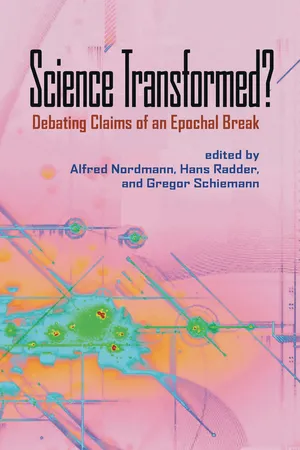
eBook - PDF
Science Transformed?
Debating Claims of an Epochal Break
- 233 pages
- English
- PDF
- Available on iOS & Android
eBook - PDF
Science Transformed?
Debating Claims of an Epochal Break
About this book
Information
Subtopic
Philosophy History & TheoryIndex
Biological SciencesTable of contents
- Contents
- Acknowledgments
- 1. Science after the End of Science? An Introduction to the “Epochal Break Thesis” - Alfred Nordmann, Hans Radder, and Gregor Schiemann
- Part I
- Part II
- Contributors
- Index
Trusted by 375,005 students
Access to over 1.5 million titles for a fair monthly price.
Study more efficiently using our study tools.
Frequently asked questions
Yes, you can cancel anytime from the Subscription tab in your account settings on the Perlego website. Your subscription will stay active until the end of your current billing period. Learn how to cancel your subscription
No, books cannot be downloaded as external files, such as PDFs, for use outside of Perlego. However, you can download books within the Perlego app for offline reading on mobile or tablet. Learn how to download books offline
Perlego offers two plans: Essential and Complete
- Essential is ideal for learners and professionals who enjoy exploring a wide range of subjects. Access the Essential Library with 800,000+ trusted titles and best-sellers across business, personal growth, and the humanities. Includes unlimited reading time and Standard Read Aloud voice.
- Complete: Perfect for advanced learners and researchers needing full, unrestricted access. Unlock 1.5M+ books across hundreds of subjects, including academic and specialized titles. The Complete Plan also includes advanced features like Premium Read Aloud and Research Assistant.
We are an online textbook subscription service, where you can get access to an entire online library for less than the price of a single book per month. With over 1.5 million books across 990+ topics, we’ve got you covered! Learn about our mission
Look out for the read-aloud symbol on your next book to see if you can listen to it. The read-aloud tool reads text aloud for you, highlighting the text as it is being read. You can pause it, speed it up and slow it down. Learn more about Read Aloud
Yes! You can use the Perlego app on both iOS and Android devices to read anytime, anywhere — even offline. Perfect for commutes or when you’re on the go.
Please note we cannot support devices running on iOS 13 and Android 7 or earlier. Learn more about using the app
Please note we cannot support devices running on iOS 13 and Android 7 or earlier. Learn more about using the app
Yes, you can access Science Transformed? by Alfred Nordmann, Hans Radder, Gregor Schiemann, Alfred Nordmann,Hans Radder,Gregor Schiemann in PDF and/or ePUB format, as well as other popular books in Biological Sciences & Philosophy History & Theory. We have over 1.5 million books available in our catalogue for you to explore.