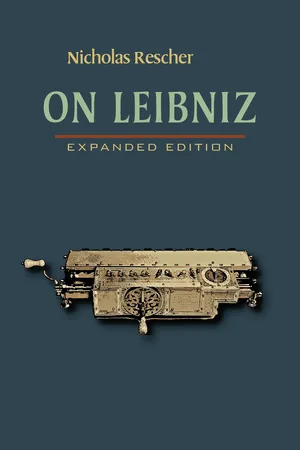
Contemporary philosopher John Searle has characterized Gottfried Wilhelm Leibniz (1646-1716) as "the most intelligent human being who has ever lived." The German philosopher, mathematician, and logician invented calculus (independently of Sir Isaac Newton), topology, determinants, binary arithmetic, symbolic logic, rational mechanics, and much more. His metaphysics bequeathed a set of problems and approaches that have influenced the course of Western philosophy from Kant in the eighteenth century until the present day.
On Leibniz examines many aspects of Leibniz's work and life. This expanded edition adds new chapters that explore Leibniz's revolutionary deciphering machine; his theoretical interest in cryptography and its ties to algebra; his thoughts on eternal recurrence theory; his rebuttal of the thesis of improvability in the world and cosmos; and an overview of American scholarship on Leibniz.
Other chapters reveal Leibniz as a substantial contributor to theories of knowledge. Discussions of his epistemology and methodology, its relationship to John Maynard Keynes and Talmudic scholarship, broaden the traditional view of Leibniz. Rescher also views Leibniz's scholarly development and professional career in historical context. As a "philosopher courtier" to the Hanoverian court, Leibniz was associated with the leading intellectuals and politicians of his era, including Spinoza, Huygens, Newton, Queen Sophie Charlotte, and Tsar Peter the Great.
Rescher extrapolates the fundamentals of Leibniz's ontology: the theory of possible worlds, the world's contingency, space-time frameworks, and intermonadic relationships. In conclusion, Rescher positions Leibniz as a philosophical role model for today's scholars. He argues that many current problems can be effectively addressed with principles of process philosophy inspired by Leibniz's system of monadology.
eBook - PDF
About this book
Information
Subtopic
Philosophy History & TheoryIndex
Biological SciencesTable of contents
- Contents
- Preface
- Chapter 1. Leibniz on Possible Worlds
- Chapter 2. Contingentia Mundi: Leibniz on the World’s Contingency
- Chapter 3. Leibniz on Intermonadic Relations
- Chapter 4. Leibniz and the Plurality of Space-Time Frameworks
- Chapter 5. Leibniz and the Concept of a System
- Chapter 6. Leibniz and Issues of Eternal Recurrence
- Chapter 7. Leibnizian Neo-Platonism and Rational Mechanics
- Chapter 8. Leibniz and the World’s Improvability
- Chapter 9. The Epistemology of Inductive Reasoning in Leibniz
- Chapter 10. Leibniz, Keynes, and the Rabbis
- Chapter 11. Leibniz and Socialized Medicine
- Chapter 12. The Contributions of the Paris Period (1672–1676) to Leibniz’s Metaphysics
- Chapter 13. Leibniz Finds a Niche (1676–1677)
- Chapter 14. Leibniz Visits Vienna (1712–1714)
- Chapter 15. Leibniz Crosses the Atlantic
- Chapter 16. Leibniz and American Philosophy
- Chapter 17. Leibniz and Cryptography
- Chapter 18. Leibniz’s Machina Deciphratoria: A Seventeenth-Century Proto-Enigma Machine
- Chapter 19. Process Philosophy and Monadological Metaphysics
- Chapter 20. Was Leibniz Ennobled?
- Chapter 21. Leibniz Disillusioned: Parting Ways from J. D. Crafft
- Postscript
- Name Index
Trusted by 375,005 students
Access to over 1.5 million titles for a fair monthly price.
Study more efficiently using our study tools.
Frequently asked questions
Yes, you can cancel anytime from the Subscription tab in your account settings on the Perlego website. Your subscription will stay active until the end of your current billing period. Learn how to cancel your subscription
No, books cannot be downloaded as external files, such as PDFs, for use outside of Perlego. However, you can download books within the Perlego app for offline reading on mobile or tablet. Learn how to download books offline
Perlego offers two plans: Essential and Complete
- Essential is ideal for learners and professionals who enjoy exploring a wide range of subjects. Access the Essential Library with 800,000+ trusted titles and best-sellers across business, personal growth, and the humanities. Includes unlimited reading time and Standard Read Aloud voice.
- Complete: Perfect for advanced learners and researchers needing full, unrestricted access. Unlock 1.5M+ books across hundreds of subjects, including academic and specialized titles. The Complete Plan also includes advanced features like Premium Read Aloud and Research Assistant.
We are an online textbook subscription service, where you can get access to an entire online library for less than the price of a single book per month. With over 1.5 million books across 990+ topics, we’ve got you covered! Learn about our mission
Look out for the read-aloud symbol on your next book to see if you can listen to it. The read-aloud tool reads text aloud for you, highlighting the text as it is being read. You can pause it, speed it up and slow it down. Learn more about Read Aloud
Yes! You can use the Perlego app on both iOS and Android devices to read anytime, anywhere — even offline. Perfect for commutes or when you’re on the go.
Please note we cannot support devices running on iOS 13 and Android 7 or earlier. Learn more about using the app
Please note we cannot support devices running on iOS 13 and Android 7 or earlier. Learn more about using the app
Yes, you can access On Leibniz by Nicholas Rescher in PDF and/or ePUB format, as well as other popular books in Biological Sciences & Philosophy History & Theory. We have over 1.5 million books available in our catalogue for you to explore.