eBook - PDF
Pittsburgh in Stages
About this book
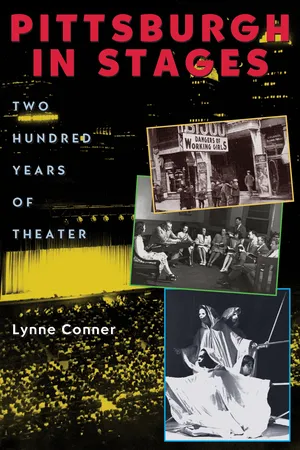
Pittsburgh has a rich and diverse theatrical tradition, from early frontier performances by officers stationed at Fort Pitt through experimental theater at the end of the twentieth century. Pittsburgh in Stages offers the first comprehensive history of theater in Pittsburgh, placing it within the context of cultural development in the city and the history of theater nationally.By the time the first permanent theater was built in 1812, Pittsburgh had already established itself as a serious patron of the theatrical arts. The city soon hosted New York and London-based traveling companies, and gained a national reputation as a proving ground for touring productions. By the early twentieth century, numerous theaters hosted 'popular-priced' productions of vaudeville and burlesque, and theater was brought to the masses. Soon after, Pittsburgh witnessed the emergence of myriad community-based theater groups and the formation of the Federation of Non-Commercial Theatres and the New Theater League, guilds designed to share resources among community producers. The rise of local theater was also instrumental to the growth of African American theatrical groups. Though victims of segregation, their art flourished, and was only later recognized and blended into Pittsburgh's theatrical melting pot.Pittsburgh in Stages relates the significant influence and interpretation of urban socioeconomic trends in the theatrical arts and the role of the theater as an agent of social change. Dividing Pittsburgh's theatrical history into distinct eras, Lynne Conner details the defining movements of each and analyzes how public tastes evolved over time. She offers a fascinating study of regional theatrical development and underscores the substantial contribution of regional theater in the history of American theatrical arts.
Information
Subtopic
North American HistoryTable of contents
- Contents
- List of Illustrations
- Preface
- Acknowledgments
- 1. The Theater as Community Life: 1790 to 1830
- 2. Theater as Community Investment: 1830 to 1870
- 3. Theater as Destination: 1870 to 1897
- 4. Theater as Big Business: 1897 to 1915
- 5. Theater as Distraction: 1915 to 1931
- 6. Theater as Social Change: 1931 to 1940
- 7. Theater as Regional Renaissance: 1940 to 1968
- 8. Theater as Civic Identities: 1968 to 1979
- 9. Theater as Cultural Capital: The 1980s
- 10. Conclusion: Pittsburgh in Stages
- Notes
- Bibliography
- Index
Trusted by 375,005 students
Access to over 1.5 million titles for a fair monthly price.
Study more efficiently using our study tools.
Frequently asked questions
Yes, you can cancel anytime from the Subscription tab in your account settings on the Perlego website. Your subscription will stay active until the end of your current billing period. Learn how to cancel your subscription
No, books cannot be downloaded as external files, such as PDFs, for use outside of Perlego. However, you can download books within the Perlego app for offline reading on mobile or tablet. Learn how to download books offline
Perlego offers two plans: Essential and Complete
- Essential is ideal for learners and professionals who enjoy exploring a wide range of subjects. Access the Essential Library with 800,000+ trusted titles and best-sellers across business, personal growth, and the humanities. Includes unlimited reading time and Standard Read Aloud voice.
- Complete: Perfect for advanced learners and researchers needing full, unrestricted access. Unlock 1.5M+ books across hundreds of subjects, including academic and specialized titles. The Complete Plan also includes advanced features like Premium Read Aloud and Research Assistant.
We are an online textbook subscription service, where you can get access to an entire online library for less than the price of a single book per month. With over 1.5 million books across 990+ topics, we’ve got you covered! Learn about our mission
Look out for the read-aloud symbol on your next book to see if you can listen to it. The read-aloud tool reads text aloud for you, highlighting the text as it is being read. You can pause it, speed it up and slow it down. Learn more about Read Aloud
Yes! You can use the Perlego app on both iOS and Android devices to read anytime, anywhere — even offline. Perfect for commutes or when you’re on the go.
Please note we cannot support devices running on iOS 13 and Android 7 or earlier. Learn more about using the app
Please note we cannot support devices running on iOS 13 and Android 7 or earlier. Learn more about using the app
Yes, you can access Pittsburgh in Stages by Lynne Thompson Conner in PDF and/or ePUB format, as well as other popular books in Media & Performing Arts & North American History. We have over 1.5 million books available in our catalogue for you to explore.