eBook - ePub
The Paradox of Violence in Venezuela
Revolution, Crime, and Policing During Chavismo
- English
- ePUB (mobile friendly)
- Available on iOS & Android
eBook - ePub
The Paradox of Violence in Venezuela
Revolution, Crime, and Policing During Chavismo
About this book
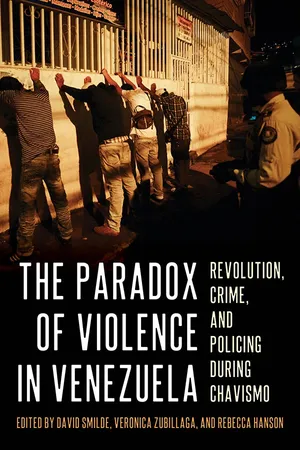
Crime and violence soared in twenty-first-century Venezuela even as poverty and inequality decreased, contradicting the conventional wisdom that these are the underlying causes of violence. The Paradox of Violence in Venezuela explains the rise of violence under both Hugo Chávez and Nicolás Maduro—leftist presidents who made considerable investment in social programs and political inclusion. Contributors argue that violence arose not from the frustration of inequality, or the needs created by poverty, but rather from the interrelated factors of a particular type of revolutionary governance, extraordinary oil revenues, a reliance on militarized policing, and the persistence of concentrated disadvantage. These factors led to dramatic but unequal economic growth, massive institutional and social change, and dysfunctional criminal justice policies that destabilized illicit markets and social networks, leading to an increase in violent conflict resolution. The Paradox of Violence in Venezuela reorients thinking about violence and its relationship to poverty, inequality, and the state.
Information
Topic
HistoriaTable of contents
- Cover Page
- Title Page
- Copyright Page
- Contents
- Acknowledgments
- Foreword
- Introduction: The Paradox of Violence in Venezuela
- Part I. The Shape of Violence
- Part II. Causal Processes and Cycles of Violence
- Part III. From Civilian Police Reform to Resurgent Militarized Policing
- Part IV. Responses to Violence: Looking Back, Looking Forward
- Notes
- References
- List of Contributors
- Index
Trusted by 375,005 students
Access to over 1.5 million titles for a fair monthly price.
Study more efficiently using our study tools.
Frequently asked questions
Yes, you can cancel anytime from the Subscription tab in your account settings on the Perlego website. Your subscription will stay active until the end of your current billing period. Learn how to cancel your subscription
No, books cannot be downloaded as external files, such as PDFs, for use outside of Perlego. However, you can download books within the Perlego app for offline reading on mobile or tablet. Learn how to download books offline
Perlego offers two plans: Essential and Complete
- Essential is ideal for learners and professionals who enjoy exploring a wide range of subjects. Access the Essential Library with 800,000+ trusted titles and best-sellers across business, personal growth, and the humanities. Includes unlimited reading time and Standard Read Aloud voice.
- Complete: Perfect for advanced learners and researchers needing full, unrestricted access. Unlock 1.5M+ books across hundreds of subjects, including academic and specialized titles. The Complete Plan also includes advanced features like Premium Read Aloud and Research Assistant.
We are an online textbook subscription service, where you can get access to an entire online library for less than the price of a single book per month. With over 1.5 million books across 990+ topics, we’ve got you covered! Learn about our mission
Look out for the read-aloud symbol on your next book to see if you can listen to it. The read-aloud tool reads text aloud for you, highlighting the text as it is being read. You can pause it, speed it up and slow it down. Learn more about Read Aloud
Yes! You can use the Perlego app on both iOS and Android devices to read anytime, anywhere — even offline. Perfect for commutes or when you’re on the go.
Please note we cannot support devices running on iOS 13 and Android 7 or earlier. Learn more about using the app
Please note we cannot support devices running on iOS 13 and Android 7 or earlier. Learn more about using the app
Yes, you can access The Paradox of Violence in Venezuela by David Smilde, Verónica Zubillaga, Rebecca Hanson, David Smilde,Verónica Zubillaga,Rebecca Hanson in PDF and/or ePUB format, as well as other popular books in Historia & Historia de Latinoamérica y el Caribe. We have over 1.5 million books available in our catalogue for you to explore.