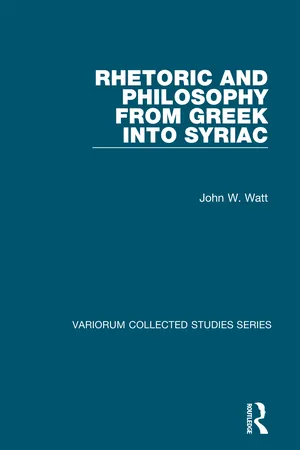
- 330 pages
- English
- ePUB (mobile friendly)
- Available on iOS & Android
eBook - ePub
Rhetoric and Philosophy from Greek into Syriac
About this book
Shortly after 500 CE, the Syriac-speaking priest and physician Sergius of Resh'aina, who had studied in Alexandria, wrote the first known exposition of Aristotle in a Semitic language. About four centuries later, Abu Bishr Matta, an alumnus of the monastic school of Dayr Qunna in Iraq, completed in Baghdad the Arabic version of the Aristotelian Organon with translations from the Syriac, and in a famous disputation argued the case for Greek logic as a theory of knowledge against rival claims of Arabic grammarians. The articles collected in this volume are concerned with the transmission and development of the Greek achievement among Syriac scholars of the Fertile Crescent during these four centuries, particularly in the fields of rhetoric and philosophy. Some range broadly over general areas, such as the Syriac appropriation of Greek liberal education or the educational curriculum in Syriac monastic schools, while others focus on themes of particular interest, including the influence of Aristotle's Rhetoric or the concept of the philosopher-king. Cumulatively they show how many aspects of Greek culture were received and elaborated in Syriac, and contribute to understanding the ways in which that culture exercised a powerful influence on the medieval Near East and the burgeoning Islamic civilisation.
Table of contents
- Cover
- Series Page
- Half Title
- Title Page
- Copyright Page
- Table of Contents
- Publisher’s Note
- Preface
- Acknowledgements
- Abbreviations
- I Grammar, rhetoric, and the enkyklios paideia in Syriac
- II Les Pères grecs dans le curriculum théologique et philologique des écoles syriaques
- III Greek historiography and the ‘Chronicle of Joshua the Stylite’
- IV Eastward and westward transmission of classical rhetoric
- V A portrait of John bar Aphtonia, founder of the monastery of Qenneshre
- VI Guarding the Syriac language in an Arabic environment: Antony of Tagrit on the use of grammar in rhetoric
- VII Syriac rhetorical theory and the Syriac tradition of Aristotle’s
- VIII The Syriac reception of Platonic and Aristotelian rhetoric
- IX Syriac panegyric in theory and practice
- X The philosopher-king in the Rhetoric of Antony of Tagrit
- XI From Themistius to al-Fārābī: Platonic political philosophy and Aristotle’s Rhetoric in the East
- XII From Synesius to al-Fārābī: philosophy, religion, and rhetoric in the Christian Orient
- XIII Syriac translators and Greek philosophy in early Abbasid Iraq
- XIV Syriac and Syrians as mediators of Greek political thought to Islam
- XV The strategy of the Baghdad philosophers: the Aristotelian tradition as a common motif in Christian and Islamic thought
- XVI Christianity in the renaissance oflslam: Abū Bishr Mattā, al-Fārābī, and Yaḥyā ibn ‘Adī
- Addenda and Corrigenda
- Index
Trusted by 375,005 students
Access to over 1.5 million titles for a fair monthly price.
Study more efficiently using our study tools.
Frequently asked questions
Yes, you can cancel anytime from the Subscription tab in your account settings on the Perlego website. Your subscription will stay active until the end of your current billing period. Learn how to cancel your subscription
No, books cannot be downloaded as external files, such as PDFs, for use outside of Perlego. However, you can download books within the Perlego app for offline reading on mobile or tablet. Learn how to download books offline
Perlego offers two plans: Essential and Complete
- Essential is ideal for learners and professionals who enjoy exploring a wide range of subjects. Access the Essential Library with 800,000+ trusted titles and best-sellers across business, personal growth, and the humanities. Includes unlimited reading time and Standard Read Aloud voice.
- Complete: Perfect for advanced learners and researchers needing full, unrestricted access. Unlock 1.5M+ books across hundreds of subjects, including academic and specialized titles. The Complete Plan also includes advanced features like Premium Read Aloud and Research Assistant.
We are an online textbook subscription service, where you can get access to an entire online library for less than the price of a single book per month. With over 1.5 million books across 990+ topics, we’ve got you covered! Learn about our mission
Look out for the read-aloud symbol on your next book to see if you can listen to it. The read-aloud tool reads text aloud for you, highlighting the text as it is being read. You can pause it, speed it up and slow it down. Learn more about Read Aloud
Yes! You can use the Perlego app on both iOS and Android devices to read anytime, anywhere — even offline. Perfect for commutes or when you’re on the go.
Please note we cannot support devices running on iOS 13 and Android 7 or earlier. Learn more about using the app
Please note we cannot support devices running on iOS 13 and Android 7 or earlier. Learn more about using the app
Yes, you can access Rhetoric and Philosophy from Greek into Syriac by John W. Watt in PDF and/or ePUB format, as well as other popular books in History & World History. We have over 1.5 million books available in our catalogue for you to explore.