eBook - ePub
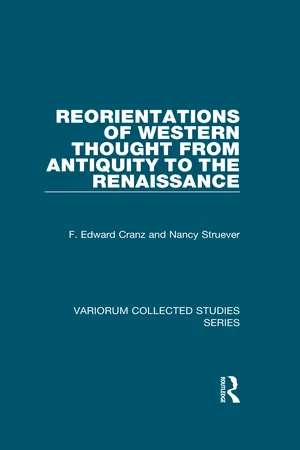
Reorientations of Western Thought from Antiquity to the Renaissance
- 400 pages
- English
- ePUB (mobile friendly)
- Available on iOS & Android
eBook - ePub
Reorientations of Western Thought from Antiquity to the Renaissance
About this book
The previous Variorum collection of studies by the late F. Edward Cranz focused specifically on Nicholas of Cusa. The present selection has an equally clear focus, but a far broader scope: it brings together materials on his major thesis, of a fundamental reorientation of the categories of thought in the Latin West, c. 1100 AD, a thesis that dominated his work from the 1960s onwards. The volume differs from the usual Variorum collection in that much of the material is hitherto unpublished, distributed only in 'samizdat' form to Cranz's friends and colleagues. Nancy Struever has collated and edited the versions of these papers, and supplied the necessary annotation for his references. It includes, too, some of the research related to his editions of the Late Antique Aristotelian commentator, Alexander Aphrodisiensis, and his early research on the reception of Classical and early Christian political thought, demonstrating the pertinence of this to the reorientation thesis. Cranz's argument, centering on Anselm's reading of Augustine, and Abelard's of Boethius, but dealing with Renaissance and Reformation figures such as Petrarch and Valla, Cusanus and Luther, Nifo and Zabarella, claims a reorientation in speculative genres of the most basic premises of the relations of mind, language, and reality. Cranz's meticulous close readings of the texts make the case that the reorientation was so deep and thorough as to problematise our modern readings of Hellenic thinkers such as Aristotle, and so radical as to be 'almost invisible' to the Medieval and post-Medieval thinkers. The definitions and distinctions of thematics in this collection are of intrinsic interest, then, to Classical and Late Antique, Medieval, Renaissance, and Early Modern intellectual historians. Indeed, Cranz's work vindicates serious intellectual historical inquiry as indispensable to our understanding of the basic motives and accomplishments of the culture of Pre-Modernity.
Table of contents
- Cover
- Series
- Title
- Copyright
- Contents
- Introduction
- Acknowledgments
- PART I: THE HISTORY OF POLITICAL THOUGHT [IN THE PATRISTIC PERIOD]
- PART II: THE FUNDAMENTAL REORIENTATION OF WESTERN THOUGHT C.1100AD
- PART III: THE ELABORATION OF THE 1100AD THESIS
- Index
Trusted by 375,005 students
Access to over 1.5 million titles for a fair monthly price.
Study more efficiently using our study tools.
Frequently asked questions
Yes, you can cancel anytime from the Subscription tab in your account settings on the Perlego website. Your subscription will stay active until the end of your current billing period. Learn how to cancel your subscription
No, books cannot be downloaded as external files, such as PDFs, for use outside of Perlego. However, you can download books within the Perlego app for offline reading on mobile or tablet. Learn how to download books offline
Perlego offers two plans: Essential and Complete
- Essential is ideal for learners and professionals who enjoy exploring a wide range of subjects. Access the Essential Library with 800,000+ trusted titles and best-sellers across business, personal growth, and the humanities. Includes unlimited reading time and Standard Read Aloud voice.
- Complete: Perfect for advanced learners and researchers needing full, unrestricted access. Unlock 1.5M+ books across hundreds of subjects, including academic and specialized titles. The Complete Plan also includes advanced features like Premium Read Aloud and Research Assistant.
We are an online textbook subscription service, where you can get access to an entire online library for less than the price of a single book per month. With over 1.5 million books across 990+ topics, we’ve got you covered! Learn about our mission
Look out for the read-aloud symbol on your next book to see if you can listen to it. The read-aloud tool reads text aloud for you, highlighting the text as it is being read. You can pause it, speed it up and slow it down. Learn more about Read Aloud
Yes! You can use the Perlego app on both iOS and Android devices to read anytime, anywhere — even offline. Perfect for commutes or when you’re on the go.
Please note we cannot support devices running on iOS 13 and Android 7 or earlier. Learn more about using the app
Please note we cannot support devices running on iOS 13 and Android 7 or earlier. Learn more about using the app
Yes, you can access Reorientations of Western Thought from Antiquity to the Renaissance by F. Edward Cranz,Nancy Struever in PDF and/or ePUB format, as well as other popular books in History & World History. We have over 1.5 million books available in our catalogue for you to explore.