eBook - ePub
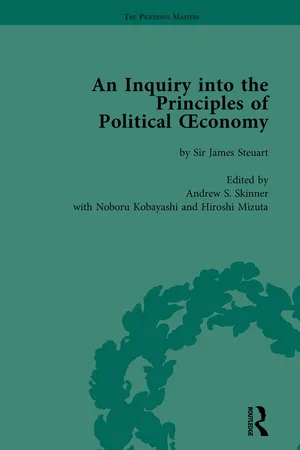
An Inquiry into the Principles of Political Oeconomy Volume 1
A Variorum Edition
- 472 pages
- English
- ePUB (mobile friendly)
- Available on iOS & Android
eBook - ePub
An Inquiry into the Principles of Political Oeconomy Volume 1
A Variorum Edition
About this book
In his four-volume "Principles", Steuart noted, for example, the economic consequences of the Seven Years' War in Germany, the state of agriculture in Picardy, and the problem of depopulation in the cities of the Austrian Netherlands.
Table of contents
- Cover
- Half Title
- Title Page
- Copyright Page
- Preface
- Abbreviations
- Introduction
- Section 1: Biographical Andrew S. Skinner
- Section 2: The First System o f Political Economy Noboru Kobayashi
- James Steuart
- Published Works
- Writings (analytical) in Manuscript
- Miscellaneous Pieces
- Note on the text
- List of authorities
- Preface
- Book I: Of Population and Agriculture
- Introduction
- CHAP. I. Of the Government of Mankind
- CHAP. II. Of the Spirit of a People
- CHAP. III. Upon what principles, and from what natural causes, do mankind multiply? and what are the effects of procreation in countries where numbers are not found to increase?
- CHAP. IV. Continuation of the same subject, with regard to the natural and immediate effects of agriculture, as to population
- CHAP. V. In what manner, and according to what principles and political causes does agriculture augment population?
- CHAP. VI. How the wants of Mankind promote their multiplication
- CHAP. VII. The effects of slavery upon the Multiplication and Employment of Mankind
- CHAP. VIII. What proportion of Inhabitants is necessary for Agriculture, and what Proportion may be usefully employed in every other Occupation?
- Chap. IX. What are the Principles which regulate the Distribution of Inhabitants into Farms, Hamlets, Villages, Towns, and Cities?
- Chap. X. Of the Consequences which result from the Separation of the two principal Classes of a People, the Farmers and the Free Hands, with regard to their Dwelling
- CHAP. XI. Of the distribution of inhabitants into classes; of the Employment, and Multiplication of them
- Chap. XII. Of the great Advantage of combining a well digested Theory and a perfect Knowledge of Facts with the practical Part of Government, in order to make a People multiply
- CHAP. XIII. Continuation of the same subject, with regard to the Necessity of having exact Lists of Births, Deaths, and Marriages, for every Class of Inhabitants in a modern Society
- CHAP. XIV. Of the Abuse of Agriculture and Population
- CHAP. XV. Application of the above Principles to the State of Population in Great-Britain
- Chap. XVI. Why are some Countries found very populous in respect of others, equally well calculated for Improvement?
- Chap. XVII. In what Manner and according to what Proportion do Plenty and Scarcity affect a People?
- Chap. XVIII. Of the Causes and Consequences of a Country’s being fully peopled
- Chap. XIX. Is the Introduction of Machines into Manufactures prejudicial to the Interest of a State, or hurtful to Population?
- CHAP. XX. Miscellaneous Observations upon Agriculture and Population
- CHAP. XXI. Recapitulation of the First Book
- Book II: Of Trade and Industry
- Introduction
- CHAP. I. Of the reciprocal Connections between Trade and Industry
- CHAP. II. Of Demand
- CHAP. III. Of the first Principles Of bartering, and how this grows into Trade
- CHAP. IV. How the prices of goods are determined by Trade
- CHAP. V. How foreign Trade opens to an industrious People, and the Consequences of it to the Merchants who set it on foot
- CHAP. VI. Consequences of the Introduction of a passive Foreign Trade among a People who live in Simplicity and Idleness
- CHAP. VII. Of double competition
- CHAP. VIII. Of what is called Expence, Profit, and Loss
- Chap. IX. The general Consequences resulting to a trading Nation, upon the opening of an active foreign Commerce
- CHAP. X. Of the balance of Work and Demand
- Chap. XI. Why in Time this Balance is destroyed
- CHAP. XII. Of the Competition between Nations
- Chap. XIII. How far the form of Government of a particular Country may be favourable or unfavourable to a competition with other nations, in matters Of Commerce
- CHAP. XIV. Security, Ease, and Happiness, no inseparable Concomitants of Trade and Industry
- CHAP. XV. A general View of the Principles to be attended to by a Statesman, who resolves to establish Trade and Industry upon a lasting Footing
- CHAP. XVI. Illustration of some Principles laid down in the former Chapter, relative to the Advancement and Support of Foreign Trade
- CHAP. XVII. Symptoms of Decay in Foreign Trade
- CHAP. XVIII. Methods of lowering the Price of Manufactures, in order to make them vendible in Foreign Markets
- CHAP. XIX. Of infant, foreign, and inland Trade, with respect to the several Principles which influence them
- CHAP. XX. Of Luxury
- CHAP. XXI. Of Physical and Political Necessaries
- CHAP. XXII. Preliminary Reflections upon inland Commerce
- CHAP. XXIII. When a Nation, Which has enriched herself by a reciprocal Commerce in Manufactures with other Nations, finds the Balance of Trade turn against her, it is her Interest to put a Stop to it altogether.
Trusted by 375,005 students
Access to over 1.5 million titles for a fair monthly price.
Study more efficiently using our study tools.
Frequently asked questions
Yes, you can cancel anytime from the Subscription tab in your account settings on the Perlego website. Your subscription will stay active until the end of your current billing period. Learn how to cancel your subscription
No, books cannot be downloaded as external files, such as PDFs, for use outside of Perlego. However, you can download books within the Perlego app for offline reading on mobile or tablet. Learn how to download books offline
Perlego offers two plans: Essential and Complete
- Essential is ideal for learners and professionals who enjoy exploring a wide range of subjects. Access the Essential Library with 800,000+ trusted titles and best-sellers across business, personal growth, and the humanities. Includes unlimited reading time and Standard Read Aloud voice.
- Complete: Perfect for advanced learners and researchers needing full, unrestricted access. Unlock 1.5M+ books across hundreds of subjects, including academic and specialized titles. The Complete Plan also includes advanced features like Premium Read Aloud and Research Assistant.
We are an online textbook subscription service, where you can get access to an entire online library for less than the price of a single book per month. With over 1.5 million books across 990+ topics, we’ve got you covered! Learn about our mission
Look out for the read-aloud symbol on your next book to see if you can listen to it. The read-aloud tool reads text aloud for you, highlighting the text as it is being read. You can pause it, speed it up and slow it down. Learn more about Read Aloud
Yes! You can use the Perlego app on both iOS and Android devices to read anytime, anywhere — even offline. Perfect for commutes or when you’re on the go.
Please note we cannot support devices running on iOS 13 and Android 7 or earlier. Learn more about using the app
Please note we cannot support devices running on iOS 13 and Android 7 or earlier. Learn more about using the app
Yes, you can access An Inquiry into the Principles of Political Oeconomy Volume 1 by Andrew S Skinner,Noboru Kobayashi,Hiroshi Mizuta in PDF and/or ePUB format, as well as other popular books in Economics & Business General. We have over 1.5 million books available in our catalogue for you to explore.