- 328 pages
- English
- ePUB (mobile friendly)
- Available on iOS & Android
eBook - ePub
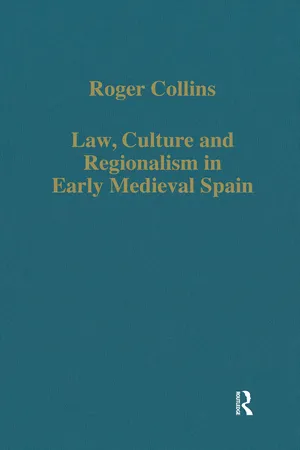
Law, Culture and Regionalism in Early Medieval Spain
About this book
Roger Collins deals here with the history of Spain, specifically Christian Spain, in the period from the 6th to the 10th century - from the Visigoths, through the time of the Arab conquests, up to the end of the era of Carolingian dominance across the Pyrenees. Particular emphasis, indeed, is placed upon the importance of this Pyrenean region, in the lands now known as France as well as those in Spain, with the author also calling into question the received notion of an Aquitanian identity in the 5th-9th centuries. Of the themes running through this volume, that of regionalism is most evident here and in the articles on the Basques, but appears equally, for instance, in the study on the relations between Merida and the Visigothic government. Similarly, legal and cultural themes provide the focus for the articles on the workings of Visigothic law in the 9th-10th centuries, or on the intellectual culture of Navarre, but recur in other parts of the collection. Two of these articles appear for the first time in English, while a third has been re-written for this volume and others supplied with additional notes or illustrations. Roger Collins traite ici de l'histoire d'Espagne et, plus particulièrement, de celle de l'Espagne chrétienne entre le 6e et le 10e siècle: des Visigoths jusqu'à la fin de l'hégémonie carolingienne au nord du pays, en passant par les conquêtes arabes. L'importance de la région pyrénéenne, recouvrant des terres qui font de nos jours partie de la France ainsi que de l'Espagne, est soulignée par l'auteur, qui remet par ailleurs en question l'idée reçue d'identité aquitaine qui prévalait entre le 5e et le 9e siècle. Certains thèmes légaux et culturels forment la base d'articles sur le fonctionnement du droit visigoth aux 9e et 10e siècles, ou encore sur la culture intellectuelle de la Navarre et ressurgissent à d'autres endroits de la collection. Le régionalisme reste cependant le plus prédominant
Table of contents
- Cover
- Series
- Half Title
- Title
- Copyright
- Contents
- Dedication
- Foreword
- I Mérida and Toledo: 550–585
- II King Leovigild and the Conversion of the Visigoths
- III Julian of Toledo and the Education of Kings in Late Seventh-Century Spain
- IV The “Autobiographical” Works of Valerius of Bierzo: their Structure and Purpose
- V Sicut lex Gothorum continet: Law and Charters in Ninth- and Tenth-Century León and Catalonia
- VI Visigothic Law and Regional Custom in Disputes in Early Medieval Spain
- VII Poetry in Ninth-Century Spain
- VIII The Ethnogenesis of the Basques
- IX Christianity and the Basques
- X The Basques in Aquitaine and Navarre: Problems of Frontier Government
- XI The Vaccaei, the Vaceti, and the rise of Vasconia
- XII Pippin I and the Kingdom of Aquitaine
- XIII Charles the Bald and Wifred the Hairy
- XIV Doubts and Certainties on the Churches of Early Medieval Spain
- XV Literacy and the Laity in Early Mediaeval Spain
- Index
Trusted by 375,005 students
Access to over 1.5 million titles for a fair monthly price.
Study more efficiently using our study tools.
Frequently asked questions
Yes, you can cancel anytime from the Subscription tab in your account settings on the Perlego website. Your subscription will stay active until the end of your current billing period. Learn how to cancel your subscription
No, books cannot be downloaded as external files, such as PDFs, for use outside of Perlego. However, you can download books within the Perlego app for offline reading on mobile or tablet. Learn how to download books offline
Perlego offers two plans: Essential and Complete
- Essential is ideal for learners and professionals who enjoy exploring a wide range of subjects. Access the Essential Library with 800,000+ trusted titles and best-sellers across business, personal growth, and the humanities. Includes unlimited reading time and Standard Read Aloud voice.
- Complete: Perfect for advanced learners and researchers needing full, unrestricted access. Unlock 1.5M+ books across hundreds of subjects, including academic and specialized titles. The Complete Plan also includes advanced features like Premium Read Aloud and Research Assistant.
We are an online textbook subscription service, where you can get access to an entire online library for less than the price of a single book per month. With over 1.5 million books across 990+ topics, we’ve got you covered! Learn about our mission
Look out for the read-aloud symbol on your next book to see if you can listen to it. The read-aloud tool reads text aloud for you, highlighting the text as it is being read. You can pause it, speed it up and slow it down. Learn more about Read Aloud
Yes! You can use the Perlego app on both iOS and Android devices to read anytime, anywhere — even offline. Perfect for commutes or when you’re on the go.
Please note we cannot support devices running on iOS 13 and Android 7 or earlier. Learn more about using the app
Please note we cannot support devices running on iOS 13 and Android 7 or earlier. Learn more about using the app
Yes, you can access Law, Culture and Regionalism in Early Medieval Spain by Roger Collins in PDF and/or ePUB format, as well as other popular books in History & World History. We have over 1.5 million books available in our catalogue for you to explore.