- 390 pages
- English
- ePUB (mobile friendly)
- Available on iOS & Android
eBook - ePub
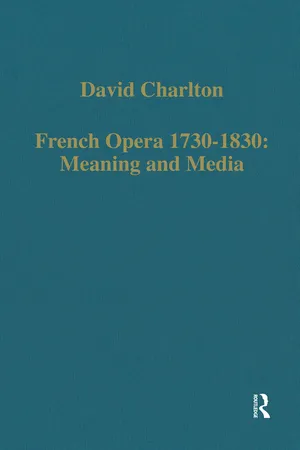
French Opera 1730-1830: Meaning and Media
About this book
The majority of these collected essays date from 1992 onwards, three of them having been specially expanded for this volume. Drawing on recent archival research and new musicological theory, they investigate distinctive qualities in French opera from early opéra comique to early grand opera. 'Media' is interpreted in terms of both narrative systems and practical theatre resources. One group of essays identifies narrative systems in 'minuet-scenes', in the diegetic romance, and in special uses of musical motives. Another group concerns the theory and æsthetics of opera, in which uses of metaphor help us interpret audience reception. A third group focuses on orchestral and staging practices, brought together in a new theory of the 'melodrama model' linking various genres from the 1780s with the world of the 1820s. French opera's relation with literature and politics is a continuing theme, explored in writings on prison scenes, Ossian, and public-private dramaturgy in grand opera. David Charlton has written widely on French music and opera topics for over 25 years. The selection of his articles presented here focuses on the period 1730-1830 when Paris was a hotbed of influential ideas in music and music theatre, with many of these ideas taken up by foreign composers. This volume assesses the French contribution to the development of Classical and Romantic styles and genres which has hitherto not received the attention it deserves.
Table of contents
- Cover
- Series
- Half Title
- Title
- Copyright
- Contents
- Preface
- Acknowledgements
- I The romance and its Cognates: Narrative, Irony and vraisemblance in Early opéra comique
- II Continuing Polarities: Opera Theory and opéra-comique
- III Orchestra and Chorus at the Comédie-Italienne (Opéra-Comique), 1755–1799
- IV The Overture to Philidor’s Le Bûcheron (1763)
- V ‘Envoicing’ the Orchestra: Enlightenment Metaphors in Theory and Practice
- VI ‘Minuet-scenes’ in Early opéra-comique
- VII Motive and Motif: Méhul before 1791
- VIII Motif and Recollection in Four Operas of Dalayrac
- IX The French Theatrical Origins of Fidelio
- X Storms, Sacrifices: the ‘Melodrama Model’ in Opera
- XI Ossian, Le Sueur and Opera
- XII The Dramaturgy of ‘Grand Opera’: Some Origins
- XIII On the Nature of ‘Grand Opera’
- XIV ‘A maître d’orchestre…conducts’: New and Old Evidence on French Practice
- Addenda et Corrigenda
- Index
Trusted by 375,005 students
Access to over 1.5 million titles for a fair monthly price.
Study more efficiently using our study tools.
Frequently asked questions
Yes, you can cancel anytime from the Subscription tab in your account settings on the Perlego website. Your subscription will stay active until the end of your current billing period. Learn how to cancel your subscription
No, books cannot be downloaded as external files, such as PDFs, for use outside of Perlego. However, you can download books within the Perlego app for offline reading on mobile or tablet. Learn how to download books offline
Perlego offers two plans: Essential and Complete
- Essential is ideal for learners and professionals who enjoy exploring a wide range of subjects. Access the Essential Library with 800,000+ trusted titles and best-sellers across business, personal growth, and the humanities. Includes unlimited reading time and Standard Read Aloud voice.
- Complete: Perfect for advanced learners and researchers needing full, unrestricted access. Unlock 1.5M+ books across hundreds of subjects, including academic and specialized titles. The Complete Plan also includes advanced features like Premium Read Aloud and Research Assistant.
We are an online textbook subscription service, where you can get access to an entire online library for less than the price of a single book per month. With over 1.5 million books across 990+ topics, we’ve got you covered! Learn about our mission
Look out for the read-aloud symbol on your next book to see if you can listen to it. The read-aloud tool reads text aloud for you, highlighting the text as it is being read. You can pause it, speed it up and slow it down. Learn more about Read Aloud
Yes! You can use the Perlego app on both iOS and Android devices to read anytime, anywhere — even offline. Perfect for commutes or when you’re on the go.
Please note we cannot support devices running on iOS 13 and Android 7 or earlier. Learn more about using the app
Please note we cannot support devices running on iOS 13 and Android 7 or earlier. Learn more about using the app
Yes, you can access French Opera 1730-1830: Meaning and Media by David Charlton in PDF and/or ePUB format, as well as other popular books in History & World History. We have over 1.5 million books available in our catalogue for you to explore.