eBook - ePub
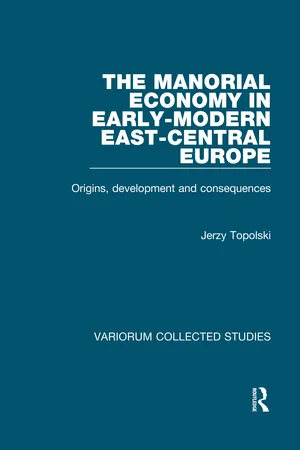
The Manorial Economy in Early-Modern East-Central Europe
Origins, Development and Consequences
- 336 pages
- English
- ePUB (mobile friendly)
- Available on iOS & Android
eBook - ePub
The Manorial Economy in Early-Modern East-Central Europe
Origins, Development and Consequences
About this book
This book is concerned with one of the fundamental problems in the economic and social history of Europe in the early modern period, namely with the bifurcation in its development: in Western Europe, the development of capitalism; in East-Central Europe, the rise of the manorial-serf economy which hampered the development of capitalism. The main motif linking together the studies in this volume is the endeavour to explain this separation. the author evaluates the different theories explaining this, and also provides further analysis of economic life, dealing with the commercial activity, economic regression, especially in Poland.
Table of contents
- Cover
- Series
- Half Title
- Title
- Copyright
- Contents
- Preface
- I Continuity and discontinuity in the development of the feudal system in Eastern Europe (Xth to XVIIth centuries)
- II The manorial-serf economy in Central and Eastern Europe in the XVIth and XVIIth centuries
- III Autour des modèles de l’explication du passage au système de la corvée en Europe centrale et orientale (XVIe-XVIIe siècles)
- IV Peasant economy before and during the first stage of industrialisation
- V Les décisions en matière d’économie dans le monde paysan en Europe centrale et Europe de l’Est du XVIe au XVIIIe siècle
- VI La dynamique du court terme et la dynamique de la longue durée dans l’explication de l’évolution agraire en Pologne du XVIe-XVIIIe siècles
- VII Croissance économique de la Pologne du Xe au XXe siècle: remarques méthodiques et tentatives d’évaluation
- VIII La réféodalisation dans l’économie des grands domaines en Europe centrale et orientale (XVIe-XVIIIe siècles)
- IX La regression économique en Pologne du XVIe au XVIIIe siècle
- X Technique agricole et la crise: l’assolement triennal en Pologne aux XVIe-XVIIIe siècle
- XI Polish economy in the XVIIIth century
- XII Methodological foundations of comparative studies of large regions of the world
- XIII The structure of the Polish nobility in the XVIth and XVIIth century: some new findings and reflections
- XIV Commerce des denrées agricoles et croissance économique de la zone baltique aux XVIe et XVIIe siècles
- XV Faktoren der Entstehung eines internationalen Jahrmarktnetzes in Polen im XVI. und XVII. Jahrhundert
- XVI The role of Gniezno in international trade
- XVII Jan Rutkowski (1886–1949) and his conception of synthesis in historical science
- XVIII The model method in economic history
- Index
Trusted by 375,005 students
Access to over 1.5 million titles for a fair monthly price.
Study more efficiently using our study tools.
Frequently asked questions
Yes, you can cancel anytime from the Subscription tab in your account settings on the Perlego website. Your subscription will stay active until the end of your current billing period. Learn how to cancel your subscription
No, books cannot be downloaded as external files, such as PDFs, for use outside of Perlego. However, you can download books within the Perlego app for offline reading on mobile or tablet. Learn how to download books offline
Perlego offers two plans: Essential and Complete
- Essential is ideal for learners and professionals who enjoy exploring a wide range of subjects. Access the Essential Library with 800,000+ trusted titles and best-sellers across business, personal growth, and the humanities. Includes unlimited reading time and Standard Read Aloud voice.
- Complete: Perfect for advanced learners and researchers needing full, unrestricted access. Unlock 1.5M+ books across hundreds of subjects, including academic and specialized titles. The Complete Plan also includes advanced features like Premium Read Aloud and Research Assistant.
We are an online textbook subscription service, where you can get access to an entire online library for less than the price of a single book per month. With over 1.5 million books across 990+ topics, we’ve got you covered! Learn about our mission
Look out for the read-aloud symbol on your next book to see if you can listen to it. The read-aloud tool reads text aloud for you, highlighting the text as it is being read. You can pause it, speed it up and slow it down. Learn more about Read Aloud
Yes! You can use the Perlego app on both iOS and Android devices to read anytime, anywhere — even offline. Perfect for commutes or when you’re on the go.
Please note we cannot support devices running on iOS 13 and Android 7 or earlier. Learn more about using the app
Please note we cannot support devices running on iOS 13 and Android 7 or earlier. Learn more about using the app
Yes, you can access The Manorial Economy in Early-Modern East-Central Europe by Jerzy Topolski in PDF and/or ePUB format, as well as other popular books in History & World History. We have over 1.5 million books available in our catalogue for you to explore.