- 382 pages
- English
- ePUB (mobile friendly)
- Available on iOS & Android
eBook - ePub
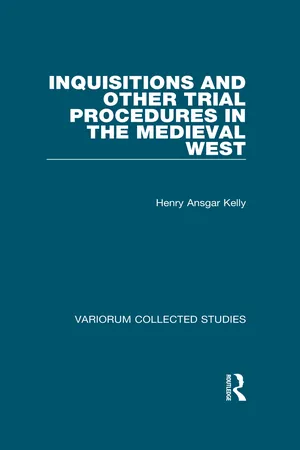
Inquisitions and Other Trial Procedures in the Medieval West
About this book
'Inquisition' was the new form of criminal procedure that was developed by the lawyer-pope Innocent III and given definitive form at the Fourth Lateran Council of 1215. It has since developed a notoriety which has obscured the reality of the procedure, and it is this that Professor Kelly is first concerned with here. In contrast to the old Roman system of relying on a volunteer accuser-prosecutor, who would be punished in case of acquittal, the inquisitorial judge himself served as investigator, accuser, prosecutor, and final judge. A probable-cause requirement and other safeguards were put in place to protect the rights of the defendant, but as time went on some of these defences were modified, abused, or ignored, most notoriously among papally appointed heresy-inquisitors; but in all cases appeal and redress were at least theoretically possible. Unlike continental practice, in England inquisitorial procedure was mainly limited to the local church courts, while on the secular side native procedures developed, most notably a system of multiple investigators/accusers/judges, known collectively as the jury. Private accusers, however, were still to be seen, illustrated here in the final pair of studies on 'appeals' of sexual rape.
Table of contents
- Cover
- Series
- Dedication
- Title
- Copyright
- Contents
- Introduction
- Acknowledgements
- I Inquisition and the Prosecution of Heresy: Misconceptions and Abuses Church History 58. Chicago, IL, 1989
- II Inquisitorial Due Process and the Status of Secret Crimes Monumenta iuris canonici, Series C: Subsidia, Vol. 9 = Proceedings of the Eighth International Congress of Medieval Canon Law (UCSD, 1988), ed. Stanley Chodorow. Vatican City, 1992
- III The Right to Remain Silent: Before and After Joan of Arc Speculum 68, no. 4. Cambridge, MA, 1993
- IV Joan of Arc's Last Trial: The Attack of the Devil's Advocates Fresh Verdicts on Joan of Arc, ed. Bonnie Wheeler and Charles T. Wood. New York/London, 1996
- V Trial Procedures against Wyclif and Wycliffites in England and at the Council of Constance Huntington Library Quarterly 61, no. 1. San Marino, CA, 1999
- VI Lollard Inquisitions: Due and Undue Process The Devil, Heresy and Witchcraft in the Middle Ages: Essays in Honor of Jeffrey B. Russell, ed. Alberto Ferreiro. Leiden, 1998
- VII English Kings and the Fear of Sorcery Mediaeval Studies 39. Toronto, 1977
- VIII The Case Against Edward IV's Marriage and Offspring: Secrecy; Witchcraft; Secrecy; Precontract The Ricardian 11, no. 142. Haywards Heath, West Sussex, 1998
- IX Statutes of Rapes and Alleged Ravishers of Wives: A Context for the Charges against Thomas Malory, Knight Viator 28. Turnhout, 1997
- X Meanings and Uses of Raptus in Chaucer's Time Studies in the Age of Chaucer 20. Columbus, OH, 1998
- Addenda and Corrigenda
- Index
Trusted by 375,005 students
Access to over 1.5 million titles for a fair monthly price.
Study more efficiently using our study tools.
Frequently asked questions
Yes, you can cancel anytime from the Subscription tab in your account settings on the Perlego website. Your subscription will stay active until the end of your current billing period. Learn how to cancel your subscription
No, books cannot be downloaded as external files, such as PDFs, for use outside of Perlego. However, you can download books within the Perlego app for offline reading on mobile or tablet. Learn how to download books offline
Perlego offers two plans: Essential and Complete
- Essential is ideal for learners and professionals who enjoy exploring a wide range of subjects. Access the Essential Library with 800,000+ trusted titles and best-sellers across business, personal growth, and the humanities. Includes unlimited reading time and Standard Read Aloud voice.
- Complete: Perfect for advanced learners and researchers needing full, unrestricted access. Unlock 1.5M+ books across hundreds of subjects, including academic and specialized titles. The Complete Plan also includes advanced features like Premium Read Aloud and Research Assistant.
We are an online textbook subscription service, where you can get access to an entire online library for less than the price of a single book per month. With over 1.5 million books across 990+ topics, we’ve got you covered! Learn about our mission
Look out for the read-aloud symbol on your next book to see if you can listen to it. The read-aloud tool reads text aloud for you, highlighting the text as it is being read. You can pause it, speed it up and slow it down. Learn more about Read Aloud
Yes! You can use the Perlego app on both iOS and Android devices to read anytime, anywhere — even offline. Perfect for commutes or when you’re on the go.
Please note we cannot support devices running on iOS 13 and Android 7 or earlier. Learn more about using the app
Please note we cannot support devices running on iOS 13 and Android 7 or earlier. Learn more about using the app
Yes, you can access Inquisitions and Other Trial Procedures in the Medieval West by H.A. Kelly in PDF and/or ePUB format, as well as other popular books in History & World History. We have over 1.5 million books available in our catalogue for you to explore.