eBook - ePub
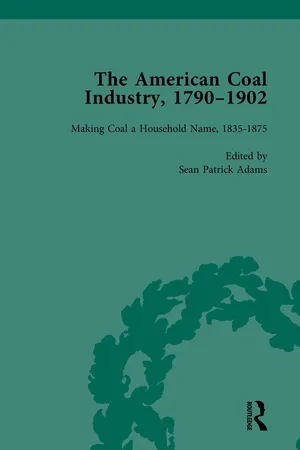
The American Coal Industry 1790-1902, Volume II
Making Coal a Household Name, 1835-1875
- 396 pages
- English
- ePUB (mobile friendly)
- Available on iOS & Android
eBook - ePub
The American Coal Industry 1790-1902, Volume II
Making Coal a Household Name, 1835-1875
About this book
The emergence of coal-based fuel economy over the course of the nineteenth century was one of the most significant features of America's Industrial Revolution, but the transition from wood to mineral energy sources was a gradual one that transpired over a number of decades. The documents in these volumes recreate the institutional history of the American coal industry in the nineteenth century - providing a first-hand perspective on the developments in regard to political economy, business structure and competition, the rise of formal trade unions, and the creation of a national coal trade. Although the collection strives to be wide-ranging in region and theme, the Pennsylvania anthracite coal trade forms the thematic backbone as it became the most important American mineral resource to see successful development throughout the nineteenth century. Consequently it saw unprecedented levels of intervention by the federal government. The texts for this collection were selected for their accessibility to modern readers as well as their relationship to a series of common themes across the nineteenth century American coal industry - with headnotes and annotations provided to explain their context and the reasons for their inclusion. The second volume, following on from the first, traces the continuation of the anthracite boom and also introduces new concerns for the coal industry. Overall the period from 1835-1875 saw the American coal trade expand from a hit-or-miss business dominated by risk-taking proprietary firms to a well-funded industry that employed the resources of state governments, large mining corporations and powerful railroads in order to keep a steady stream of mineral fuel flowing to the growing industrial and commercial heating markets of the United States. The transformation generated many conflicts - which are illustrated by the documents in this volume.
Table of contents
- Cover
- Half Title
- Contents of the Edition
- Title Page
- Copyright Page
- Table of Contents
- Introduction
- Denison Olmsted, ‘Observations on the Use of Anthracite Coal’, in The American Almanac and Repository of Useful Knowledge for the Year 1837 (1837)
- Caleb Cushing, ‘Article X. The Anthracite Coal Trade of Pennsylvania’, North American Review (1836)
- William Williams Mather, Report on the Geological Reconnaissance of Kentucky, Made in 1838 (1839), extract
- [Charles Ellet], An Address to the Stockholders of the Schuylkill Navigation Company, in Reply to a Pamphlet Circulated by the Reading Rail Road Company (1844)
- Isaac Lea, Report to the Directors of the Pequa Railroad and Improvement Company (1849)
- Is Coal Mining a Safe Investment Bet?
- ‘A Correspondent of the New York Journal of Commerce’, ‘Visit to a Coal Mine’, Hunt’s Merchant Magazine (1854)
- David Thomas Ansted, ‘The Ohio and Kanawha Valleys, and the Coal Basin of the Kanawha’, in Scenery, Science and Art (1854)
- Herman Haupt, The Coal Business on the Pennsylvania Railroad. A Communication Addressed to the President, Directors, and Stockholders of the Pennsylvania Railroad, on the Cost of Transportation (1857)
- Little Rock Mining Company, A Statement of the Operations of the Little Rock Mining Co. in the La Salle Coal Basin. Cheap Fuel for Chicago and the North-West (1858)
- Volney L. Maxwell, Mineral Coal. Two Lectures, by Volney L. Maxwell, Esq., Read at Institute Hall, Wilkes-Barre, Penna, in February, 1858 (1869)
- Eli Bowen, Coal and the Coal Trade (1862)
- ‘Stockholders of the Consumers’ Mutual Coal Co.’, The Consumers Mutual Coal Company (1864)
- ‘The Boatmen of the Schuylkill Canal’, Appeal of the Boatmen of the Schuylkill Canal, to the Coal Consumers, Coal Producers and the Coal Land Owners, for Protection Against the Intended Monopoly of the Carrying Companies from the Schuylkill Coal Regions (1864)
- C. B. Conant, ‘Coal Fever: The Price and Prospects of Anthracite Coal’, Merchants’ Magazine and Commercial Review (1865)
- George Derby, An Inquiry into the Influence of Anthracite Fires upon Health; with Remarks upon Artificial Moisture, and the Best Modes of Warming Houses, 2nd edn (1868), extract
- J. C. Bayles, ‘The Coal Question’, Hunt’s Merchant Magazine (1869)
- Charles Barnard, ‘From Hod to Mine. In Seven Lifts’, American Homes (1874)
- Editorial Notes
- Silent Corrections
- List of Sources
Trusted by 375,005 students
Access to over 1.5 million titles for a fair monthly price.
Study more efficiently using our study tools.
Frequently asked questions
Yes, you can cancel anytime from the Subscription tab in your account settings on the Perlego website. Your subscription will stay active until the end of your current billing period. Learn how to cancel your subscription
No, books cannot be downloaded as external files, such as PDFs, for use outside of Perlego. However, you can download books within the Perlego app for offline reading on mobile or tablet. Learn how to download books offline
Perlego offers two plans: Essential and Complete
- Essential is ideal for learners and professionals who enjoy exploring a wide range of subjects. Access the Essential Library with 800,000+ trusted titles and best-sellers across business, personal growth, and the humanities. Includes unlimited reading time and Standard Read Aloud voice.
- Complete: Perfect for advanced learners and researchers needing full, unrestricted access. Unlock 1.5M+ books across hundreds of subjects, including academic and specialized titles. The Complete Plan also includes advanced features like Premium Read Aloud and Research Assistant.
We are an online textbook subscription service, where you can get access to an entire online library for less than the price of a single book per month. With over 1.5 million books across 990+ topics, we’ve got you covered! Learn about our mission
Look out for the read-aloud symbol on your next book to see if you can listen to it. The read-aloud tool reads text aloud for you, highlighting the text as it is being read. You can pause it, speed it up and slow it down. Learn more about Read Aloud
Yes! You can use the Perlego app on both iOS and Android devices to read anytime, anywhere — even offline. Perfect for commutes or when you’re on the go.
Please note we cannot support devices running on iOS 13 and Android 7 or earlier. Learn more about using the app
Please note we cannot support devices running on iOS 13 and Android 7 or earlier. Learn more about using the app
Yes, you can access The American Coal Industry 1790-1902, Volume II by Sean Patrick Adams in PDF and/or ePUB format, as well as other popular books in History & World History. We have over 1.5 million books available in our catalogue for you to explore.