- 352 pages
- English
- ePUB (mobile friendly)
- Available on iOS & Android
eBook - ePub
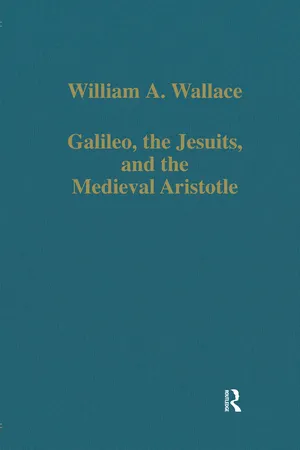
Galileo, the Jesuits, and the Medieval Aristotle
About this book
The conventional opposition of scholastic Aristotelianism and humanistic science has been increasingly questioned in recent years, and in these articles William Wallace aims to demonstrate that a progressive Aristotelianism in fact provided the foundation for Galileo's scientific discoveries. The first series of articles supply much of the documentary evidence that has led the author to the sources for Galileo's early notebooks: they show how Galileo, while teaching or preparing to teach at Pisa, actually appropriated much of his material from Jesuit lectures given at the Collegio Romano in 1598-90. The next articles then trace a number of key elements in Galileo's later work, mainly relating to logical methodology and natural philosophy, back to sources in medieval Aristotelian thought, notably in the writings of Albert the Great and Thomas Aquinas. La mise en opposition conventionnelle entre l'aristotélisme scolastique et la science humaniste a été de plus en plus remise en question durant les dernières années. Tout au long de ces articles, William Wallace tente de démontrer que l'aristotélisme progressif a en fait pourvu le fondement des découvertes scientifiques de Galilée. Le premier groupe d'articles fournit la plupart des preuves documentées qui ont mené l'auteur aux sources des premiers cahiers de notes de Galilée; on y voit comment celui-ci, alors qu'il enseignait, ou s'apprêtait à enseigner à Pise, s'était en fait approprié quantité de donneés issues de cours magistraux jésuites qui avaient été donnés au Collegio Romano entre 1588 et 90. Les études suivantes retracent à leur tour un certain nombre d'elements-clef des travaux ultérieurs de Galilée, se rapportant plus particulièrement à la méthodologie logique et a la philosophie naturelle, jusqu'à leurs sources dans la pensée aristotélicienne du Moyen Age, notamment dans les écrits d'Albert le Grand et de Thomas d'Aquin.
Table of contents
- Cover
- Series
- Half Title
- Title
- Copyright
- Contents
- Preface
- Galileo and His Jesuit Sources
- The Medieval Aristotle
- Addenda
- Index
Trusted by 375,005 students
Access to over 1.5 million titles for a fair monthly price.
Study more efficiently using our study tools.
Frequently asked questions
Yes, you can cancel anytime from the Subscription tab in your account settings on the Perlego website. Your subscription will stay active until the end of your current billing period. Learn how to cancel your subscription
No, books cannot be downloaded as external files, such as PDFs, for use outside of Perlego. However, you can download books within the Perlego app for offline reading on mobile or tablet. Learn how to download books offline
Perlego offers two plans: Essential and Complete
- Essential is ideal for learners and professionals who enjoy exploring a wide range of subjects. Access the Essential Library with 800,000+ trusted titles and best-sellers across business, personal growth, and the humanities. Includes unlimited reading time and Standard Read Aloud voice.
- Complete: Perfect for advanced learners and researchers needing full, unrestricted access. Unlock 1.5M+ books across hundreds of subjects, including academic and specialized titles. The Complete Plan also includes advanced features like Premium Read Aloud and Research Assistant.
We are an online textbook subscription service, where you can get access to an entire online library for less than the price of a single book per month. With over 1.5 million books across 990+ topics, we’ve got you covered! Learn about our mission
Look out for the read-aloud symbol on your next book to see if you can listen to it. The read-aloud tool reads text aloud for you, highlighting the text as it is being read. You can pause it, speed it up and slow it down. Learn more about Read Aloud
Yes! You can use the Perlego app on both iOS and Android devices to read anytime, anywhere — even offline. Perfect for commutes or when you’re on the go.
Please note we cannot support devices running on iOS 13 and Android 7 or earlier. Learn more about using the app
Please note we cannot support devices running on iOS 13 and Android 7 or earlier. Learn more about using the app
Yes, you can access Galileo, the Jesuits, and the Medieval Aristotle by William A. Wallace in PDF and/or ePUB format, as well as other popular books in History & World History. We have over 1.5 million books available in our catalogue for you to explore.