- 314 pages
- English
- ePUB (mobile friendly)
- Available on iOS & Android
eBook - ePub
About this book
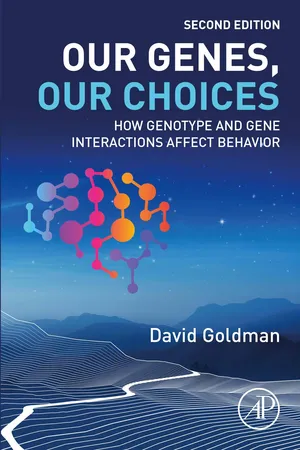
Our Genes, Our Choices: How Genotype and Gene Interactions Affect Behavior, Second Edition explains how the complexity of human behavior, including concepts of free will, derives from a relatively small number of genes, which direct neurodevelopmental sequences. Are people free to make choices, or do genes determine behavior? Paradoxically, the answer to both questions is "yes," because of neurogenetic individuality, a new theory with profound implications. Here, author David Goldman uses judicial, political, medical, and ethical examples to illustrate that this lifelong process is guided by individual genotype, molecular and physiologic principles, as well as by randomness and environmental exposures, a combination of factors that we choose and do not choose. Written in an authoritative yet accessible style, the book includes practical descriptions of the function of DNA, discusses the scientific and historical bases of genethics, and introduces the topics of epigenetics and the predictive power of behavioral genetics.
In the decade since the first edition published, knowledge of genetic influences on the neurogenetic underpinnings of behavior has been transformed by genomic technologies. Genome-Wide Association studies, for example, have revealed that hundreds of genes influence vulnerability to psychiatric disease and innate predisposition to risk-taking behaviors. This new edition has been thoroughly revised to focus on free will and its neurogenetic origins. In addition, the use of polygenic scores for behavioral prediction are discussed in-depth, reflecting the GWAS (Genome-Wide Association Study) revolution and combined use of genetic predictors in polygenic scores. Sections on epigenetics are also substantially expanded throughout, better defined, and tied to neuroplasticity and gene-environment interaction. Figures and illustrations have been added or improved throughout, and disease nosology and terminology has been updated.
- Updates on the previous edition which was the First Prize winner of the 2013 BMA Medical Book Award for Basic and Clinical Sciences
- Poses and resolves challenges to moral responsibility raised by modern genetics and neuroscience
- Analyzes the neurogenetic origins of human behavior and free will
- Features expanded sections on the neurogenetic basis of free will, polygenic risk scores, and epigenetic influence over behavior, as well as improved figures and updated terminology
Information
Table of contents
- Cover
- Front Matter
- Table of Contents
- Copyright
- Disclaimer
- Dedication
- About the author
- Preface
- List of Illustrations
- Chapter 1 : Introduction: Thou mayest choose
- Chapter 2 : The jinn in the genome
- Chapter 3 : 2B or not 2B?
- Chapter 4 : Stephen Mobley and his X chromosome
- Chapter 5 : Dial multifactorial for murder: The intersection of genes and culture
- Chapter 6 : Distorted capacity: The measure of the impaired will
- Chapter 7 : Distorted capacity: Neuropsychiatric diseases and the impaired will
- Chapter 8 : Inheritance of behavior and genes “for” behavior: Gene wars
- Chapter 9 : The scientific and historic basis of genethics
- Chapter 10 : The world is double helical: DNA, RNA, and proteins, in a few easy pieces
- Chapter 11 : The stochastic brain: From DNA blueprint to behavior
- Chapter 12 : Reintroducing genes and behavior
- Chapter 13 : Warriors and worriers
- Chapter 14 : How many genes does it take to make a behavior?
- Chapter 15 : The genesis and genetics of sexual behavior
- Chapter 16 : Gene-by-environment interaction
- Chapter 17 : The epigenetic revolution: The imprint of the environment on the genome
- Chapter 18 : Time out for free will
- Chapter 19 : The top-down neurogenesis of free will
- Chapter 20 : Neurogenetic origins of free will
- Index
- A
Trusted by 375,005 students
Access to over 1.5 million titles for a fair monthly price.
Study more efficiently using our study tools.
Frequently asked questions
Yes, you can cancel anytime from the Subscription tab in your account settings on the Perlego website. Your subscription will stay active until the end of your current billing period. Learn how to cancel your subscription
No, books cannot be downloaded as external files, such as PDFs, for use outside of Perlego. However, you can download books within the Perlego app for offline reading on mobile or tablet. Learn how to download books offline
Perlego offers two plans: Essential and Complete
- Essential is ideal for learners and professionals who enjoy exploring a wide range of subjects. Access the Essential Library with 800,000+ trusted titles and best-sellers across business, personal growth, and the humanities. Includes unlimited reading time and Standard Read Aloud voice.
- Complete: Perfect for advanced learners and researchers needing full, unrestricted access. Unlock 1.5M+ books across hundreds of subjects, including academic and specialized titles. The Complete Plan also includes advanced features like Premium Read Aloud and Research Assistant.
We are an online textbook subscription service, where you can get access to an entire online library for less than the price of a single book per month. With over 1.5 million books across 990+ topics, we’ve got you covered! Learn about our mission
Look out for the read-aloud symbol on your next book to see if you can listen to it. The read-aloud tool reads text aloud for you, highlighting the text as it is being read. You can pause it, speed it up and slow it down. Learn more about Read Aloud
Yes! You can use the Perlego app on both iOS and Android devices to read anytime, anywhere — even offline. Perfect for commutes or when you’re on the go.
Please note we cannot support devices running on iOS 13 and Android 7 or earlier. Learn more about using the app
Please note we cannot support devices running on iOS 13 and Android 7 or earlier. Learn more about using the app
Yes, you can access Our Genes, Our Choices by David Goldman in PDF and/or ePUB format, as well as other popular books in Biological Sciences & Genetics & Genomics. We have over 1.5 million books available in our catalogue for you to explore.