- 568 pages
- English
- ePUB (mobile friendly)
- Available on iOS & Android
eBook - ePub
Nano-enabled Agrochemicals in Agriculture
About this book
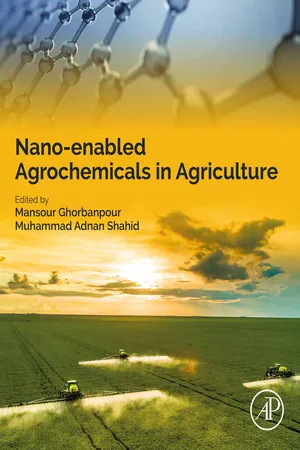
Nano-Enabled Agrochemicals in Agriculture presents a targeted overview of the safe implementation of nanotechnologies within agricultural and horticultural settings, with the purpose of achieving enhanced production while maintaining ecological integrity. The growing global request for agricultural crops and products requires high standards of quality and safety, which has stimulated the search for new technologies that preserve their quality and delay their decomposition. Nanotechnology may boost plant production by improving nutrient uptake/use efficiency with nanoformulations of fertilizers and agrochemicals for plant enhancement, detection and treatment of diseases, and host-parasite interactions at the molecular level using nanosensors. It also may improve plant disease diagnostics, removal of contaminants from soil and water, postharvest management of vegetables and flowers, and reclamation of salt-affected soils.
Although the markets for nanoproducts and nanoformulations continue to increase, there are also growing concerns regarding the fate and behavior of nanomaterials in environmental systems. Exploring important topics related to nanotechnology and nanomaterials, the book includes the use of nanochemicals in insect pest management, as nanofungicides, nanoherbicides, micronutrient supply, and nanosensors to monitor crop and soil health conditions, from detection of agrochemicals to their slow release of agrochemicals, and their impact on related environs.
This book will serve as an excellent resource for a wide range of plant scientists who have concerns about nanomaterial interactions with terrestrial and aquatic plants.
- Focuses on emerging important topics related to nanotechnology and nanomaterials on agricultural systems
- Emphasizes new applications of nanomaterials in the agricultural sciences, from fertilizers to irrigation systems
- Addresses concerns about nanomaterial interactions with terrestrial and aquatic plants
Information
Table of contents
- Cover
- Front Matter
- Table of Contents
- Copyright
- Contributors
- List of Illustrations
- List of Tables
- Chapter 1 : The role of nanotechnology to combat major recent worldwide challenges
- Chapter 2 : Classification of nanomaterials and their physical and chemical nature
- Chapter 3 : The theory of relativity effect in nanoparticles: Deciphering of unknown effects with nano-puzzle and nano-domini
- Chapter 4 : Eco-friendly routes for obtaining nanoparticles and their application in agro-industry
- Chapter 5 : The mechanisms involved in the synthesis of biogenic nanoparticles
- Chapter 6 : Advanced analytical techniques for physico-chemical characterization of nano-materials
- Chapter 7 : Nanotechnology for cargo delivery with a special emphasis on pesticide, herbicide, and fertilizer
- Chapter 8 : Nano-biofertilizers for enhanced nutrient use efficiency
- Chapter 9 : Nanopriming technology for improving crop plants under stressful conditions: concept and methods
- Chapter 10 : Applications of nanotechnology in precision agriculture
- Chapter 11 : Algal nanoparticles and their potential application in agriculture
- Chapter 12 : Silver and zinc nanoparticles in the improvement of agricultural crops
- Chapter 13 : Biogenic nanoparticles and their application for removal of organic contaminants from water and wastewater
- Chapter 14 : Stimulatory role of nanomaterials on agricultural crops
- Chapter 15 : Green synthesis of nanoparticles and their uses in agriculture
- Chapter 16 : A comprehensive review on nanopesticides and nanofertilizers—A boon for agriculture
- Chapter 17 : Nano-enabled agrochemicals for sustainable agriculture
- Chapter 18 : Synthesis of nanofungicides by encapsulating fungicide nanoparticles using functionalized graphene and its application against phytopathogenic Rhizoctonia solani
- Chapter 19 : Effects of nanoparticles on phytotoxicity, cytotoxicity, and genotoxicity in agricultural crops
- Chapter 20 : Engineered nanomaterial-mediated changes in the growth and development of common agricultural crops
- Chapter 21 : Biosynthesis and green synthesis of nanoparticles and their use in agriculture
- Chapter 22 : Nanoparticle-based solutions for diagnosis and management of fungal plant pathogens
- Chapter 23 : Current status and future prospects of nanoparticles as plant genetic materials carrier
- Chapter 24 : Current developments in nanotechnology for the growth of different industrial sectors: 2010–20
- Chapter 25 : Impacts of nanomaterials on metabolic profiling of agricultural crops
- Chapter 26 : Polymeric nanoparticle-based insecticide: A critical review of agriculture production
- Chapter 27 : Nano–delivery system: In the agriculture sector
- Chapter 28 : Nanotechnology, a new tool for agriculture and agroindustry
- Chapter 29 : Synthesis of different TiO2 nanostructures using central composite design optimization method and application of TiO2-nanobelt for water microorganism's purification
- Index
- A
Trusted by 375,005 students
Access to over 1.5 million titles for a fair monthly price.
Study more efficiently using our study tools.
Frequently asked questions
Yes, you can cancel anytime from the Subscription tab in your account settings on the Perlego website. Your subscription will stay active until the end of your current billing period. Learn how to cancel your subscription
No, books cannot be downloaded as external files, such as PDFs, for use outside of Perlego. However, you can download books within the Perlego app for offline reading on mobile or tablet. Learn how to download books offline
Perlego offers two plans: Essential and Complete
- Essential is ideal for learners and professionals who enjoy exploring a wide range of subjects. Access the Essential Library with 800,000+ trusted titles and best-sellers across business, personal growth, and the humanities. Includes unlimited reading time and Standard Read Aloud voice.
- Complete: Perfect for advanced learners and researchers needing full, unrestricted access. Unlock 1.5M+ books across hundreds of subjects, including academic and specialized titles. The Complete Plan also includes advanced features like Premium Read Aloud and Research Assistant.
We are an online textbook subscription service, where you can get access to an entire online library for less than the price of a single book per month. With over 1.5 million books across 990+ topics, we’ve got you covered! Learn about our mission
Look out for the read-aloud symbol on your next book to see if you can listen to it. The read-aloud tool reads text aloud for you, highlighting the text as it is being read. You can pause it, speed it up and slow it down. Learn more about Read Aloud
Yes! You can use the Perlego app on both iOS and Android devices to read anytime, anywhere — even offline. Perfect for commutes or when you’re on the go.
Please note we cannot support devices running on iOS 13 and Android 7 or earlier. Learn more about using the app
Please note we cannot support devices running on iOS 13 and Android 7 or earlier. Learn more about using the app
Yes, you can access Nano-enabled Agrochemicals in Agriculture by Mansour Ghorbanpour,Muhammad Adnan Shahid in PDF and/or ePUB format, as well as other popular books in Technology & Engineering & Biotechnology. We have over 1.5 million books available in our catalogue for you to explore.