eBook - ePub
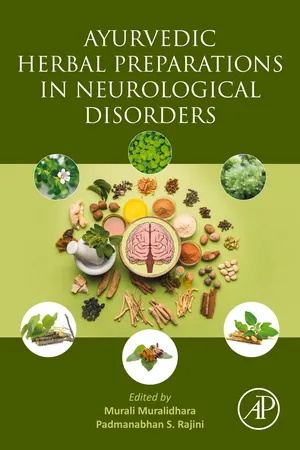
Ayurvedic Herbal Preparations in Neurological Disorders
- 588 pages
- English
- ePUB (mobile friendly)
- Available on iOS & Android
eBook - ePub
Ayurvedic Herbal Preparations in Neurological Disorders
About this book
Ayurvedic Herbal Preparations in Neurological Disorders provides a comprehensive and mechanistic understanding of the therapeutic potential of many ayurvedic herbal preparations in disease management. Examining research data for evidence-based ayurvedic approaches, this volume begins with a focused introduction to major ayurvedic plants, discussing various mechanisms underlying their neuromodulatory potential in preclinical and clinical settings. Major subsets of ayurvedic plants are discussed, including Bacopa monnieri, Centella asiatica, Withania somnifera, and others. This volume outlines the importance of integrative approaches along with existing treatments in the intervention/management of Alzheimer's disease, Parkinson's disease, depressive mood disorders, epilepsy, schizophrenia, and more.
More than a mere compilation of studies, this volume identifies relevant gaps for future research avenues and encourages interdisciplinary collaboration and sharing of knowledge to together identify the most efficacious ayurvedic approaches. Highlighting recent developments (e.g., Ayurgenomics, Ayurahar) and other pertinent research for neuroprotection, this book is crucial for anyone researching or working in the field of neurological disorder treatment and prevention.
- Provides a focused introduction to major Ayurvedic plants and their therapeutic potential in the management of neurodegenerative diseases
- Discusses various mechanisms underlying the neuromodulatory potential of several ayurvedic herbal preparations in preclinical and clinical settings
- Examines major subsets of ayurvedic plants (e.g., Bacopa monnieri, Centella asiatica, Withaniasomnifera, and others) and potential of several other plants in various neurological disorders
- Outlines the importance of integrative approaches along with existing treatments in the intervention/management of depressive mood disorders, epilepsy, schizophrenia, and more
- Highlights recent developments (e.g., Ayurgenomics, Ayurahar) and other pertinent research for neuroprotection
Information
Table of contents
- Cover
- Front Matter
- Table of Contents
- Copyright
- Dedication
- List of contributors
- Preface
- Acknowledgments
- List of Illustrations
- List of Tables
- Chapter One : Ayurveda: Ayurvedic herbs against neurological disorders: are they golden nuggets?
- Chapter Two : Overview of approaches in ayurveda for neurological health and disorders
- Chapter Three : Therapeutic efficacy of ayurvedic polyherbal formulations (PHF): Interactive mechanisms and broad-spectrum activities against neurological disorders
- Chapter Four : Insights into the neuroprotective strategies to alleviate neurodegenerative conditions: Role of Ayurvedic herbs and their bioactives
- Chapter Five : Multiple broad spectrum Neuromodulatory effects of Bacopa monnieri and Centella asiatica: mechanistic considerations
- Chapter Six : Exploring the neuro-ameliorative propensity of Withania somnifera—Indian ginseng
- Chapter Seven : Acorus calamus in neurological disorders: a detailed overview
- Chapter Eight : Synaptic and mitochondrial alterations in traumatic brain injury (TBI): neuroprotective effects of phytochemicals and herbal products
- Chapter Nine : Dietary regulation of miRNAs involved in neurodegenerative diseases: role of nutraceuticals/Ayurvedic herbals
- Chapter Ten : Propensity of ayurvedic herbs as potential modulators of gut microbiome (GM): implications in neurological disorders
- Chapter Eleven : Genetic modulators of neurodegenerative diseases and their amelioration by natural products
- Chapter Twelve : Therapeutic propensity and pharmacological Action of herbal extract in Parkinson's Disease
- Chapter Thirteen : Phytochemicals for neurodegeneration and neuroinflammation: medicine of the future or a mirage?
- Chapter Fourteen : Ayurvedic herbs–derived cognitive enhancers for the management of Alzheimer's disease (AD)
- Chapter Fifteen : Role of ayurvedic herbs in the management of major depressive disorders (MDD)
- Chapter Sixteen : Mass spectrometry–based approaches for the identification of molecular mechanism of action of ayurvedic medicines in Parkinson disease
- Chapter Seventeen : Insights into the efficacy of Drosophila as a predictive preclinical model to understand the mechanism of neuroprotection of ayurvedic herbals
- Chapter Eighteen : Parkinson's Disease models of Caenorhabditis elegans to study mechanism of action of Ayurvedic nootropics
- Chapter Nineteen : Utilization of zebrafish as a preclinical model for obtaining insights into molecular mechanisms of the neuroprotective role of ayurvedic herbal preparations
- Chapter Twenty : Indian spices and their bioactives in neurological disorders
- Chapter Twenty One : Ayurveda herbs and herbal preparations in the management of neurological disorders
- Chapter Twenty Two : Yoga as a therapeutic intervention for the management of neurodegenerative disorders
- Chapter Twenty Three : Nanotechnology-enabled phytochemicals from Ayurvedic herbs for the treatment of neurodegenerative disorders: an overview
- Chapter Twenty Four : Neuroprotective potential of plant-based bioactive polysaccharides: molecular mechanisms and therapeutic advances
- Chapter Twenty Five : Ayurvedic science and herbaceuticals in neurological disorders: An overview of the current scenario; challenges and future perspectives
- Glossary
- Index
- A
Trusted by 375,005 students
Access to over 1.5 million titles for a fair monthly price.
Study more efficiently using our study tools.
Frequently asked questions
Yes, you can cancel anytime from the Subscription tab in your account settings on the Perlego website. Your subscription will stay active until the end of your current billing period. Learn how to cancel your subscription
No, books cannot be downloaded as external files, such as PDFs, for use outside of Perlego. However, you can download books within the Perlego app for offline reading on mobile or tablet. Learn how to download books offline
Perlego offers two plans: Essential and Complete
- Essential is ideal for learners and professionals who enjoy exploring a wide range of subjects. Access the Essential Library with 800,000+ trusted titles and best-sellers across business, personal growth, and the humanities. Includes unlimited reading time and Standard Read Aloud voice.
- Complete: Perfect for advanced learners and researchers needing full, unrestricted access. Unlock 1.5M+ books across hundreds of subjects, including academic and specialized titles. The Complete Plan also includes advanced features like Premium Read Aloud and Research Assistant.
We are an online textbook subscription service, where you can get access to an entire online library for less than the price of a single book per month. With over 1.5 million books across 990+ topics, we’ve got you covered! Learn about our mission
Look out for the read-aloud symbol on your next book to see if you can listen to it. The read-aloud tool reads text aloud for you, highlighting the text as it is being read. You can pause it, speed it up and slow it down. Learn more about Read Aloud
Yes! You can use the Perlego app on both iOS and Android devices to read anytime, anywhere — even offline. Perfect for commutes or when you’re on the go.
Please note we cannot support devices running on iOS 13 and Android 7 or earlier. Learn more about using the app
Please note we cannot support devices running on iOS 13 and Android 7 or earlier. Learn more about using the app
Yes, you can access Ayurvedic Herbal Preparations in Neurological Disorders by Murali Muralidhara,Padmanabhan S. Rajini in PDF and/or ePUB format, as well as other popular books in Biological Sciences & Neuroscience. We have over 1.5 million books available in our catalogue for you to explore.