- 400 pages
- English
- ePUB (mobile friendly)
- Available on iOS & Android
eBook - ePub
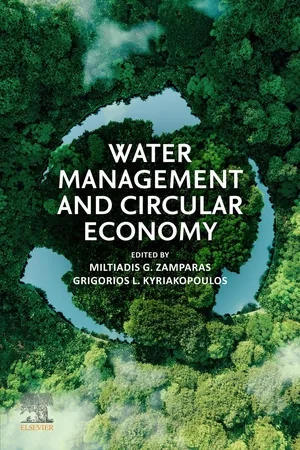
Water Management and Circular Economy
About this book
Water Management and Circular Economy covers the role of water in the mainstream dimensions of society, economy, environment/ecology and technology. Along with the under conceptualization of the Circular Economy (CE), the book covers the role of recycling and reusing the otherwise lost sources of waste, gray or untapped water sources towards a second round of utility. This book bridges the gap between water inflows in nature with the wide spectrum of its potential applications in humanity. Sections cover direct and indirect entities conceptualized as "outflows, including water, energy, products and services to urban, suburban, rural and insular contexts of analysis.
As such, this content will be important reading for Water Scientists, Water Managers, and civil engineers.
- Includes real-world applications and case studies to show how these policies can be adopted
- Presents global coverage, with a diverse list of contributors – all of whom are experts in the field
- Showcases a multidisciplinary approach, with editors from environmental and managerial backgrounds, thus helping to cross the bridge between social and science fields
Information
Table of contents
- Cover
- Front Matter
- Table of Contents
- Front Matter
- Copyright
- Contents
- Contributors
- About the editors
- Preface
- List of Illustrations
- List of Tables
- Part I : Introduction and Fundamentals
- Chapter 1 : Closing the loop in water management
- Chapter 2 : Selecting resource recovery technologies and assessment of impacts
- Chapter 3 : Circularity in wastewater allocation as a solution for increased water availability: A focus on optimization methods and applications
- Part II : Novel wastewater treatment techniques in terms of circular economy
- Chapter 4 : The use of nature-based solutions for circular water management: International case studies and examples of ecological engineering
- Chapter 5 : Advanced wastewater oxidation processes and their role in water reuse for a circular economy
- Chapter 6 : Sustainable management of reused water by the implementation of photo-Fenton and floatation method in petroleum industries
- Part III : Spatial policies, footprint estimations and regulation challenges of water management and circular economy
- Chapter 7 : Assessing policy and planning contexts for the transition to water circular economy: Examples from Southern Europe
- Chapter 8 : Water resources preservation through circular economy: The case of Romania
- Chapter 9 : Regenerate and reuse water in Spain: Facts and politics
- Chapter 10 : Circular economy and sustainable strategies: Theoretical framework, policies and regulation challenges, barriers, and enablers for water management
- Part IV : Resource recovery and waste-to-energy from sewage and sludge in support of circular economy
- Chapter 11 : Novel bioelectrochemical processes focused on nitrogen in wastewater: Energy generation and resource recovery
- Chapter 12 : Benefits from reclaimed wastewater and biosolid reuse in agriculture and in the environment
- Chapter 13 : Sewage sludge as a source of organic to be used as soil improvement
- Part V : The challenges of reusing wastewater for irrigation purposes
- Chapter 14 : A shared view on the current scenario of wastewater irrigation practice within the Mediterranean basin countries
- Chapter 15 : On-going challenges, hazard identification, health risk assessment, and regulatory guidelines and standards of the water resource management
- Chapter 16 : Public health risks associated with the reuse of wastewater for irrigation
- Part VI : Conclusion and future research
- Chapter 17 : Fostering the transition to water reuse: The role of institutional arrangements in the European Union circular economy action plans
- Index
- A
Trusted by 375,005 students
Access to over 1.5 million titles for a fair monthly price.
Study more efficiently using our study tools.
Frequently asked questions
Yes, you can cancel anytime from the Subscription tab in your account settings on the Perlego website. Your subscription will stay active until the end of your current billing period. Learn how to cancel your subscription
No, books cannot be downloaded as external files, such as PDFs, for use outside of Perlego. However, you can download books within the Perlego app for offline reading on mobile or tablet. Learn how to download books offline
Perlego offers two plans: Essential and Complete
- Essential is ideal for learners and professionals who enjoy exploring a wide range of subjects. Access the Essential Library with 800,000+ trusted titles and best-sellers across business, personal growth, and the humanities. Includes unlimited reading time and Standard Read Aloud voice.
- Complete: Perfect for advanced learners and researchers needing full, unrestricted access. Unlock 1.5M+ books across hundreds of subjects, including academic and specialized titles. The Complete Plan also includes advanced features like Premium Read Aloud and Research Assistant.
We are an online textbook subscription service, where you can get access to an entire online library for less than the price of a single book per month. With over 1.5 million books across 990+ topics, we’ve got you covered! Learn about our mission
Look out for the read-aloud symbol on your next book to see if you can listen to it. The read-aloud tool reads text aloud for you, highlighting the text as it is being read. You can pause it, speed it up and slow it down. Learn more about Read Aloud
Yes! You can use the Perlego app on both iOS and Android devices to read anytime, anywhere — even offline. Perfect for commutes or when you’re on the go.
Please note we cannot support devices running on iOS 13 and Android 7 or earlier. Learn more about using the app
Please note we cannot support devices running on iOS 13 and Android 7 or earlier. Learn more about using the app
Yes, you can access Water Management and Circular Economy by Miltiadis G. Zamparas,Grigorios L. Kyriakopoulos in PDF and/or ePUB format, as well as other popular books in Technology & Engineering & Environmental Management. We have over 1.5 million books available in our catalogue for you to explore.