eBook - ePub
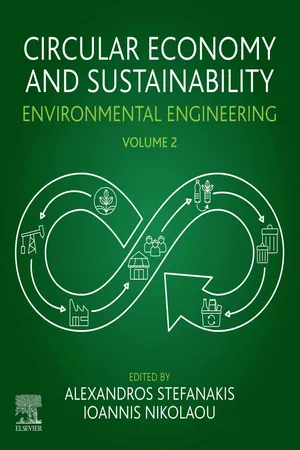
Circular Economy and Sustainability
Volume 2: Environmental Engineering
- 582 pages
- English
- ePUB (mobile friendly)
- Available on iOS & Android
eBook - ePub
Circular Economy and Sustainability
Volume 2: Environmental Engineering
About this book
The concept of circular economy is based on strategies, practices, policies, and technologies to achieve principles related to reusing, recycling, redesigning, repurposing, remanufacturing, refurbishing, and recovering water, waste materials, and nutrients to preserve natural resources. It provides the necessary conditions to encourage economic and social actors to adopt strategies toward sustainability. However, the increasing complexity of sustainability aspects means that traditional engineering and management/economics alone cannot face the new challenes and reach the appropriate solutions.
Thus, this book highlights the role of engineering and management in building a sustainable society by developing a circular economy that establishes and protects strong social and cultural structures based on cross-disciplinary knowledge and diverse skills. It includes theoretical justification, research studies, and case studies to provide researchers, practitioners, professionals, and policymakers the appropriate context to work together in promoting sustainability and circular economy thinking.
Volume 1, Circular Economy and Sustainability: Management and Policy, discusses the content of circular economy principles and how they can be realized in the fields of economy, management, and policy. It gives an outline of the current status and perception of circular economy at the micro-, meso-, and macro-levels to provide a better understanding of its role to achieve sustainability.
Volume 2, Circular Economy and Sustainability: Environmental Engineering, presents various technological and developmental tolls that emphasize the implementation of these principles in practice (micro-level). It demonstrates the necessity to establish a fundamental connection between sustainable engineering and circular economy.
- Presents a novel approach linking circular economy concept to environmental engineering and management to promote sustainability goals in modern societies
- Approaches the topic of production and consumption at both the micro- and macro-levels, integrating principles with practice
- Offers a range of theoretical and foundational knowledge in addition to case studies that demonstrate the potential impact of circular economy principles on economic and societal progress
Information
Table of contents
- Cover
- Front Matter
- Table of Contents
- Copyright
- Contributors
- Preface
- List of Illustrations
- List of Tables
- Chapter 1 : Circular economy approach in the water and wastewater sector
- Chapter 2 : Integrating circularity to achieve sustainability: Examples of various wastewater treatment systems
- Chapter 3 : Risks associated with the circular economy: Treated sewage reuse in agriculture
- Chapter 4 : Wastewater reuse for agricultural irrigation in Greece: Review of guidelines under the prism of the latest European Union's policy developments
- Chapter 5 : A circular model for sustainable produced water management in the oil and gas industry
- Chapter 6 : College of engineering Pune hostel campus: An Indian experience of sustainable wastewater treatment and reuse
- Chapter 7 : Wastewater treatment and sludge management strategies for environmental sustainability
- Chapter 8 : Recovery of nutritional resources of urban sewage sludge in lettuce production
- Chapter 9 : Sludge drying reed beds: A key ecotechnology for a sustainable sanitation infrastructure in Brazil
- Chapter 10 : Manure treatment and recycling technologies
- Chapter 11 : Circular economy in the Mesopotamian Marshes: The Eden in Iraq Wastewater Garden Project
- Chapter 12 : Design concept and performance of a constructed wetland system engineered for the circular economy
- Chapter 13 : Valorization of solid waste in subsurface flow constructed wetlands based on renewable modular structures: A contribution to a circular economy
- Chapter 14 : Nature-based solutions for socially and environmentally responsible new cities: The contribution of green roofs
- Chapter 15 : Constructed wetlands’ application for flower farms wastewater treatment in developing countries: Case study in Kenya
- Chapter 16 : Ecotoxicity evaluation of diclofenac potassium in vertical flow constructed wetlands as posttreatment of septic tank effluent
- Chapter 17 : Searching for sustainability in organic matter and nitrogen removal by integrating constructed wetlands and microbial fuel cells
- Chapter 18 : Creative approaches in engaging the community toward ecological waste management and wetland conservation
- Chapter 19 : Circular economy in the building sector: Towards a holistic framework for implementing circular business models
- Chapter 20 : Improving circular building under uncertainty and complexity: Exploring recent trends in the Netherlands
- Chapter 21 : Circular materials—An essay on challenges with current manufacturing and recycling strategies as well as on the potential of life cycle integrated designs
- Chapter 22 : Waste to energy at the neighborhood microscale in the urban regeneration of Madrid peripheries: Towards effective circular neighborhoods
- Chapter 23 : Optimization of surface mining operation based on a circular economy model
- Chapter 24 : Sustainability assessment of bioleaching for mineral resource recovery from MSWI ashes
- Chapter 25 : Circular economy for the sustainability of the wood-based industry: The case of Caraga Region, Philippines
- Chapter 26 : Equilibrium modeling and statistical analysis of struvite precipitation for nutrient recovery from corn-ethanol downstream process
- Chapter 27 : Food processing wastes as a potential source of adsorbent for toxicant removal from water
- Chapter 28 : Sustainable circular economy design in 2050 for water and food security using renewable energy
- Chapter 29 : Towards circular economy in e-waste management in India: Issues, challenges, and solutions
- Index
- A
Trusted by 375,005 students
Access to over 1.5 million titles for a fair monthly price.
Study more efficiently using our study tools.
Frequently asked questions
Yes, you can cancel anytime from the Subscription tab in your account settings on the Perlego website. Your subscription will stay active until the end of your current billing period. Learn how to cancel your subscription
No, books cannot be downloaded as external files, such as PDFs, for use outside of Perlego. However, you can download books within the Perlego app for offline reading on mobile or tablet. Learn how to download books offline
Perlego offers two plans: Essential and Complete
- Essential is ideal for learners and professionals who enjoy exploring a wide range of subjects. Access the Essential Library with 800,000+ trusted titles and best-sellers across business, personal growth, and the humanities. Includes unlimited reading time and Standard Read Aloud voice.
- Complete: Perfect for advanced learners and researchers needing full, unrestricted access. Unlock 1.5M+ books across hundreds of subjects, including academic and specialized titles. The Complete Plan also includes advanced features like Premium Read Aloud and Research Assistant.
We are an online textbook subscription service, where you can get access to an entire online library for less than the price of a single book per month. With over 1.5 million books across 990+ topics, we’ve got you covered! Learn about our mission
Look out for the read-aloud symbol on your next book to see if you can listen to it. The read-aloud tool reads text aloud for you, highlighting the text as it is being read. You can pause it, speed it up and slow it down. Learn more about Read Aloud
Yes! You can use the Perlego app on both iOS and Android devices to read anytime, anywhere — even offline. Perfect for commutes or when you’re on the go.
Please note we cannot support devices running on iOS 13 and Android 7 or earlier. Learn more about using the app
Please note we cannot support devices running on iOS 13 and Android 7 or earlier. Learn more about using the app
Yes, you can access Circular Economy and Sustainability by Alexandros Stefanakis,Ioannis Nikolaou in PDF and/or ePUB format, as well as other popular books in Biological Sciences & Environmental Economics. We have over 1.5 million books available in our catalogue for you to explore.