eBook - ePub
Emerging Contaminants in the Terrestrial-Aquatic-Atmosphere Continuum
Occurrence, Health Risks and Mitigation
- 434 pages
- English
- ePUB (mobile friendly)
- Available on iOS & Android
eBook - ePub
Emerging Contaminants in the Terrestrial-Aquatic-Atmosphere Continuum
Occurrence, Health Risks and Mitigation
About this book
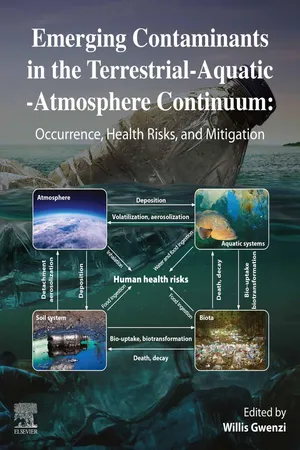
Emerging Contaminants in Terrestrial and Aquatic Environments: Occurrence, Health Risks, and Mitigation provides the latest information on the synthesis of the occurrence, behavior, human health risks and mitigation of emerging contaminants in developing countries. First highlighting sources, industrial applications, key drivers and regulatory frameworks, the book then goes on to discuss the nature of emerging contaminants, including organic (e.g., pharmaceuticals), inorganic (e.g., rare earth elements) and biological agents (e.g., antimicrobial resistance). It then presents the dissemination, environmental behavior, and fate in terrestrial and aquatic systems as well as the human and ecological exposure pathways, health risks, and more.
Offering a transdisciplinary approach that brings together perspectives and contributions from experts in environmental sciences, hydrology, environmental engineering, ecotoxicology, chemistry, material sciences, and legal and policy aspects, the book provides an approachable and flexible resource for researchers and upper-level students with diverse academic backgrounds.
- Adopts a lifecycle perspective by including industrial applications, behavior and fate and human health risks and removal
- Focuses on developing regions and covers a wide range of emerging contaminants, including those often overlooked in earlier books such as rare earth elements and antimicrobial resistance
- Presents a clear understanding of the contrasts between developed and developing countries with respect to emerging contaminants and their health risks and mitigation, including water and wastewater treatment systems commonly used in developing countries
- Covers human and ecological health risks in developing countries
Information
Table of contents
- Cover
- Front Matter
- Table of Contents
- Copyright
- Dedication
- Contributors
- Editor biography
- Preface
- Acknowledgements
- List of Illustrations
- List of Tables
- Chapter 1 : Emerging contaminants: A handful of conceptual and organizing frameworks
- Chapter 2 : Emerging contaminants in the terrestrial-aquatic-atmosphere continuum: A global perspective
- Chapter 3 : High-technology rare earth elements in the soil-plant system: Occurrence, behaviour, and fate
- Chapter 4 : (Micro)plastics in the soil system: Occurrence, behaviour, fate, and future directions
- Chapter 5 : Occurrence and behaviour of emerging organic contaminants in aquatic systems
- Chapter 6 : Anthropogenic rare earth elements in aquatic environments: Occurrence, behaviour, and fate
- Chapter 7 : (Micro)plastics in aquatic systems: Current research focal areas, under-studied matrices, and future directions
- Chapter 8 : Antibiotic-resistant bacteria and antibiotic resistance genes in aquatic systems: Occurrence, behaviour, and fate
- Chapter 9 : Air-borne emerging contaminants: An under-studied reservoir and a potential health risk?
- Chapter 10 : Occurrence, behaviour and fate of airborne microplastics
- Chapter 11 : Ecological health risks of high-technology rare earth elements
- Chapter 12 : Ecological health risks of antibiotic resistance: A perspective on the evidence, challenges, and research needs
- Chapter 13 : Ecological health risks of emerging organic contaminants
- Chapter 14 : Occurrence and ecological health risks of microplastics
- Chapter 15 : Rare earth elements: Human exposure, risk factors, and health risks
- Chapter 16 : Occurrence, human exposure pathways, and health risks of (micro)plastics
- Chapter 17 : The environmental resistome: Human exposure, health risks, and research needs
- Chapter 18 : Health risk assessment and mitigation of emerging contaminants: A call for an integrated approach
- Chapter 19 : Emerging contaminants: Approaches for policy and regulatory responses in low-income countries
- Chapter 20 : Remediation technologies for contaminated soil systems
- Chapter 21 : Bio- and chemical surfactants for remediation of emerging organic contaminants
- Chapter 22 : Ten (10) key research questions on emerging contaminants and novel entities, and their health risks
- Chapter 23 : Epilogue: Summary, the next-frontier emerging contaminants/novel entities, and a look ahead
- Index
- A
Trusted by 375,005 students
Access to over 1.5 million titles for a fair monthly price.
Study more efficiently using our study tools.
Frequently asked questions
Yes, you can cancel anytime from the Subscription tab in your account settings on the Perlego website. Your subscription will stay active until the end of your current billing period. Learn how to cancel your subscription
No, books cannot be downloaded as external files, such as PDFs, for use outside of Perlego. However, you can download books within the Perlego app for offline reading on mobile or tablet. Learn how to download books offline
Perlego offers two plans: Essential and Complete
- Essential is ideal for learners and professionals who enjoy exploring a wide range of subjects. Access the Essential Library with 800,000+ trusted titles and best-sellers across business, personal growth, and the humanities. Includes unlimited reading time and Standard Read Aloud voice.
- Complete: Perfect for advanced learners and researchers needing full, unrestricted access. Unlock 1.5M+ books across hundreds of subjects, including academic and specialized titles. The Complete Plan also includes advanced features like Premium Read Aloud and Research Assistant.
We are an online textbook subscription service, where you can get access to an entire online library for less than the price of a single book per month. With over 1.5 million books across 990+ topics, we’ve got you covered! Learn about our mission
Look out for the read-aloud symbol on your next book to see if you can listen to it. The read-aloud tool reads text aloud for you, highlighting the text as it is being read. You can pause it, speed it up and slow it down. Learn more about Read Aloud
Yes! You can use the Perlego app on both iOS and Android devices to read anytime, anywhere — even offline. Perfect for commutes or when you’re on the go.
Please note we cannot support devices running on iOS 13 and Android 7 or earlier. Learn more about using the app
Please note we cannot support devices running on iOS 13 and Android 7 or earlier. Learn more about using the app
Yes, you can access Emerging Contaminants in the Terrestrial-Aquatic-Atmosphere Continuum by Willis Gwenzi in PDF and/or ePUB format, as well as other popular books in Biological Sciences & Environmental Science. We have over 1.5 million books available in our catalogue for you to explore.