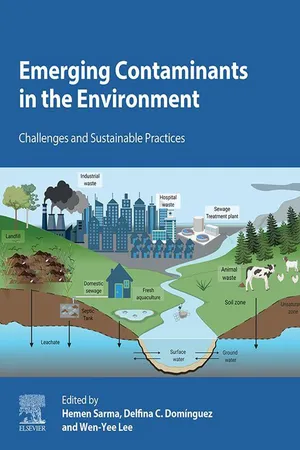
eBook - ePub
Emerging Contaminants in the Environment
Challenges and Sustainable Practices
- 712 pages
- English
- ePUB (mobile friendly)
- Available on iOS & Android
eBook - ePub
Emerging Contaminants in the Environment
Challenges and Sustainable Practices
About this book
Emerging Contaminants in the Environment: Challenges and Sustainable Practices covers all aspects of emerging contaminants in the environment, from basic understanding to different types of emerging contaminants and how these threaten organisms, their environmental fate studies, detection methods, and sustainable practices of dealing with contaminants. Emerging contaminant remediation is a pressing need due to the ever-increasing pollution in the environment, and it has gained a lot of scientific and public attention due to its high effectiveness and sustainability. The discussions in the book on the bioremediation of these contaminants are covered from the perspective of proven technologies and practices through case studies and real-world data. One of the main benefits of this book is that it summarizes future challenges and sustainable solutions. It can, therefore, become an effective guide to the elimination (through sustainable practices) of emerging contaminants. At the back of these explorations on sustainable bioremediation of emerging contaminants lies the set of 17 goals articulated by the United Nations in its 2030 Agenda for Sustainable Development, adopted by all its member states.
This book provides academics, researchers, students, and practitioners interested in the detection and elimination of emerging contaminants from the environment, with the latest advances by leading experts in emerging contaminants the field of environmental sciences.
- Covers most aspects of the most predominant emerging contaminants in the environment, including in soil, air, and water
- Describes the occurrence of these contaminants, the problems they cause, and the sustainable practices to deal with the contaminants
- Includes data from case studies to provide real-world examples of sustainable practices and emerging contaminant remediation
Information
Table of contents
- Emerging Contaminants in the Environment
- Cover
- Title Page
- Copyright
- Table of Contents
- List of Contributors
- Preface
- Chapter 1 Understanding emerging contaminants in soil and water: current perspectives on integrated remediation approaches
- List of abbreviations
- Chapter 2 Emerging environmental contaminants—current status, challenges, and technological solutions
- 2.1: Introduction
- Chapter 3 Anticancer drugs in the environment: environmental levels and technological challenges
- 3.1: Introduction
- Chapter 4 Exposure to 1,4-dioxane and disinfection by-products due to the reuse of wastewater
- 4.1: Introduction
- Chapter 5 Transport, fate, and bioavailability of emerging pollutants in soil, sediment, and wastewater treatment plants: potential environmental impacts
- 5.1: Introduction
- Chapter 6 Pharmaceutical and personal care products in the environment: occurrence and impact on the functioning of the ecosystem
- 6.1: Introduction
- Chapter 7 Excessive pharmaceutical and personal care products in the environment cause life-threatening diseases
- 7.1: Introduction
- Chapter 8 A broad perspective on antimicrobial resistance in coastal waters
- 8.1: Introduction to the problem
- Chapter 9 Environmental fate and transportation of perfluorinated compounds
- 9.1: Introduction
- Chapter 10 Engineered nanomaterials: threats, releases, and concentrations in the environment
- Abbreviations
- Chapter 11 Plastic pollution in marine and freshwater environments: abundance, sources, and mitigation
- 11.1: Introduction
- Chapter 12 Electronic waste: an emerging contaminant in the geo-environment
- 12.1: Introduction
- Chapter 13 Effects of pesticides on human physiology, genetics, and evolution
- 13.1: Introduction
- Chapter 14 Integrative behavioral and ecotoxicological effects of nanoparticles
- 14.1: Introduction
- Chapter 15 Determination of multiclass emerging contaminants using QuEChERS method
- List of abbreviations
- Chapter 16 Removal of quinolone antibiotics from wastewaters and sewage sludge
- 16.1: Introduction
- Chapter 17 Chemosensing technology for rapid detection of emerging contaminants
- 17.1: Introduction
- Chapter 18 Methods of bisphenol A detection by gas chromatography and mass spectrometry (GC-Ms) in human breast milk and foodstuff
- 18.1: Introduction
- Chapter 19 Microalgae as whole-cell biosensors in the prospective assessment of toxic effects of emerging contaminants
- 19.1: Microalgae as whole-cell biosensors
- Chapter 20 The mixture of agricultural pesticides and their impact on populations: bioremediation strategies
- 20.1: Introduction
- Chapter 21 Assisted and amended technology for the sustainable remediation of emerging contaminants
- 21.1: Introduction
- Chapter 22 Bioremediation of cytostatic pharmaceutical and personal care products and emerging technologies
- 22.1: Introduction
- Chapter 23 Removal of antimicrobial resistance determinants from wastewater: a risk perspective on conventional and emerging technologies
- Chapter 24 Novel nanomaterials for nanobioremediation of polyaromatic hydrocarbons
- 24.1: Introduction
- Index
Trusted by 375,005 students
Access to over 1.5 million titles for a fair monthly price.
Study more efficiently using our study tools.
Frequently asked questions
Yes, you can cancel anytime from the Subscription tab in your account settings on the Perlego website. Your subscription will stay active until the end of your current billing period. Learn how to cancel your subscription
No, books cannot be downloaded as external files, such as PDFs, for use outside of Perlego. However, you can download books within the Perlego app for offline reading on mobile or tablet. Learn how to download books offline
Perlego offers two plans: Essential and Complete
- Essential is ideal for learners and professionals who enjoy exploring a wide range of subjects. Access the Essential Library with 800,000+ trusted titles and best-sellers across business, personal growth, and the humanities. Includes unlimited reading time and Standard Read Aloud voice.
- Complete: Perfect for advanced learners and researchers needing full, unrestricted access. Unlock 1.5M+ books across hundreds of subjects, including academic and specialized titles. The Complete Plan also includes advanced features like Premium Read Aloud and Research Assistant.
We are an online textbook subscription service, where you can get access to an entire online library for less than the price of a single book per month. With over 1.5 million books across 990+ topics, we’ve got you covered! Learn about our mission
Look out for the read-aloud symbol on your next book to see if you can listen to it. The read-aloud tool reads text aloud for you, highlighting the text as it is being read. You can pause it, speed it up and slow it down. Learn more about Read Aloud
Yes! You can use the Perlego app on both iOS and Android devices to read anytime, anywhere — even offline. Perfect for commutes or when you’re on the go.
Please note we cannot support devices running on iOS 13 and Android 7 or earlier. Learn more about using the app
Please note we cannot support devices running on iOS 13 and Android 7 or earlier. Learn more about using the app
Yes, you can access Emerging Contaminants in the Environment by Hemen Sarma,Delfina C. Dominguez,Wen-Yee Lee in PDF and/or ePUB format, as well as other popular books in Biological Sciences & Environmental Science. We have over 1.5 million books available in our catalogue for you to explore.