- 526 pages
- English
- ePUB (mobile friendly)
- Available on iOS & Android
eBook - ePub
About this book
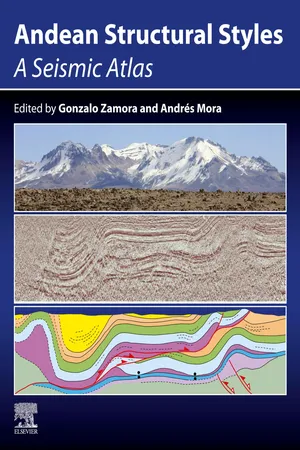
Andean Structural Styles: A Seismic Atlas is a comprehensive reference illustrating the variability in structural styles and hydrocarbon traps that exist in the Andean chain. The Andean chain, stretching over more than 5,000 km (3,000 mi) from Venezuela to Argentina, contains a large number of sedimentary basins which have developed in a wide range of tectonic settings. Some of these basins are highly mature, with hydrocarbon production from Paleozoic, Mesozoic, and Cenozoic sedimentary sequences, while others are still underexplored.
Andean Structural Styles: A Seismic Atlas covers topics including fold types, thrust faults, triangle zones, inversion structures, synorogenic deposits, and growth stratal geometries. These topics are illustrated by thirty-two seismic examples interpreted and uninterpreted, covering most of the Andean basins, and five chapters reviewing the structural styles of the Andes, the complexity of processing seismic in these settings, how analogue models help in the interpretation, and several outcrop analogues. This reference is invaluable to both hydrocarbon exploration of the Andes and researchers and students in the fields of exploration geology and structural geology. Also, those teaching structural geology and seismic interpretation will find a valuable resource with lots of uninterpreted seismic examples that can be used in their lectures.
- Includes a vast collection of high-quality, color images
- Features case studies covering the entirety of the Andes Mountain chain
- Presents high-quality seismic data that was previously only available to oil companies
Information
Topic
Physical SciencesSubtopic
Geology & Earth SciencesTable of contents
- Andean Structural Styles
- Cover
- Title Page
- Copyright
- Table of Contents
- List of Contributors
- Dedication
- Dedication
- In memoriam
- Preface
- Acknowledgments
- Chapter 1 Tectonic inheritance and structural styles in the Andean fold-thrust belt and foreland basin
- Chapter 2 Seismic imaging in fold-and-thrust belts
- Chapter 3 Analogue modeling as a tool to assist seismic structural interpretation in the Andean fold-and-thrust belt
- Chapter 4 Folding of a weak boundary zone between an axial zone and a frontal belt, Chicamocha Valley, Eastern Cordillera of Colombia
- Chapter 5 Natural examples of regional-scale structures from the southern Central Andes and Patagonian Andes
- Chapter 6 Outcrop-scale natural examples of structures from the southern Central Andes
- Chapter 7 Thrust sequence in the Sinú Fold Belt (South Caribbean Deformed Belt), offshore northwestern Colombia
- Chapter 8 Relationships between normal faulting, mud diapirism and thrusting in the trailing part of the Sinú Fold Belt (South Caribbean Deformed Belt), offshore Northwestern Colombia
- Chapter 9 Strike-slip fault zone in an oblique convergent margin: Bahia Basin, Caribbean margin of northern Colombia
- Chapter 10 Structural styles of the Upper Magdalena valley, Northern Andes, Colombia: case studies
- Chapter 11 Forelimb deformation in basement uplifts. Example from the Sierra de la Macarena, Colombia
- Chapter 12 Seismic expression of transpressional thick-skinned deformation in the southern foothills of Colombia
- Chapter 13 Structural styles and evolution of the Colombian Eastern foothills Piedemonte triangle zone
- Chapter 14 Seismic and structural analysis of the San Francisco oil field (Colombia). Structural controls on a complex hydrocarbon charge history
- Chapter 15 La Cira Basement-high; Middle Magdalena Valley Basin, Colombia
- Chapter 16 Regional structure, trap mechanisms, and basin evolution of the Middle Magdalena Basin of Colombia
- Chapter 17 Structural styles of the southern Putumayo Foreland Basin, northern Andes, Colombia
- Chapter 18 An appraisal of basin development at the trailing edge of the Northern Andes, SW Ecuador–NW Peru
- Chapter 19 The Manabí and Esmeraldas-Borbón forearc basins of Ecuador
- Chapter 20 Situche Complex, Marañon Basin, Peru
- Chapter 21 Large transport thrust in the Huallaga sub-Basin (northern Peruvian sub-Andean zone)
- Chapter 22 The San Martín Anticline: a classic example of a fault-bend fold in the Camisea fold and thrust belt, Central Andes, Perú
- Chapter 23 The Sagari-Kinteroni Anticline: an example of an out-of-sequence tectonic wedge in the Camisea area, Peru
- Chapter 24 The Candamo antiformal stack, Madre de Dios Basin, Peru
- Chapter 25 Fault-related fold evolution in the Bolivian Northern Sub-Andean Zone
- Chapter 26 Transition from thin-to thick-skinned tectonics: example from the Boomerang Hills, Bolivia
- Chapter 27 Structural interpretation in the Bolivian southern Sub-Andean: from surface to hydrocarbon prospect generation
- Chapter 28 Seismic interpretation challenges in the southern Subandean fold and thrust belt of Bolivia
- Chapter 29 Thin skin fold belt structural style in the Argentinean–Bolivian Subandean foothills: the Madrejones Anticline example
- Chapter 30 Structural styles of the Villa Unión-San Isidro basement-involved fold and thrust belt, northern Ischigualasto-Villa Unión Basin province of La Rioja, Argentina
- Chapter 31 Structural styles, tectonic evolution, and petroleum systems of transverse pre-Andean structures: examples from the Cuyo and Neuquén basins
- Chapter 32 Structure beneath the southern Payenia volcanic field, Neuquén Basin, Argentina
- Chapter 33 Structural development in the frontal Malargüe fold and thrust belt, Neuquén Basin, Argentina
- Chapter 34 Interpreting a complex triangle zone in the Agrio fold thrust belt, Neuquén Basin. Argentina
- Chapter 35 Exploration in a thick to thin-skinned transition: Faja Plegada triangle zone. Neuquén, Argentina
- Chapter 36 Foothills structure of the Andes of Tierra del Fuego, Argentina and Chile
- Chapter 37 Inverted structures in the western Central Andes thrust belt front
- Chapter 38 Interaction between inverted normal and reverse faults in the inner forearc of the Central Andes: an example from the Salar de Atacama Basin
- Index
Trusted by 375,005 students
Access to over 1.5 million titles for a fair monthly price.
Study more efficiently using our study tools.
Frequently asked questions
Yes, you can cancel anytime from the Subscription tab in your account settings on the Perlego website. Your subscription will stay active until the end of your current billing period. Learn how to cancel your subscription
No, books cannot be downloaded as external files, such as PDFs, for use outside of Perlego. However, you can download books within the Perlego app for offline reading on mobile or tablet. Learn how to download books offline
Perlego offers two plans: Essential and Complete
- Essential is ideal for learners and professionals who enjoy exploring a wide range of subjects. Access the Essential Library with 800,000+ trusted titles and best-sellers across business, personal growth, and the humanities. Includes unlimited reading time and Standard Read Aloud voice.
- Complete: Perfect for advanced learners and researchers needing full, unrestricted access. Unlock 1.5M+ books across hundreds of subjects, including academic and specialized titles. The Complete Plan also includes advanced features like Premium Read Aloud and Research Assistant.
We are an online textbook subscription service, where you can get access to an entire online library for less than the price of a single book per month. With over 1.5 million books across 990+ topics, we’ve got you covered! Learn about our mission
Look out for the read-aloud symbol on your next book to see if you can listen to it. The read-aloud tool reads text aloud for you, highlighting the text as it is being read. You can pause it, speed it up and slow it down. Learn more about Read Aloud
Yes! You can use the Perlego app on both iOS and Android devices to read anytime, anywhere — even offline. Perfect for commutes or when you’re on the go.
Please note we cannot support devices running on iOS 13 and Android 7 or earlier. Learn more about using the app
Please note we cannot support devices running on iOS 13 and Android 7 or earlier. Learn more about using the app
Yes, you can access Andean Structural Styles by Gonzalo Zamora,Andrés Mora in PDF and/or ePUB format, as well as other popular books in Physical Sciences & Geology & Earth Sciences. We have over 1.5 million books available in our catalogue for you to explore.