- 522 pages
- English
- ePUB (mobile friendly)
- Available on iOS & Android
eBook - ePub
Advances in Microbe-assisted Phytoremediation of Polluted Sites
About this book
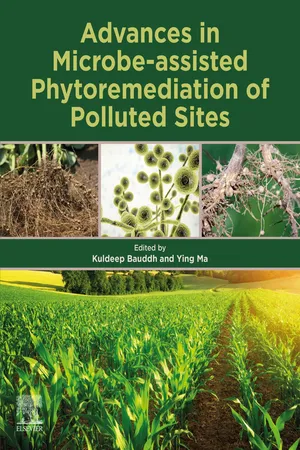
Advances in Microbe-assisted Phytoremediation of Polluted Sites provides a comprehensive overview of the use of phytoremediation to decontaminate polluted land through microbial enhanced phytoremediation, including the use of plants with respect to ecological and environmental science. The book discusses the potential of microbial-assisted phytoremediation of the contaminant, including heavy metals, pesticides, polyaromatic hydrocarbons, etc., with case studies as examples. Key subjects covered include plant-microbe interaction in contaminated ecosystems, microbe-augmented phytoremediation for improved ecosystem services, and success stories on microbe-assisted phytoremediation of contaminated sites.
With increasing demand for land-space for social, industrial and agricultural use, the theoretical millions of hectares of contaminated sites around the world are a resource sorely needed that currently cannot be utilized. Decontamination of this land using ecologically-sound methods is paramount not only to land use, but in the prevention of toxic substances deteriorating local ecosystems by reducing productivity and contaminating the food chain – which can eventually aggregate in food chains and pose the potential risk of non-curable diseases to humans such as cancer.
- Provides novel information on the potential for microbial inoculants to be used in phytoremediation
- Discusses principles and mechanisms of plant-microbe interaction for enhanced phytoremediation with improved soil health
- Investigates phytoremediation solutions for a multitude of contaminants, including heavy metals, fly ash, petroleum, arsenic, TPH, mining effluents, fluoride, lead and other major pollutants
Information
Table of contents
- Advances in Microbe-assisted Phytoremediation of Polluted Sites
- Cover
- Title Page
- Copyright Page
- Table of Contents
- Contributors
- Chapter1 Microbe-assisted phytoremediation of environmental contaminants
- Chapter2 Microbial augmented phytoremediation with improved ecosystems services
- Chapter3 Role of genetic engineering in microbe-assisted phytoremediation of polluted sites
- Chapter4 Phytoremediation potential of genetically modified plants
- chapter5 The role of bacteria in metal bioaccumulation and biosorption
- Chapter6 Plant-microbe association to improve phytoremediation of heavy metal
- Chapter7 Bacterial-mediated phytoremediation of heavy metals
- Chapter8 Recent advances in microbial-aided phytostabilization of trace element contaminated soils
- Chapter 9 Phytoremediation of heavy metal contaminated soil in association with arbuscular mycorrhizal fungi
- chapter10 Role of Pb-solubilizing and plant growth-promoting bacteria in Pb uptake by plants
- Chapter 11 Role of Cd-resistant plant growth-promoting rhizobacteria in plant growth promotion and alleviation of the phytotoxic effects under Cd-stress
- Chapter12 Beneficial plant microbiome assisted chromium phytoremediation
- Chapter13 Toxic potential of arsenic and its remediation through microbe-assisted phytoremediation
- Chapter14 Microbe-assisted phytomanagement of fly ash spoiled sites
- Chapter15 Role of microorganism in phytoremediation of mine spoiled soils
- Chapter16 Rhizobacteria assisted phytoremediation of oily sludge contaminated sites
- Chapter17 Bioremediation of oil-contaminated sites using biosurfactants
- Chapter18 Association of plants and microorganisms for degradation of polycyclic aromatic hydrocarbons
- Chapter19 The potential of engineered endophytic bacteria to improve phytoremediation of organic pollutants
- Index
Trusted by 375,005 students
Access to over 1.5 million titles for a fair monthly price.
Study more efficiently using our study tools.
Frequently asked questions
Yes, you can cancel anytime from the Subscription tab in your account settings on the Perlego website. Your subscription will stay active until the end of your current billing period. Learn how to cancel your subscription
No, books cannot be downloaded as external files, such as PDFs, for use outside of Perlego. However, you can download books within the Perlego app for offline reading on mobile or tablet. Learn how to download books offline
Perlego offers two plans: Essential and Complete
- Essential is ideal for learners and professionals who enjoy exploring a wide range of subjects. Access the Essential Library with 800,000+ trusted titles and best-sellers across business, personal growth, and the humanities. Includes unlimited reading time and Standard Read Aloud voice.
- Complete: Perfect for advanced learners and researchers needing full, unrestricted access. Unlock 1.5M+ books across hundreds of subjects, including academic and specialized titles. The Complete Plan also includes advanced features like Premium Read Aloud and Research Assistant.
We are an online textbook subscription service, where you can get access to an entire online library for less than the price of a single book per month. With over 1.5 million books across 990+ topics, we’ve got you covered! Learn about our mission
Look out for the read-aloud symbol on your next book to see if you can listen to it. The read-aloud tool reads text aloud for you, highlighting the text as it is being read. You can pause it, speed it up and slow it down. Learn more about Read Aloud
Yes! You can use the Perlego app on both iOS and Android devices to read anytime, anywhere — even offline. Perfect for commutes or when you’re on the go.
Please note we cannot support devices running on iOS 13 and Android 7 or earlier. Learn more about using the app
Please note we cannot support devices running on iOS 13 and Android 7 or earlier. Learn more about using the app
Yes, you can access Advances in Microbe-assisted Phytoremediation of Polluted Sites by Kuldeep Bauddh,Ying Ma in PDF and/or ePUB format, as well as other popular books in Biological Sciences & Environmental Science. We have over 1.5 million books available in our catalogue for you to explore.