eBook - ePub
Multiscale Modeling Approaches for Composites
- 345 pages
- English
- ePUB (mobile friendly)
- Available on iOS & Android
eBook - ePub
Multiscale Modeling Approaches for Composites
About this book
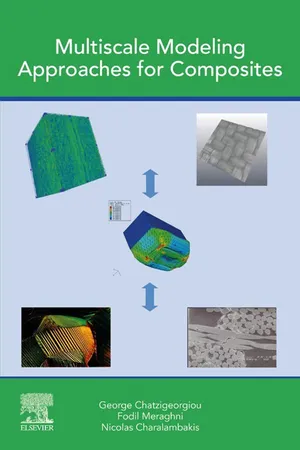
Multiscale Modeling Approaches for Composites outlines the fundamentals of common multiscale modeling techniques and provides detailed guidance for putting them into practice. Various homogenization methods are presented in a simple, didactic manner, with an array of numerical examples.
The book starts by covering the theoretical underpinnings of tensors and continuum mechanics concepts, then passes to actual micromechanic techniques for composite media and laminate plates. In the last chapters the book covers advanced topics in homogenization, including Green's tensor, Hashin-Shtrikman bounds, and special types of problems. All chapters feature comprehensive analytical and numerical examples (Python and ABAQUS scripts) to better illustrate the theory.
- Bridges theory and practice, providing step-by-step instructions for implementing multiscale modeling approaches for composites and the theoretical concepts behind them
- Covers boundary conditions, data-exchange between scales, the Hill-Mandel principle, average stress and strain theorems, and more
- Discusses how to obtain composite properties using different boundary conditions
- Includes access to a companion site, featuring the numerical examples, Python and ABACUS codes discussed in the book
Information
Table of contents
- Title of Book
- Cover image
- Title page
- Table of Contents
- Copyright
- About the authors
- Foreword
- Preface
- Acknowledgments
- Part I: Tensors and continuum mechanics concepts
- Part II: Micromechanics for composite media
- Part III: Special topics in homogenization
- Appendix A. Fiber orientation in composites
- Index
Trusted by 375,005 students
Access to over 1.5 million titles for a fair monthly price.
Study more efficiently using our study tools.
Frequently asked questions
Yes, you can cancel anytime from the Subscription tab in your account settings on the Perlego website. Your subscription will stay active until the end of your current billing period. Learn how to cancel your subscription
No, books cannot be downloaded as external files, such as PDFs, for use outside of Perlego. However, you can download books within the Perlego app for offline reading on mobile or tablet. Learn how to download books offline
Perlego offers two plans: Essential and Complete
- Essential is ideal for learners and professionals who enjoy exploring a wide range of subjects. Access the Essential Library with 800,000+ trusted titles and best-sellers across business, personal growth, and the humanities. Includes unlimited reading time and Standard Read Aloud voice.
- Complete: Perfect for advanced learners and researchers needing full, unrestricted access. Unlock 1.5M+ books across hundreds of subjects, including academic and specialized titles. The Complete Plan also includes advanced features like Premium Read Aloud and Research Assistant.
We are an online textbook subscription service, where you can get access to an entire online library for less than the price of a single book per month. With over 1.5 million books across 990+ topics, we’ve got you covered! Learn about our mission
Look out for the read-aloud symbol on your next book to see if you can listen to it. The read-aloud tool reads text aloud for you, highlighting the text as it is being read. You can pause it, speed it up and slow it down. Learn more about Read Aloud
Yes! You can use the Perlego app on both iOS and Android devices to read anytime, anywhere — even offline. Perfect for commutes or when you’re on the go.
Please note we cannot support devices running on iOS 13 and Android 7 or earlier. Learn more about using the app
Please note we cannot support devices running on iOS 13 and Android 7 or earlier. Learn more about using the app
Yes, you can access Multiscale Modeling Approaches for Composites by George Chatzigeorgiou,Fodil Meraghni,Nicolas Charalambakis in PDF and/or ePUB format, as well as other popular books in Technology & Engineering & Mechanical Engineering. We have over 1.5 million books available in our catalogue for you to explore.